From prolonged droughts and devastating wildfires to collapsing glaciers, extreme heat and rising sea levels, the climate crisis is no longer a distant warning. Its effects are being felt across continents, threatening livelihoods, disrupting ecosystems and putting millions of lives at risk.Yet, as the planet grapples with the mounting consequences of global warming, the countries expected to lead the fight are struggling to agree on a common course of action.This disconnect was evident at the 31st United Nations Climate Change Conference (COP31), held in Antalya, Turkey, from November 9 to 20.Despite growing evidence of climate change, the summit ended without consensus on its central political agreement, the Antalya Pacts, exposing deep divisions over fossil fuels, climate finance and the responsibility of nations to pay for climate action.Co-hosted by Turkey and Australia, the negotiations became the longest-running climate talks in UN history.The final day was marked by heated exchanges over the omission of fossil fuel commitments and disagreements over financial assistance for developing countries. Some delegations walked out, while others accused oil-producing nations and developed countries of obstructing progress.The outcome has renewed questions about whether annual climate summits can deliver meaningful collective action at a time when the world is struggling to contain global warming.Despite the failure to agree on the central political declaration, countries made progress on several other issues, including climate finance mechanisms and a framework for a just transition.Here are eight key takeaways from COP31 and the major climate challenges that remain unresolved.
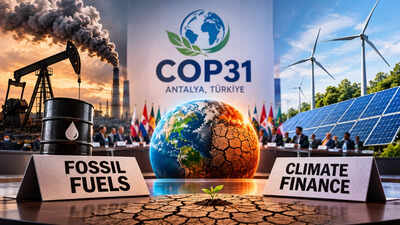
One of the biggest setbacks was the failure of countries to agree on language concerning fossil fuels
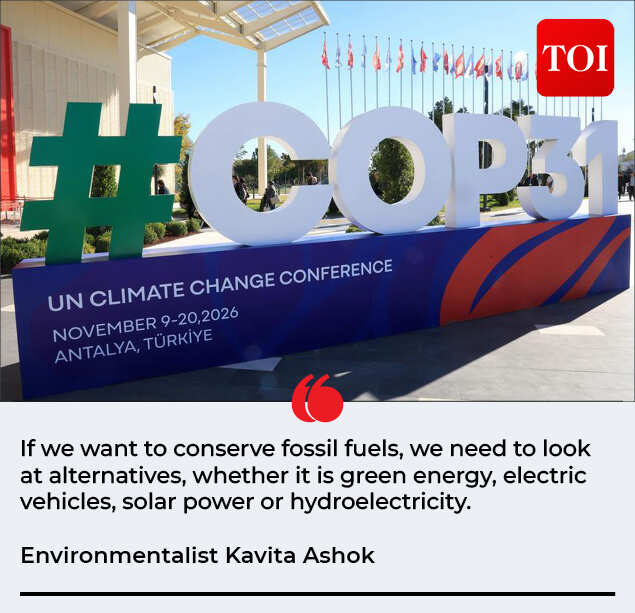
1. Fossil fuel phaseout remains a major sticking pointOne of the biggest setbacks at COP31 was the failure of countries to agree on language concerning fossil fuels in the Antalya Pacts.The disagreement was significant because, at COP28 in Dubai in 2023, countries had agreed to transition away from fossil fuels in energy systems. However, three years later, they failed to reach a consensus on reaffirming or strengthening that commitment.The divide between countries pushing for a faster transition away from coal, oil and gas and those reluctant to make stronger commitments remained evident throughout the negotiations.Germany and several other European countries called for a global phaseout of fossil fuels. German environment minister Carsten Schneider had pushed for a commitment to a “global phaseout of fossil fuels”. However, oil-producing nations, including Saudi Arabia, resisted stronger language.The final negotiations exposed the depth of these differences. EU representative Darragh O’Brien accused some oil-producing nations of obstructing progress, saying the talks had been “hijacked by some oil states”.Russian delegate Sergei Kononuchenko, meanwhile, switched from Russian to English to directly address the EU delegation. He criticised developed countries for providing climate finance largely through loans to developing nations, describing it as “an old colonial distribution of labour under a new banner”.Environmentalist Kavita Ashok said, “After reading the draft, it is very disheartening as an environmentalist to see that fossil fuels, the very issue the conference was meant to address, have been sidelined.”Ashok said any transition away from fossil fuels must also account for the millions of people whose livelihoods depend on coal, petroleum and natural gas industries, particularly in countries such as India.She stressed the need to develop viable alternatives and ensure that the shift towards cleaner energy does not leave workers and communities behind.“If we want to conserve fossil fuels, we need to look at alternatives, whether it is green energy, electric vehicles, solar power or hydroelectricity. There are so many forms of energy that can come into action,” she told TOI.The failure to agree on fossil fuels has also raised concerns about the durability of earlier climate commitments. The inability to reaffirm the pledge made at COP28 highlights the growing difficulty of building consensus on more ambitious climate action, even as the urgency of reducing emissions increases.
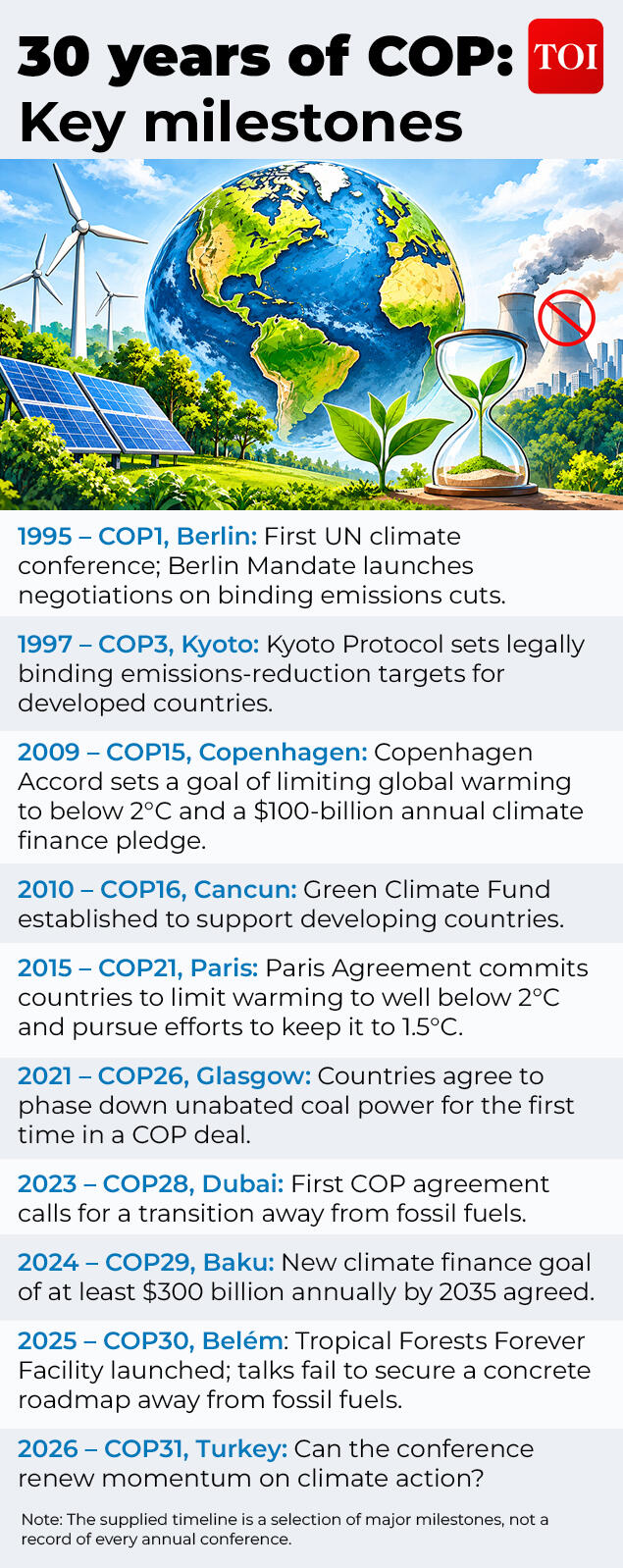
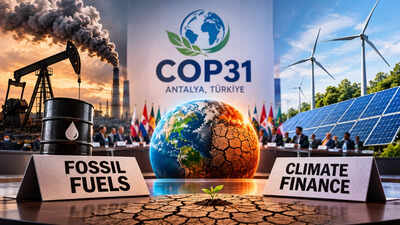
Climate finance was another major sticking point.
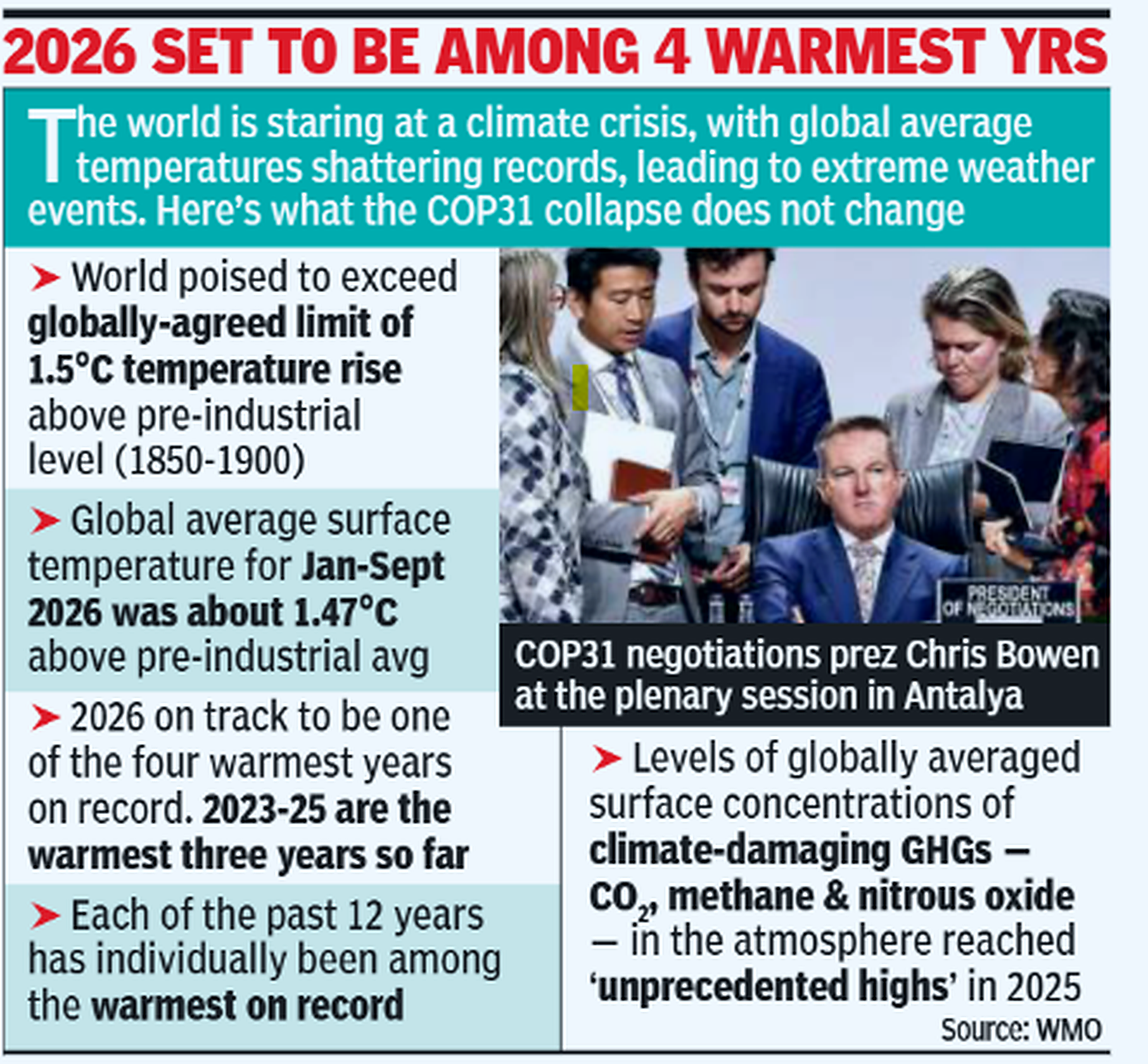
2. Climate finance: Developing countries still await clarityClimate finance was another major sticking point, with countries failing to agree on how much additional funding should be made available to help developing nations adapt to climate change.At COP29 in Baku, countries agreed to a new climate finance goal of at least $300 billion annually by 2035. At COP30 in Belém, Brazil, they agreed to triple adaptation finance to $120 billion annually by 2035, from a baseline of $40 billion.However, the interpretation and implementation of these commitments remain contested. At COP31, countries failed to agree on a clear additional funding figure for adaptation.The uncertainty over financial commitments also drew criticism from Ashok, who warned that any reduction in promised assistance would disproportionately affect vulnerable nations.“The very will that existed for developed countries to help developing countries is being sidelined. Developing countries need that kind of aid and financial assistance to work on their climate change and global warming projects,” she said.Referring to the $120-billion annual adaptation finance commitment, she questioned whether developing countries could rely on promises made at previous climate summits.“If you diminish such a promise or trim the finances, countries in the Global South are really going to suffer,” she said.The issue is particularly significant for developing countries, which face mounting costs from extreme weather events, rising temperatures and the need to strengthen infrastructure against climate-related risks.3. The world is preparing for life beyond 1.5°CCOP31 was the first climate summit since the United Nations warned that global temperatures were likely to exceed the 1.5°C threshold above pre-industrial levels within the next few years.The threshold is central to the 2015 Paris Agreement, under which countries committed to limiting global warming to well below 2°C while pursuing efforts to keep the rise to 1.5°C.The draft agreement at COP31 had acknowledged the likelihood of the world temporarily crossing the 1.5°C threshold and called for the overshoot to be kept as small and short-lived as possible. However, that recognition was lost after countries failed to agree on the central text.The United Nations Environment Programme (UNEP) has warned that existing national climate commitments remain insufficient.If countries fully implement their current pledges, global temperatures could rise by up to 2.6°C. While this would represent an improvement over earlier projections of 3°C to 3.5°C, it would still expose communities and ecosystems to severe climate risks.Atmospheric greenhouse gas concentrations are also continuing to rise. According to the World Meteorological Organization, carbon dioxide levels reached a new record in 2025, while methane and nitrous oxide concentrations also hit record highs.The annual growth rate of atmospheric carbon dioxide has tripled since the 1960s, rising from an average of 0.8 parts per million (ppm) to 2.4 ppm between 2011 and 2020.Despite the worsening indicators, UN Secretary-General Antonio Guterres has stressed that crossing the 1.5°C threshold does not mean the climate fight is over.
COP31 ends without consensus
4. Climate impacts and glacier loss demand urgent attentionThe consequences of rising temperatures are becoming increasingly visible, with extreme weather events threatening communities, infrastructure and livelihoods.Severe droughts, extreme heat, wildfires and falling water levels affected several parts of Europe during the summer. In August, flash floods triggered by a rock-ice avalanche in Nepal and Tibet washed away villages, killing more than 1,400 people and leaving thousands missing.Scientists have linked the disaster to rising temperatures and the destabilisation of mountain environments.An ICCI-UNEP report titled Overshoot and the Cryosphere warns that temporarily exceeding the 1.5°C warming threshold could accelerate the loss of glaciers and ice sheets, with consequences extending far beyond polar and mountain regions.James Kirkham, chief scientist at the International Cryosphere Climate Initiative and coordinating lead author of the report, told PTI that hundreds of millions of people could be affected by rising sea levels in the coming decades.He also warned that the loss of mountain glaciers could trigger water shortages, affecting agriculture, drinking water, irrigation and electricity generation. The risks are particularly significant for countries such as India and Nepal, where communities depend on Himalayan glaciers and seasonal snowmelt.“It’s a global problem, and it requires a global response to limit emissions, slow the rate of loss and build resilience, often across borders,” he added.5. US absence highlights geopolitical divisionsThe United States was another notable absence at COP31, with the federal government not sending an official delegation for the second consecutive year.President Donald Trump’s administration has distanced itself from international climate cooperation. The US withdrew from the Paris Agreement in January 2026 and formally notified the UN of its intention to leave the UN Framework Convention on Climate Change.However, American participation at the summit did not disappear entirely. A group of 18 Democratic members of the US House of Representatives travelled to Antalya, alongside other American political figures, including state and local leaders.Their presence followed the November midterm elections and was intended to maintain international contacts despite the federal administration’s position.6. Renewable energy transition continues despite political deadlockDespite the failure to reach agreement on the central political declaration, the expansion of renewable energy continued to feature prominently in discussions outside the formal negotiations.The International Energy Agency’s latest World Energy Outlook pointed to energy security as a major driver of the global transition. It said disruption to oil and gas supplies through the Strait of Hormuz had caused the biggest energy supply shock in history.Prolonged uncertainty over fossil fuel supplies could encourage countries to reduce their dependence on imported oil and gas and shift towards domestically generated electricity.The economics of clean energy have also changed, with solar panels, batteries and electric vehicles becoming increasingly competitive.At COP31, investment announcements and voluntary initiatives under the Action Agenda focused on electrification, shifting more energy use from fossil fuels to electricity.“We are not entering the age of electricity, we have arrived at the age of electricity,” Fatih Birol, head of the IEA, told the BBC. He said energy security and climate policies were now “closely aligned”.However, accelerating the transition also requires governments to address policy barriers, infrastructure gaps and delays in obtaining permits.7. Climate leadership under scrutinyQuestions over the credibility of climate action extend beyond negotiating tables. Environmentalist Kavita Ashok criticised a contradiction between asking ordinary people to reduce their carbon footprints and the travel practices of world leaders attending climate summits.“We have top leaders flying in their private jets. That is such a joke. If you are telling people to reduce their carbon footprint, even a layperson understands how to do it,” she told TOI.Pointing to everyday measures such as carpooling and conserving energy, she questioned the message sent by leaders who arrive at climate conferences in private aircraft.
COP31 ends without consensus
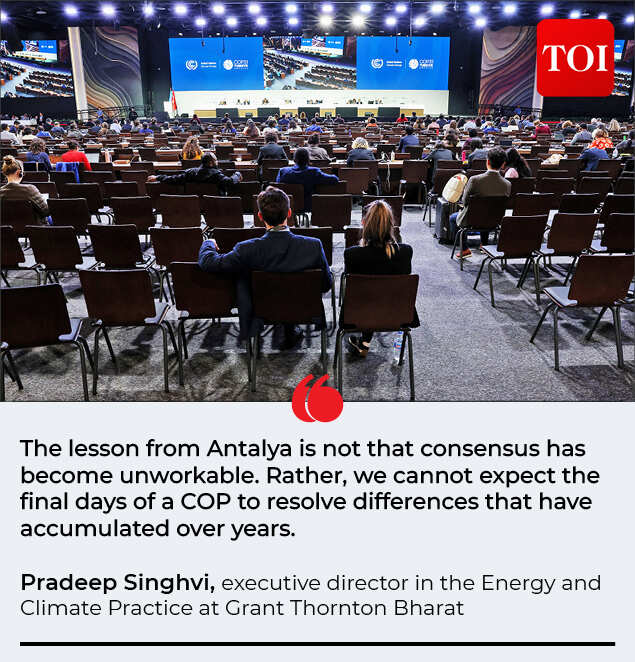
8. COP31 exposes the limits of consensus, but is the process failing?While the failure to agree on the Antalya Pacts dominated the outcome, COP31 also saw progress on several other issues.Funds raised through a global carbon credit system will go towards helping developing countries adapt to climate change.Countries also agreed to advance a just transition framework designed to protect workers and communities as economies shift towards cleaner energy.As many as 164 other agenda items were discussed during the negotiations, some of which resulted in agreements.However, several issues remained unresolved and will now be taken up at COP32, including the work programme responsible for driving forward action on emissions cuts.The outcome has reignited the debate over the effectiveness of annual UN climate conferences.For three decades, the COP process has focused on building an international framework to tackle global warming. The Paris Agreement in 2015 marked a major diplomatic breakthrough, with countries committing to keep global warming well below 2°C and pursue efforts to limit it to 1.5°C.Subsequent summits delivered further commitments, including the establishment of a fund for climate-related loss and damage at COP27, a commitment to transition away from fossil fuels and triple renewable energy capacity at COP28, a new climate finance target at COP29 and increased support for adaptation at COP30.Offering a different perspective, Pradeep Singhvi, executive director, Energy and Climate, Grant Thornton Bharat, said COP31’s failure to produce a headline political agreement did not necessarily mean global climate cooperation was weakening.“Antalya will be remembered as a difficult COP. It ended without its headline political decision, while the proposed Antalya Pact did not include explicit language on transitioning away from fossil fuels. This may raise questions about the strength of global climate cooperation, but the underlying picture is more nuanced,” he told TOI.Singhvi said reaching an agreement on shared climate goals was easier than deciding how individual countries should achieve them, given their differing economic circumstances and energy requirements.“In my experience, agreeing on where we need to go is far easier than agreeing on how each of us gets there. The previous commitments have not gone away. What Antalya has shown is how much work it will take to put those commitments into practice,” he said.He pointed out that some economies remained heavily dependent on energy revenues, while others were still working to provide affordable and reliable electricity to growing populations. For climate-vulnerable nations, the pace of the transition could have serious consequences.“A common roadmap therefore requires more than stronger language. It requires confidence that countries can move ahead without compromising development or energy security, supported by finance and technology on practical terms,” he said.Singhvi added that differences between countries were inevitable in a consensus-driven process, but accommodating these varied circumstances was also essential to the legitimacy of international climate agreements.“The lesson from Antalya, in my view, is not that consensus has become unworkable. Rather, we cannot expect the final days of a COP to resolve differences that have accumulated over years,” he said.He stressed that greater efforts were needed between climate summits, particularly on financing, implementation and the practical choices involved in transitioning away from fossil fuels.“Ultimately, the strength of international climate cooperation will be judged not only by the agreements reached at COPs, but by the investment, technology and measurable progress they enable on the ground,” he added.COP31 has once again exposed the difficulty of reconciling national interests with the need for collective climate action.While the summit failed to deliver agreement on some of the most contentious issues, the larger challenge remains unchanged: translating promises into action before the costs of global warming become even harder to contain.