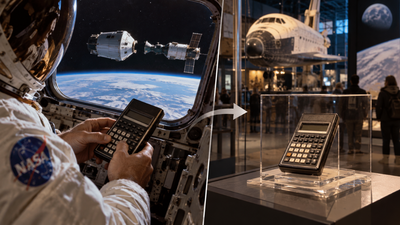
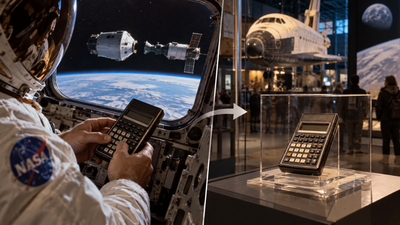
In 1975, Nasa sent an unusual piece of technology into orbit: a pocket-sized Hewlett-Packard HP-65 programmable calculator carried aboard the Apollo-Soyuz Test Project. It was not the spacecraft’s main computer, but a backup device programmed with rendezvous and guidance equations in case the Apollo Guidance Computer failed. The calculator travelled during a landmark mission that brought American astronauts and Soviet cosmonauts together in orbit. Decades later, its journey continued on Earth. In 2012, 37 years after Apollo-Soyuz, Nasa transferred the HP-65 to the Smithsonian’s National Air and Space Museum, where it remains part of the institution’s collection today.
Nasa’s pocket calculator was built for programmable calculations
Hewlett-Packard introduced the HP-65 in 1974. According to the Smithsonian’s National Air and Space Museum, it was the “first magnetic card programmable handheld scientific calculator”. Its design allowed users to store and load programmes using narrow magnetic cards that could be inserted into a reader beneath the calculator’s display.The calculator was compact by the standards of the period, measuring about 15.2 by 7.6 by 3.8 centimetres. Its kit included magnetic cards that could be used to save or load programmes, giving users a way to carry programmed calculations rather than entering them from scratch each time. This capability became particularly useful for specialised calculations in environments where access to larger computing equipment was limited.
The HP-65 backed up Apollo-Soyuz’s main computer
According to Nasa, the HP-65 was selected by Nasa for the Apollo-Soyuz Test Project, which launched in July 1975. The Smithsonian says the calculator was programmed with “rendezvous and guidance equations” and carried as a backup in case the main Apollo Guidance Computer failed. It was therefore intended as a contingency device rather than as a replacement for the spacecraft’s principal computer.The mission places the calculator in the context of an unusual flight. On July 15, 1975, an Apollo spacecraft launched with three astronauts, and two days later, on July 17, it docked with a Soviet Soyuz spacecraft carrying two cosmonauts. The nine-day mission was designed to test the compatibility of rendezvous and docking systems as well as the possibility of an international space rescue. During nearly two days of joint activities, the five crew members conducted five joint experiments and exchanged commemorative items.
Apollo-Soyuz became the first international partnership in space
The Apollo-Soyuz Test Project was significant beyond the technology carried aboard the spacecraft. NASA described Apollo-Soyuz as the first international partnership in space. The mission brought together the United States and Soviet Union at a time when the two countries had been major rivals in spaceflight. The spacecraft were specifically modified for the mission, including Apollo’s addition of equipment connected with the docking module.The docking itself took place on July 17, 1975, after more than three years of planning and preparation.The Apollo and Soyuz spacecraft remained docked for nearly two days while the crews carried out joint activities and experiments. The agency says the successful mission “paved the way for future international partnerships” in space.
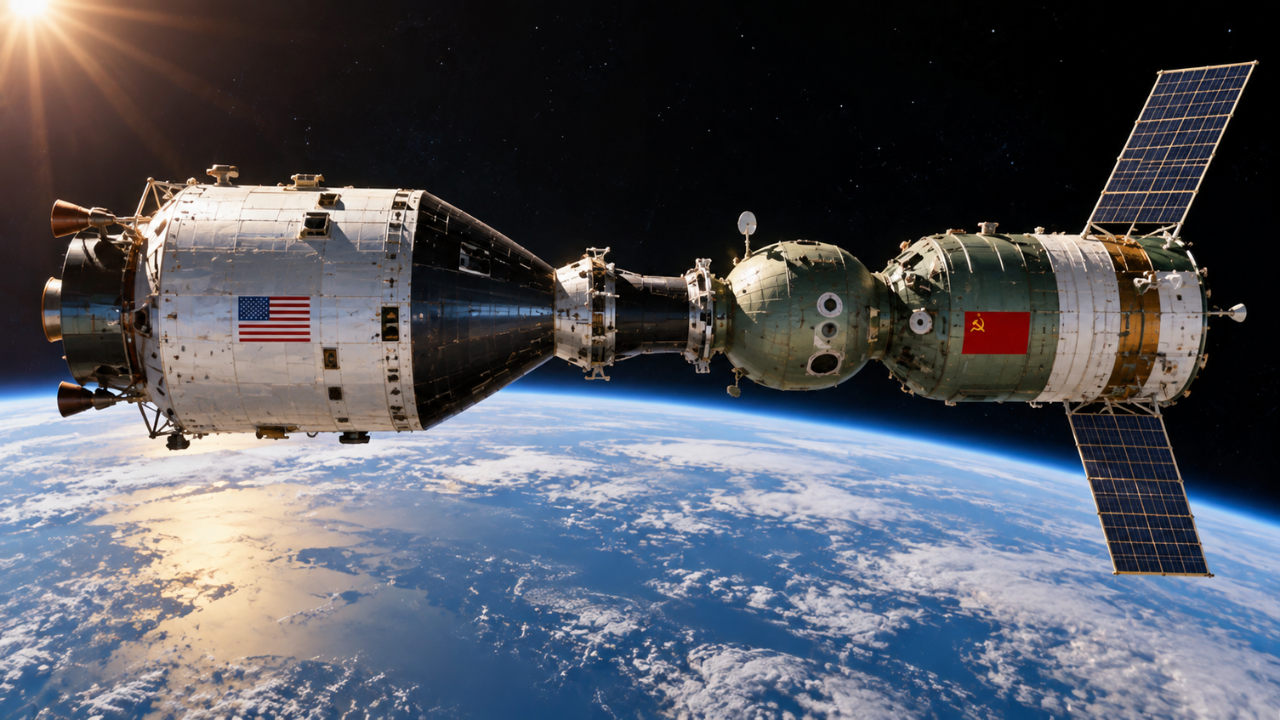
Image AI generated
HP-65 reached the Smithsonian 37 years later
The particular specimen may have been retained or acquired by Nasa for later use. By the time the Space Shuttle began flying in 1981, more advanced versions of the calculator were available, marking how quickly portable computing technology was developing.Nasa eventually transferred the device to the National Air and Space Museum in 2012, when the Space Shuttle programme ended. That means 37 years passed between the Apollo-Soyuz mission in 1975 and the calculator’s transfer to the museum. Today, the object is catalogued as “Calculator, Programmable, HP-65”, with inventory number A20120307000. The Smithsonian records its country of origin as the United States and identifies Hewlett Packard Corporation as its manufacturer.The calculator is part of the Smithsonian’s collection but is not currently on display. The museum records that it is currently either on loan or in storage. Its survival provides a physical link to an era when a pocket-sized calculator, equipped with magnetic programming cards, could be considered useful backup equipment for a crew travelling into orbit.