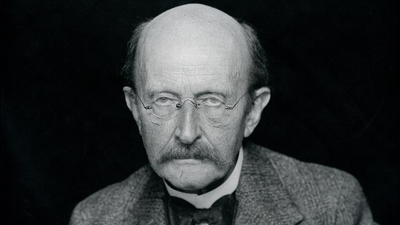
Max Planck, the German physicist whose work helped lay the foundation for quantum theory, believed that science was ultimately a search for deeper and more fundamental truths. His reflections on scientific discovery reveal how strongly he valued the pursuit of universal principles rather than simply solving individual problems. In his Scientific Autobiography, Planck wrote about his own motivation for pursuing physics and described the search for fundamental truth as the highest purpose of scientific work. His words offer an insight into the mindset of one of the most influential physicists of the modern era and remain particularly relevant today, as scientists continue to investigate some of nature’s biggest unanswered questions.
Quote of the day by Max Planck
“I had always looked upon the search for the absolute as the noblest and most worth while task of science.” Planck’s words reflect his belief that the ultimate purpose of science is to discover fundamental truths about nature. By referring to the “absolute”, he was expressing an interest in principles that could provide a deeper and universal understanding of the physical world. The quote comes from his Scientific Autobiography, published in English translation as part of Scientific Autobiography and Other Papers. Rather than presenting science simply as a collection of discoveries, Planck viewed it as an ongoing search for the fundamental principles governing the universe.
Who was Max Planck?
Max Planck was born in Kiel, Germany, in 1858 and became one of the most influential theoretical physicists of the modern era. His research into black-body radiation led him to propose that energy could be emitted or absorbed in discrete quantities known as quanta. This idea challenged established concepts in classical physics and became a foundation of quantum theory. Planck was awarded the Nobel Prize in Physics in 1918 for his discovery of energy quanta. His scientific career was marked by a continuing interest in fundamental physical laws, making his reflection on the purpose of science particularly connected to his own work.
The discovery that changed physics
Planck’s breakthrough emerged from his attempt to explain the spectrum of radiation produced by heated objects, a problem that classical physics could not adequately solve. He proposed that energy was exchanged in discrete amounts rather than continuously and introduced what became known as Planck’s constant, represented by the symbol h. His hypothesis initially addressed a specific problem in theoretical physics, but its implications were much broader. Albert Einstein later applied the concept of energy quanta to the photoelectric effect, while other physicists developed quantum theory further. These developments eventually transformed the understanding of matter, energy and the microscopic world.
Why his words still matter
Planck’s idea of searching for the “absolute” remains relevant because modern science continues to pursue fundamental explanations for phenomena that are not yet fully understood. Researchers are investigating questions surrounding dark matter, dark energy, quantum gravity, the origins of the universe and the relationship between quantum mechanics and gravity. His legacy also demonstrates how fundamental research can eventually influence technology in unexpected ways. Quantum physics has contributed to technologies including semiconductors, lasers, atomic clocks and modern electronic systems. Planck’s quote therefore serves not simply as an inspirational statement but as a reflection of the scientific curiosity that can drive discoveries with consequences far beyond their original purpose.
A lasting lesson from Planck
The enduring message behind Planck’s words is that science is driven by the desire to understand the deeper rules governing nature. His own career demonstrates how pursuing a fundamental question can challenge established ideas and open an entirely new field of knowledge. The quantum hypothesis that emerged from his work eventually helped reshape modern physics and contributed to technologies that define much of the modern world. More than a century after his breakthrough, scientists continue the same fundamental pursuit, searching for explanations that can bring seemingly complex phenomena under universal principles. Planck’s words remain a reminder that one of the greatest ambitions of science is not merely to observe the universe, but to understand the laws that make it work.