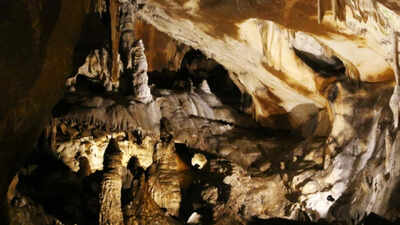
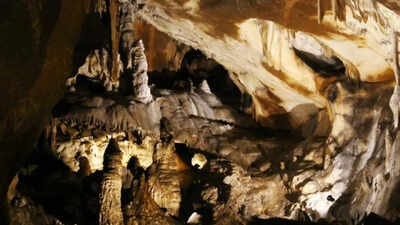
Scientists studying ancient human remains from a cave in southwestern France have found evidence that people living in eastern and western Europe were genetically connected more than 30,000 years ago.DNA recovered from a woman who lived during the Gravettian period showed that although most of her ancestry was linked to western Europe, she also had genetic connections to populations in central and eastern Europe. The findings challenge the earlier understanding that these groups remained largely genetically separate during the Ice Age.The discovery was made by an international research team led by the University of Vienna. The study, published in the journal Science Advances recently, examined ancient human genomes and DNA preserved in cave sediments to understand how populations were connected during the Late Stone Age.The woman’s remains were discovered in Isturitz Cave in southwestern France. Researchers recovered what they describe as the oldest genome-wide dataset of a modern human from southwestern Europe. Their analysis suggests that genetic exchange between eastern and western populations occurred around 32,500 to 31,500 years ago.Archaeological discoveries had already suggested that people travelled and maintained contacts across Europe during this period. However, earlier genetic studies indicated that eastern and western populations had relatively distinct ancestry. The new research suggests that the connections between these groups were more extensive than previously understood.
What the DNA from the French cave revealed
The woman belonged to the Gravettian period, a prehistoric culture that existed across Europe between approximately 34,000 and 25,000 years ago.People associated with this culture left behind various archaeological objects, including portable artworks known as Venus figurines. These discoveries have helped researchers understand aspects of their lives, but limited genetic evidence has made it difficult to establish how different populations were related.Until recently, scientists had recovered ancient DNA from only around two dozen human skeletons associated with the Gravettian period. The new analysis provides further evidence of connections between populations living across different parts of Europe.“Our results show that eastern and western European populations were not as genetically isolated as previously assumed,” said Pere Gelabert, the study’s first author from the University of Vienna’s Department of Evolutionary Anthropology, as quoted in the press release issued by the University.“Gene flow across such large distances adds a new dimension to our understanding of how Gravettian populations were connected,” he added.Researchers also identified a similar genetic signal in a previously studied individual from Ormesson, France. Together with archaeological evidence, these findings support the possibility that Isturitz Cave served as a meeting place for different groups.
Scientists recover human DNA from cave soil
The research was not limited to human bones. Scientists also examined ancient DNA preserved in sediments collected from caves in Spain.At Chufín Cave in northern Spain, genetic evidence showed that ancestry associated with western European populations continued in the region over thousands of years.The team made another discovery at El Miron Cave in Cantabria, Spain, where they recovered human nuclear DNA from a sediment layer approximately 22,000 years old.Although no human bones or teeth were available from that layer, the preserved DNA allowed researchers to identify the ancestry of people who had occupied the cave.“Sedimentary DNA allows us to recover genetic information from periods where human remains are missing,” said Ron Pinhasi, senior author of the study and a researcher at the University of Vienna.“This gives us a way to connect archaeological layers with the genetic ancestry of the people who occupied a site,” he explained.The findings from El Miron suggest that western European ancestry persisted through the Last Glacial Maximum, a particularly cold period of the last Ice Age. This supports the idea that the Iberian Peninsula served as a refuge for human populations during that time.
Ancient remains in Italy
The researchers also examined ancient human remains from southern Italy to understand family relationships among Gravettian populations. Their analysis included Ostuni1b, a male fetus believed to be the son of a previously studied woman known as Ostuni1.Genetic evidence suggested that the child’s father probably belonged to the same population as his mother. However, the parents were not closely related.According to the researchers, this suggests that mating practices may have helped these populations avoid high levels of inbreeding.The Italian findings, combined with evidence from France and Spain, suggest that populations could maintain genetic continuity within particular regions while also exchanging genes with people living much farther away.The research team is now combining DNA recovered from sediments with advanced proteomic analyses to investigate the earliest movements of modern humans across Europe. They also hope to understand how these populations interacted with carnivores in places where organic remains are limited.