
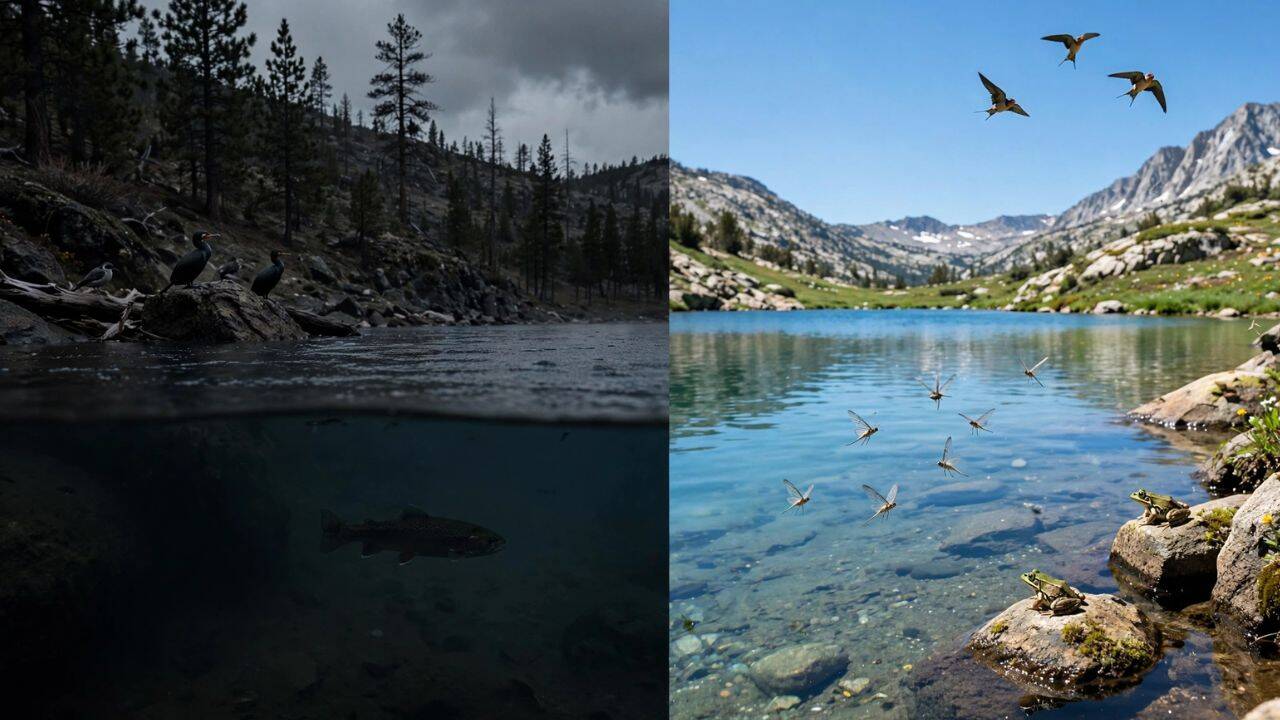
In the high-elevation lakes of California’s Sierra Nevada, trout introduced into mountain lakes are affecting more than the water itself. Researchers studied 39 lakes in Sequoia and Kings Canyon National Parks, comparing bird abundance with aquatic insects emerging from the water. A study published in Ecosphere titled ‘Crossing boundaries: Introduced trout alter the bird community in a naturally fishless headwaters ecosystem’ found that lakes with introduced trout had fewer birds and supported a different mix of bird species than naturally fishless lakes. Mayflies were far more abundant at lakes without fish, while lakes containing trout had fewer mayflies and fewer birds.
How did trout affect bird numbers around mountain lakes
The researchers compared lakes with trout against naturally fishless lakes in the high-elevation headwaters of Sequoia and Kings Canyon National Parks. Across the study, researchers recorded fewer individual birds at stocked lakes. After accounting for elevation, the estimated average was 5.15 birds per stocked point and 6.48 birds per fishless point. That amounted to roughly one fewer bird detection within a 300-metre radius around each survey point. The researchers described this as about a 20% difference in total bird abundance.
PC: AI Generated
How did researchers track birds and insects in the Sierra Nevada lakes
The researchers selected permanent lakes above 3,000 metres in elevation and expanded their study to 39 lakes across 10 basins. Bird surveys were conducted during the breeding season in June and July. Researchers recorded every bird seen or heard during 10-minute counts at points along each lake shoreline. The study covered three summers, with surveys conducted in 2014, 2015, and 2020. To examine the food available to birds, the researchers also used sticky traps at 10 lakes during summer 2015. These traps collected flying aquatic insects emerging from the water.
Why were mayflies far less common in lakes with trout
The insect results showed a clear difference between the two types of lakes. Mayflies were much more abundant at fishless lakes when they were present, while lakes with trout were far more likely to have no mayflies at all. Mayfly emergence also occurred in short seasonal bursts, with most lakes reaching their peak in late June. At fishless lakes, the number of insects captured, the area they covered, and their size varied considerably. Lakes stocked with trout still had insects emerging from the water, but these were generally smaller species such as midges, flies and mosquitoes.
Which birds were affected by trout in the mountain lakes
The presence of trout was linked to a change in the bird community around the lakes rather than simply a decline in the number of species. Two alpine specialists, the Gray-crowned Rosy-finch and Clark’s Nutcracker, were found in lower numbers at lakes stocked with trout. The Mountain White-crowned Sparrow showed the opposite pattern and was more common at stocked lakes, although the researchers considered this result weaker. Among the nine most common species studied, the other six showed no clear difference between the two lake types.
Bird abundance rose after trout removal
The researchers also examined a lake where Park personnel began removing trout in 2016. By 2020, trout numbers had fallen substantially, and the lake was showing signs of becoming functionally fishless, including a strong emergence of mayflies. Bird abundance rose beyond the range recorded in earlier years and reached levels similar to those at a nearby fishless reference lake. The analysis found that bird abundance doubled after the trout were removed. The American Dipper and Mountain Bluebird were also recorded at the lake in 2020, after neither species had been detected there before trout removal.