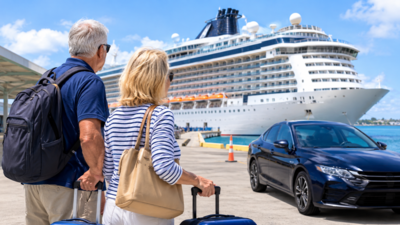
A parking arrangement that seemed like a minor inconvenience before a Caribbean holiday turned into an expensive dispute for a Florida couple. After returning from a seven-night cruise aboard Celebrity Apex, the passenger found his Ford Expedition covered in hardened white deposits that he believed were sea salt. He subsequently spent $405 on washing and detailing the vehicle before seeking reimbursement from Celebrity Cruises. When the company refused, he pursued the matter through arbitration before taking it to a small claims court. The dispute eventually had consequences far beyond the original bill. Royal Caribbean, Celebrity’s parent company, informed the passenger and his wife that they were no longer welcome aboard its ships.
Port Canaveral cruise parking takes an unexpected turn for Celebrity Cruises passenger
Eric J. and his wife arrived at Port Canaveral in Florida to board Celebrity Apex for a seven-night Caribbean sailing. The couple had used the port’s parking facilities for years, generally preferring the covered garage. On this occasion, however, the garage was full.Eric said he was directed towards an uncovered overflow parking area by people he believed were Celebrity Cruises employees. He parked his Ford Expedition there before taking a shuttle to the cruise terminal with his wife. Although he was unhappy about having to leave the vehicle outdoors, the couple proceeded with their holiday.The concern resurfaced when they returned. According to Eric, his vehicle was covered in hard white spots, which he identified as deposits of sea salt, according to Consumer Rescue. He believed prolonged exposure to the coastal conditions had affected the paintwork and wanted the marks removed before they caused further deterioration.According to Consumer Rescue, Eric initially spent $35 at a local car wash. The service did not remove the salt deposits to his satisfaction, prompting him to arrange professional detailing at home for another $370.
Celebrity Cruises passenger seeks $405 reimbursement for car cleaning
Reportedly, Eric subsequently hired a mobile car detailing company to work on the vehicle. The service included professional handwashing and bug removal, along with other detailing work. The invoice came to another $370, bringing his total spending to $405.Once the work was completed, Eric was satisfied with the result. He then turned to Celebrity Cruises, asking the company to reimburse him for the two cleaning services. His argument was that the vehicle had been exposed to the conditions because he had followed directions given at the cruise terminal. The company suggested that he examine his cruise contract, which made clear that parking at the port was not included in the cruise arrangements.The parking facilities at Port Canaveral are operated by the Canaveral Port Authority, rather than Celebrity Cruises or its parent company, Royal Caribbean Group. The cruise line’s position was that the responsibility for the parking arrangement did not fall within its contractual obligations.
Royal Caribbean passenger files arbitration demand over $405 car cleaning bill
The refusal did not end Eric’s attempt to recover the money. After examining his cruise agreement, he found a clause referring to arbitration and decided to approach the American Arbitration Association (AAA), an organisation that administers arbitration and mediation proceedings. He submitted a ‘Demand for Arbitration’ against Royal Caribbean, including photographs of the vehicle, his parking receipt, the two cleaning bills and a copy of his cruise contract. He also paid a $225 filing fee to initiate the process.According to Consumer Rescue, the AAA required Royal Caribbean to pay a further $375 fee before the complaint could proceed. By this stage, the dispute had grown beyond the original cleaning expense, with the combined fees and detailing costs taking the amount involved above $1,000.However, the AAA did not proceed with the complaint. About a month after Eric submitted his demand, its Consumer Filing Team informed him that it would not administer the case. Its communication said either party could choose to take the dispute to the appropriate court.
Royal Caribbean gives longtime passenger a lifetime ban after lawsuit
Soon after filing the paperwork, he received a telephone call from someone identifying himself as a Royal Caribbean representative. Eric initially thought the company might finally be contacting him to discuss compensation or settle the disagreement. Instead, he was informed that he and his wife had been permanently banned from sailing with Royal Caribbean and its affiliated cruise brands.For Eric, the announcement was particularly difficult to accept because of his history with the company. He told Consumer Rescue that he had been sailing with Royal Caribbean for more than 20 years and had never previously encountered a problem. He and his wife were members of the Crown and Anchor Society’s Diamond-level loyalty programme and frequently travelled in suites.The ban meant losing the privileges accumulated through those years of cruising. Eric described the situation as a misunderstanding and hoped the company would reconsider its decision.
Why the passenger believed the cruise line was responsible
Eric later approached consumer advocate Michelle Couch-Friedman, founder of Consumer Rescue, asking for assistance in getting the ban reversed. In his account, he maintained that Celebrity’s customer service team had directed him to the contract when he sought compensation. He believed the contract’s dispute-resolution provisions meant that arbitration was the appropriate next step. When the AAA declined to administer the case, he understood its response to mean that court proceedings were the remaining option.He also argued that the cruise line had failed to respond to the arbitration notice, leaving him with little choice but to continue with the claim. In correspondence shared with Couch-Friedman, he said the couple had followed the procedures set out in their agreement and had not expected to be banned for doing so.Eric indicated that he was prepared to withdraw the claim if that would help restore his relationship with the cruise line. He wanted his previous customer status and associated benefits back.
The port authority’s warning that vehicles were parked at owners’ risk
Couch-Friedman contacted the Canaveral Port Authority to establish who operated the parking facilities and what responsibility it accepted for vehicles left there. The authority confirmed that passengers using its parking areas received a disclaimer printed on the reverse of their payment receipts. It stated that the authority was not responsible for vehicles or personal belongings, including losses or damage resulting from circumstances such as adverse weather.Eric had submitted a copy of his parking receipt as part of his evidence. The front identified the Canaveral Port Authority as the parking operator. According to Couch-Friedman’s account, the document therefore raised a fundamental problem with his decision to pursue Royal Caribbean over the incident. The parking was not operated by Celebrity, and the receipt contained a warning that vehicles were left at the owner’s risk. The claim also relied on Eric’s belief that cruise employees had directed him to the outdoor facility, something that did not establish that the cruise line operated or controlled the parking area.The $370 detailing invoice described a deluxe cleaning service, including bug removal and work intended to improve the vehicle’s appearance and protect it against the elements.
Consumer advocate questions passenger’s legal arguments
Couch-Friedman said she could not establish why Royal Caribbean should be responsible for the cost of cleaning a vehicle parked in a facility operated by the port authority. She also challenged Eric’s interpretation of the AAA communication. The association had said it would not administer the case and that either party could take the dispute to court. It had not instructed him to file a lawsuit, nor had Royal Caribbean advised him to pursue legal action over the cleaning bill.During their exchanges, Couch-Friedman raised the possibility that artificial intelligence might have influenced the way Eric was handling the complaint. She said she had encountered other consumer disputes involving legal-sounding arguments and demands that appeared to rely on incorrect information generated by AI tools.Eric did not confirm or deny using AI when she asked him directly. He continued to maintain that he had followed the instructions provided by the cruise line and the arbitration organisation. Couch-Friedman eventually told him that she considered the complaint to be without a sound basis and could not help him secure a reversal of the ban while the lawsuit remained active.
Florida court dispute could add legal fees to Royal Caribbean car wash case
Despite the consumer advocate’s assessment, Eric did not agree to abandon his position. In a later message, he again said he was willing to withdraw the claim in the hope of repairing the relationship with Royal Caribbean. The case was still on the court docket at the time of Couch-Friedman’s report. She said she would be interested to see whether Royal Caribbean sent its lawyers to contest the matter. She also pointed out that Florida courts can, in certain circumstances, order a plaintiff to pay the defendant’s legal fees if a lawsuit is found to be frivolous.For the couple, the disagreement had moved a long way from the original $405 expenditure. What began as a complaint about an uncovered parking space had developed into a small claims dispute and a permanent exclusion from Royal Caribbean, Celebrity Cruises and Silversea. Whether the cruise line will reconsider the ban remains uncertain.Disclaimer: This article is based on a report by Michelle Couch-Friedman, founder of Consumer Rescue. The Times of India has not independently verified the passenger’s account, the allegations concerning the vehicle or the status and outcome of the legal proceedings.