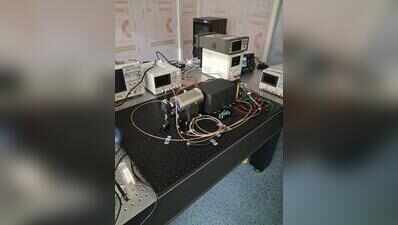
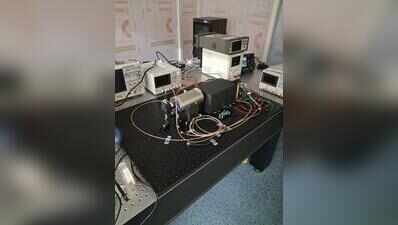
Pune: GPS satellites that help us find directions and mobile networks that connect systems used by defence forces need extremely accurate timekeeping to work properly. QuPrayog, a startup incubated at the I-HUB Quantum Technology Foundation at the Indian Institute of Science Education and Research (IISER), Pune, has developed a prototype of an advanced atomic clock that could help India make these technologies more reliable while reducing dependence on imported equipment.The deep-tech startup has developed a laboratory-scale atomic clock using rubidium-87 atoms. The company completed the prototype in seven months and aims to launch a smaller, miniature version by Aug 2027.Unlike ordinary clocks that measure time using electronic components, atomic clocks use the natural behaviour of atoms to keep time with exceptional accuracy. They are particularly important for GPS navigation systems, where even small timing errors can affect the accuracy of location and navigation signals.The technology could become increasingly important as India explores a new generation of navigation satellites operating closer to Earth, known as Low Earth Orbit (LEO) satellites. These satellites need smaller, lighter and energy-efficient clocks to maintain accurate timing and synchronise signals. Such clocks can also support navigation systems designed to function when conventional GPS signals are unavailable or disrupted.Explaining the importance of the development, Jay Mangaonkar, CEO and co-founder of QuPrayog, said, “Position, navigation and timing has always been central to India’s strategic independence. As Indian private companies advance in LEO-based navigation, GPS-denied navigation and other emerging technologies, the need for highly precise and reliable timing becomes increasingly critical.”He said the company’s objective was to reduce India’s dependence on imported atomic clocks and develop a reliable domestic supply chain for high-performance timing systems. This would make the technology more accessible to Indian companies working in space, navigation and strategic sectors.The prototype uses a technique called Coherent Population Trapping (CPT). In simple terms, it uses carefully controlled laser light to interact with rubidium atoms and produce a very specific frequency. This frequency acts as a highly stable reference against which the clock’s electronic components can be adjusted.Kunj Tandon, CEO, I-Hub Quantum Technology Foundation, said, “Unlike conventional atomic clocks that use microwave cavities, this approach uses light to interact with atoms. This makes it suitable for developing smaller clocks with lower power requirements and fewer complex components.”The company said laboratory tests showed a frequency stability of approximately 3 × 10⁻¹⁰ over one second, improving to around 2 × 10⁻¹¹ over 100 to 1,000 seconds. It also reported that the system improved the stability of an ordinary crystal oscillator by about 50 times over 1,000 seconds.Mangaonkar said the achievement involved bringing together atomic physics, laser technology, optical systems, precision electronics and control engineering. The next phase will focus on improving the clock’s performance, reliability and packaging before making it smaller.Founded in 2024 by Dr Jay Mangaonkar and Dr Rahul Sawant, QuPrayog is also incubated at the IIT Madras Incubation Cell. Its technology development receives support from India’s deep-tech ecosystem, including the National Quantum Mission of Union govt’s Department of Science and Technology. The National Quantum Mission, approved in 2023 with an allocation of Rs 6,003.65 crore over eight years, includes the development of indigenous technologies in quantum sensing and precision measurement.The startup’s longer-term plans include developing compact and rugged atomic clocks for satellite navigation, telecommunications, scientific instruments and other applications, besides exploring optical atomic clock technology.