A fourth-year aerospace engineering student from the Indian Institute of Space Science and Technology (IIST), Thiruvananthapuram, has earned national recognition for developing a technology-based solution to address threats to India’s forests. Omkar Manik Jadhav has secured the First Runner-Up position at the National Finals of the 10th edition of the IET India Scholarship Award 2026, winning a cash prize of ₹3 lakh.Jadhav’s achievement places him among the top two performers in a competition that attracted 48,761 undergraduate engineering students from across the country. His selection at the national level followed a series of competitive rounds that assessed participants on their technical understanding, innovation, problem-solving capabilities, and ability to develop solutions to real-world challenges.Representing IIST, Jadhav presented an innovative prototype titled ‘Forest Sentinel‘, a forest threat detection system designed to identify potential forest fires and illegal logging activities at an early stage. His project stood out for its focus on using affordable, low-power technology to address monitoring challenges in large and remote forest regions.
From regional winner to national runner-up: Jadhav’s journey
Jadhav’s performance in the competition was marked by a strong showing at the regional level. He secured first place in the South 2 Regional Round, conducted on September 5, 2026, winning a prize of ₹1 lakh. The victory also earned him a place in the national finals, where he competed against four other regional winners representing different parts of India.The IET India Scholarship Award follows a multi-stage selection process intended to identify engineering students who can demonstrate more than academic proficiency. Participants are assessed on their ability to apply engineering knowledge, develop innovative ideas and translate technical concepts into workable solutions.The national finals were held on September 26, 2026, bringing together five regional winners. Each finalist was required to develop and present a working prototype based on a distinct problem statement assigned during the preceding round.The projects were evaluated by a national jury, with participants expected to demonstrate the technical depth, practical application and innovation potential of their proposed solutions. Jadhav’s Forest Sentinel secured him the second position nationally.
Forest Sentinel: How the IIST student ‘s prototype aims to protect forests
At the centre of Jadhav’s presentation was Forest Sentinel, a technology-driven system designed to address two persistent challenges in forest conservation: the early detection of fires and the identification of illegal logging activities.Monitoring extensive forest areas is difficult, particularly in remote locations where conventional surveillance infrastructure may be expensive, inaccessible or inadequate. Delays in identifying fires can allow them to spread across large areas, while illegal tree felling can go undetected in regions with limited monitoring facilities.Forest Sentinel seeks to address these challenges through a network of small, low-cost and low-power devices equipped with onboard sensors. The devices are designed to identify potential threats and unusual activity locally, rather than depending entirely on continuous human surveillance.Once a possible threat or anomaly is detected, the system is designed to transmit an alert directly to a satellite. The satellite can subsequently relay the information to a designated base camp, allowing the concerned monitoring team to receive information about potential threats in remote forest locations.The proposed architecture aims to make forest monitoring more accessible by reducing dependence on conventional ground-based surveillance systems. Its emphasis on affordability, low power consumption and satellite-based communication also makes it relevant to regions where establishing extensive monitoring infrastructure can be challenging.By bringing together sensor-based detection and satellite communication, the project demonstrates how engineering concepts can be applied to environmental protection and the management of natural resources.
National recognition for an engineering solution
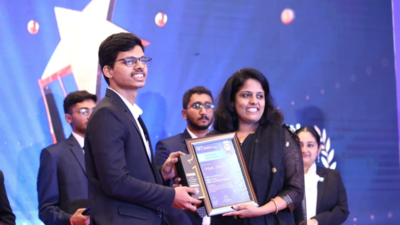
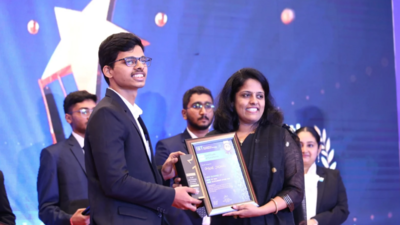
Jadhav was declared the First Runner-Up at the conclusion of the national competition, securing the second position among the five finalists. The award carried a cash prize of ₹3 lakh and was presented by Kavitha Rajan, Vice President – Sales (India and South Asia) at ADP India Private Limited.The presentation took place in the presence of industry representatives and senior members of the Institution of Engineering and Technology (IET).The recognition marks an important achievement in Jadhav’s academic journey, particularly as it reflects his ability to move beyond theoretical engineering concepts and develop a prototype addressing an environmental challenge.
What is the IET India Scholarship Award?
The IET India Scholarship Award is a national-level initiative organised by the Institution of Engineering and Technology to recognise promising undergraduate engineering students across India.The programme seeks to identify students demonstrating strong technical knowledge, innovative thinking, problem-solving abilities and the potential to develop solutions to real-world problems.Its selection process includes multiple stages, culminating in a national competition where regional winners present their projects before a jury. The format provides participants with an opportunity to demonstrate the practical relevance of their ideas and their ability to translate engineering knowledge into technology-driven solutions.Jadhav’s performance in the 10th edition, which saw participation from 48,761 undergraduate engineering students, brings further recognition to IIST Thiruvananthapuram and its engineering community.His Forest Sentinel project also highlights the role that emerging engineers can play in addressing challenges beyond conventional industrial applications. By applying aerospace-linked communication capabilities and sensor-based technology to forest protection, the project offers an example of how engineering innovation can contribute to environmental monitoring and conservation.