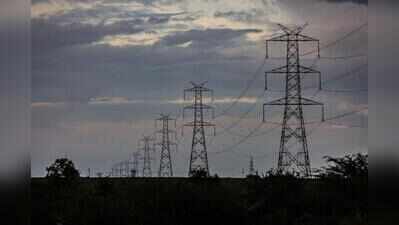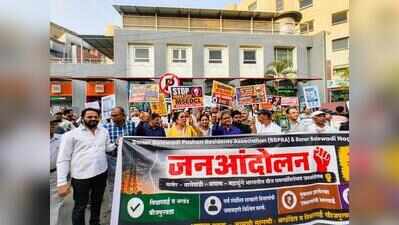
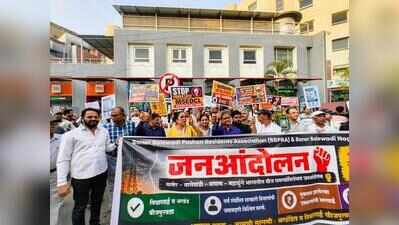
Pune: For lakhs of residents in the rapidly expanding suburbs of Pune and Pimpri Chinchwad, power cuts have become a routine hardship rather than an occasional inconvenience. From Bavdhan and Baner to Ravet and Charholi, neighbourhoods are grappling with frequent outages, voltage fluctuations and damage to electrical appliances. In some pockets, blackouts last for days. The widespread complaint is that development has outpaced the expansion of power infrastructure.Decade-long wait for Bavdhan Few areas illustrate the crisis better than Bavdhan, where towering residential projects and new commercial establishments continue to mushroom even as the area remains dependent on two aging substations at NCL and Dahanukar Colony. “We began demanding a new substation a decade ago. Officials initially told us there was no suitable space, so we helped identify a site. Maharashtra State Electricity Distribution Company Limited (MSEDCL), however, rejected it, citing the steep slope of the land as unsuitable for construction. Later, survey number 23/3 near the Talathi office in Bavdhan was identified as an ideal location, but the plot has been reserved for Kelkar museum. We are now back to square one,” Manish Deo, a core member of the Bavdhan Citizens Forum (BCF), said. “The latest update we have received is that the district collector has rejected the land for the substation until an alternative site is identified for Kelkar museum. The museum reservation was made more than a decade ago, but no construction has taken place since then. The land should therefore be returned to govt and used for another purpose. Meanwhile, corporators, MP Supriya Sule and local residents are all searching for a suitable site — either for the substation or as an alternative location for the museum,” Deo said. Residents said the pace of development had overwhelmed the existing power network. “Whether it is a new building, office or even a food truck, every establishment needs electricity. The growing demand is placing severe pressure on existing substations. Bavdhan currently has around 80,000 residents, and another 5,000 to 10,000 people are added each year. The existing substations were built to serve the population living in and around those areas, but the additional load is affecting adequate power supply. Bavdhan needs a substation of its own,” Atul Patil, another core member of BCF, told TOI. The issue has also sparked speculation over competing interests for the proposed site. “Residents were made aware that there are some vested interests for the survey number 23/3 land, wherein some political leaders are keen to set up a theatre on this land. How will this space run without electricity? To add to this, I am not sure whether people of Bavdhan even want a theatre over a substation,” Patil said. Baner-Balewadi’s infra lag A similar story is unfolding in Baner and Balewadi, where residents say power outages have become routine as the area’s population and commercial footprint expand rapidly. “There are new projects being launched in our area almost every other day, making a dedicated substation essential. Commercial hubs such as Balewadi High Street should ideally have had their own substation, but that did not happen. Instead, they were supplied electricity from the residential network, increasing the load on the transformer. This may also be contributing to the frequent power outages in the area,” IT professional Sarang Wable, a long-time Baner resident, said. “Our outages can usually be traced to increased power consumption during summer, festivals such as Diwali and then also during the monsoon. In some pockets, residents have experienced power cuts lasting three to four days this year. Three years ago, land was also allocated for a substation, but no action was taken and the site is now filled with construction debris. For now, MSEDCL is managing the load by adding extra lines. But residents should not have to suffer because officials failed to act on time,” he said. The mounting frustration prompted guardian minister Chandrakant Patil to intervene in May, directing MSEDCL officials to strengthen supply and prepare both short- and long-term plans for the Baner-Balewadi area. Yet residents insisted that a new substation alone would not solve the crisis. “Power supply is disrupted every time it rains or even when a minor fault is detected. There is also an urgent need to upgrade the existing infrastructure to support the proposed substation, as both will ultimately be interconnected. Improving the current network and prioritising monsoon preparedness and routine maintenance are equally important. With new connections being sought every day, residents should not be left with infrastructure that exists only on paper but is too poorly maintained to address the problem. The issue needs to be tackled on all fronts,” resident Swapna Narayan said. Ravet demands long-term vision In Pimpri Chinchwad’s rapidly urbanising Ravet-Kiwale-Mamurdi belt, residents are raising similar concerns. The Ravet-Kiwale-Mamurdi Federation recently also wrote to MLA Shankar Jagtap, flagging persistent power supply issues among a host of other infrastructure challenges. “Over the past few years, the Ravet, Kiwale and Mamurdi region has witnessed extensive urbanisation, with several multi-storey buildings and large housing complexes coming up. However, essential infrastructure, particularly electricity supply, has not kept pace with this growth. Like other civic issues, power outages are not merely an inconvenience for residents; they also affect their quality of life,” federation president Prajakta Rudrawar told TOI. According to the federation, recurring outages have disrupted lifts, water pumps, security systems, work-from-home arrangements, business operations and the daily routines of senior citizens. The group has sought a joint review with MSEDCL officials to assess feeder capacity, transformer loads and cable networks, and identify permanent solutions. Jagtap, in a letter to MSEDCL in Sept, highlighted repeated power disruptions caused by snapped wires during rains and falling tree branches, urging officials to explore underground cabling. “Our demands are simple. We want a masterplan for the area taking into consideration the projected growth for the next 10-15 years and also an individual action plan for all civic issues, including power supply,” Rudrawar added. OFFICIAL SPEAK We carry out regular maintenance of our power distribution network. However, underground MSEDCL cables are frequently damaged during road excavation work by various agencies, including the National Highways Authority of India (NHAI), leading to power outages. We have repeatedly asked NHAI and other agencies to inform MSEDCL in advance so that our staff can be deputed to supervise the work and help prevent damage to the cables. Unfortunately, these instructions are often not followed, resulting in avoidable disruptions to power supply — Vikas Puri | Public relations officer, MSEDCL