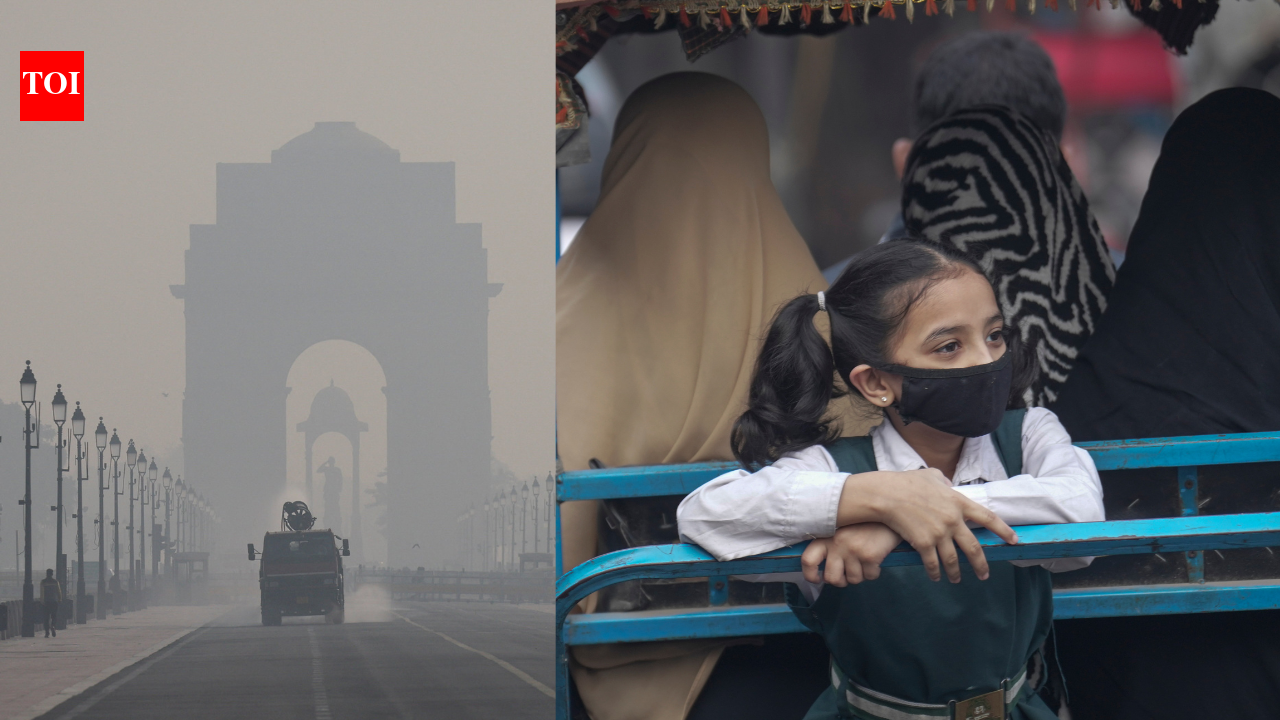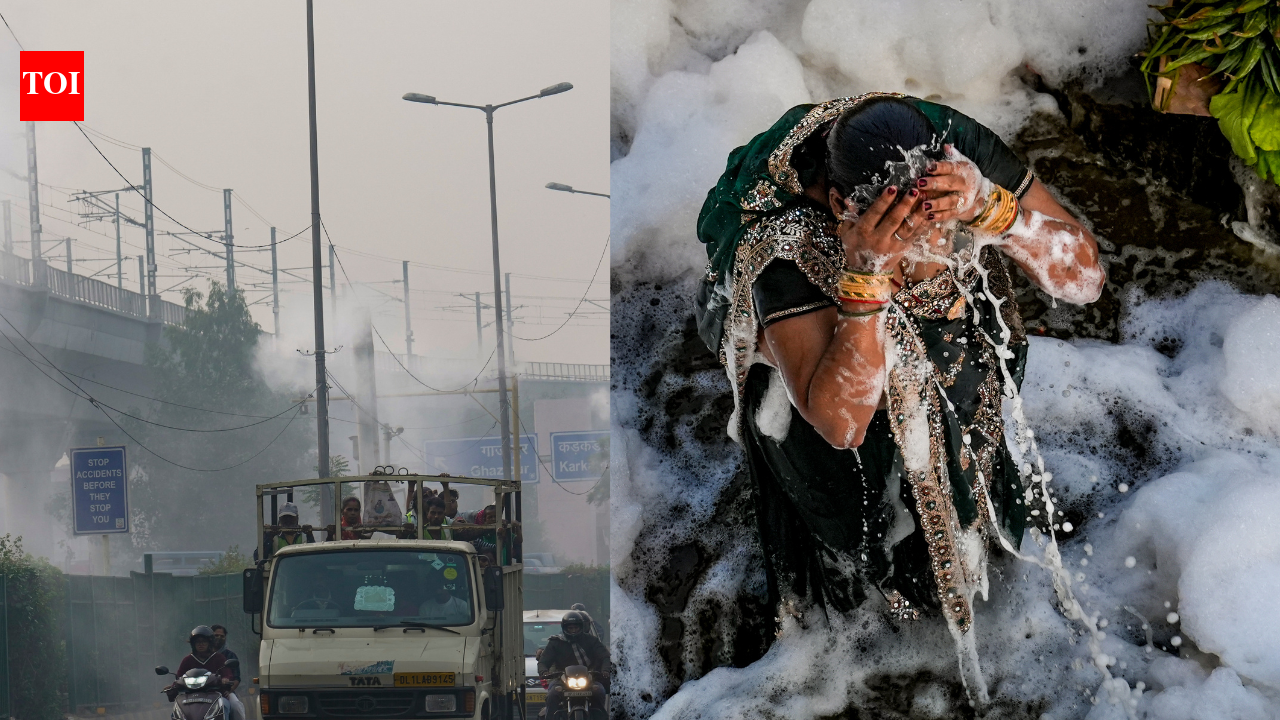
NEW DELHI: Delhi witnessed improvement in pollution levels on Monday, with PM2.5 concentrations dropping significantly across several monitoring stations. However, the overall air quality index (AQI) continued to remain in the ‘poor’ category, while a thick layer of smog lingered over several parts of the national capital.The improvement came despite the absence of significant rainfall or strong winds, raising questions over the sharp decline in pollution levels. Experts said weather conditions were favourable for the dispersion of pollutants, but did not fully explain the scale of the improvement.The AQI stood at 216 at 7.05am on Monday, in the ‘poor’ category, according to the Central Pollution Control Board (CPCB). Sirifort recorded an AQI of 346 and NSIT Dwarka 330, both in the ‘very poor’ category.Among other areas, Punjabi Bagh recorded an AQI of 276, Chandni Chowk 271, ITO 267, North Campus Delhi University 259, IIT Delhi 258, JNU 240, Burari 221 and Anand Vihar 205. Okhla Phase 2 recorded an AQI of 191, while IMD Lodhi Road registered 149, both in the ‘moderate’ category.The improvement in air quality came as the condition of the Yamuna remained a political flashpoint during Chhath Puja celebrations in the capital.Thousands of Purvanchali devotees gathered at the river’s ghats to offer prayers, even as visuals of white foam floating on the water triggered a political exchange between the Aam Aadmi Party (AAP) and the BJP.AAP accused the BJP governments in Delhi and at the Centre of making false claims about cleaning the Yamuna, sharing videos and pictures purportedly showing devotees performing rituals amid the foam. The party said the visuals exposed the government’s claims about the river’s clean-up.The BJP rejected the allegations and hit back at the previous AAP government, claiming the Yamuna had become more than half clean in two years.The party also said Chhath celebrations, which it alleged had been restricted at the Yamuna ghats during the previous government, were now being held on a grand scale across the city.Delhi Chief Minister Rekha Gupta highlighted the scale of this year’s celebrations, saying Chhath was being observed across nearly 1,400 ghats in the capital. The exchange once again brought the Yamuna’s pollution into focus during the festival.On Sunday, PM2.5 concentrations had dropped sharply across Delhi, with readings at most of the 32 monitoring stations moving into the ‘good’ or ‘satisfactory’ categories by 6pm. At RK Puram and Major Dhyan Chand Stadium, PM2.5 levels fell below 10 micrograms per cubic metre between 2pm and 3pm.At Tikri Kalan, concentrations dropped from 256–193 in the early morning to 9.84–8.74 between 1pm and 3pm.However, the overall AQI did not reflect the same improvement as it is calculated using a 24-hour average, with the highest pollutant sub-index determining the final category.Delhi’s AQI, which stood at 350 at 10am on Sunday, improved to 332 by noon and 290 by 4pm. IIT Delhi remained among the worst-affected locations, recording an AQI of 404 by noon before improving to 350 by 4pm.According to the India Meteorological Department (IMD), the maximum wind speed recorded was 15 kmph at 2.30pm on Sunday. Although scattered rainfall was reported, IMD monitoring stations did not record rainfall between 8.30am and 5.30pm.Sunil Dahiya of Envirocatalyst said weather conditions were favourable for the dispersion of pollutants, but not enough to explain the scale of the decline.Manoj Kumar of the Centre for Research on Energy and Clean Air (CREA) said gaseous pollutants such as nitrogen dioxide, sulphur dioxide and ozone also contribute to AQI readings, and sustained improvement would depend on reducing emissions.Meanwhile, AAP Delhi president Saurabh Bharadwaj on Sunday alleged manipulation in the government’s AQI data, questioning the readings at monitoring stations in Jahangirpuri and Anand Vihar.He also claimed that water was being continuously sprayed near the Jahangirpuri monitoring station to artificially lower pollution readings.“The pollution levels published in newspapers today expose alleged manipulation in the government’s AQI data… The data shows that IIT Delhi has the highest AQI in the city, even though it is a green and clean campus,” he told ANI.“If the AQI is the highest there, imagine what the levels must be in Jahangirpuri and Anand Vihar,” he said.According to IITM’s source-apportionment data until 9am on Sunday, biomass burning contributed 37% of Delhi’s pollution load, followed by secondary organic aerosols at 22% and vehicular emissions at 17%. Secondary inorganic aerosols accounted for 7%, while waste burning contributed 5%.The CPCB classifies AQI between 0 and 50 as ‘good’, 51 and 100 as ‘satisfactory’, 101 and 200 as ‘moderate’, 201 and 300 as ‘poor’, 301 and 400 as ‘very poor’ and 401 and 500 as ‘severe’.(With agency inputs)