NEW DELHI: The hourly PM2.5 concentration at northwest Delhi’s Jahangirpuri spiked to 4,985 micrograms per cubic metre (µg/m³) at 6pm and 8pm on Diwali, before shooting up again at 8am the next day, making it the most polluted location Sunday and Monday in the city.This was around 83 times the daily national ambient air quality standard of 60 µg/m³ and over 332 times World Health Organisation’s (WHO) daily safe guideline of 15 µg/m³.However, Delhi Pollution Control Committee (DPCC) changed the readings Monday night, showing that Jahangirpuri hit its peak PM2.5 levels at 776 µg/m³ at Diwali midnight.The pattern of extreme pollution around midnight was witnessed in most parts of the city when firecrackers were set off in large numbers.A TOI analysis of DPCC real-time air quality data shows that most stations witnessed a sharp rise in PM2.5 levels around midnight. Thereafter, the pollution levels remained high till at least 6am Monday.At Mundka, the hourly PM2.5 levels jumped from 245 µg/m³ at 7pm on Diwali to 3,744 µg/m³ at 2am Monday.
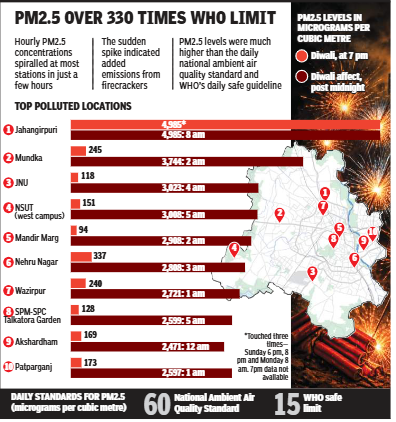
PM2.5 over 330 times WHO limit
A similar trend was witnessed across the city. JNU saw a peak hourly PM2.5 concentration of 3,023 µg/m³ at 4am Monday; it was just 118 µg/m³ at 7pm Sunday. The peak reading at NSUT (west campus) was 3,008 µg/m³ and 2,908 µg/m³ at Mandir Marg.The stations, which recorded hazardous levels of hourly PM2.5 levels, included Nehru Nagar in Lajpat Nagar (2,808 µg/m³), Wazirpur (2,721), Talkatora Garden (2,599), CWG Sports Complex in Akshardham (2,471), Patparganj (2,597) and Ashok Vihar (2,589).Sunil Dahiya, founder of Envirocatalyst, a think tank, said, “Through Diwali night, people across Delhi inhaled PM2.5 averaging 450 to 550 µg/m³. That is eight to nine times the national 24-hour standard and 30 to 37 times WHO’s guideline. Even a few hours at these levels can trigger asthma attacks, worsen lung diseases and raise the risk of heart attacks and strokes.”Dahiya said children, the elderly, pregnant women, outdoor workers and people with heart or lung conditions are hit hardest in such situations.“Fine particles reach deep into their lungs and bloodstream, and the coarser PM10 inflames airways and eyes. One night was added to a season in which Delhi’s air was already more than twice the safe limit before a single cracker was burst,” he said.Several locations in Delhi recorded high hourly PM10 levels.It reached 4,697 µg/m³ at Punjabi Bagh, making it nearly 47 times higher than the daily national ambient air quality standard for PM10 at 100 µg/m³. It was more than 104 times higher than WHO’s daily safe guideline of 45 µg/m³.Hourly PM10 concentrations surged to 3,490 µg/m³ at Anand Vihar, 3,929 at Patparganj, 2,881 at RK Puram, 2,879 at Nehru Nagar and 2,671 at Wazirpur.