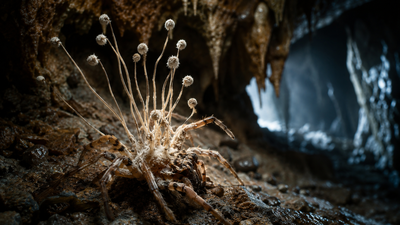
In 2025, scientists discovered a new “zombie” fungus in British caves; it appears to manipulate spiders before killing them |

A new species of fungus capable of manipulating spiders before killing them has been formally identified in caves and disused buildings across Northern Ireland, the Republic of Ireland and Wales, marking one of the first confirmed cases of such behavioural control found in a temperate climate. Named Gibellula attenboroughii in honour of the broadcaster Sir…
Read More

A California reservoir forecasting system could add enough usable water to save $100 million to $200 million a year without building a new reservoir, a study estimates

Representative Image (AI-generated) California’s water problem is often framed around the need for more storage, new infrastructure and expensive construction. But a new study suggests that part of the answer may already be sitting behind the state’s existing dams. By using better weather and water forecasts to decide when reservoirs should release or retain water,…

Read More

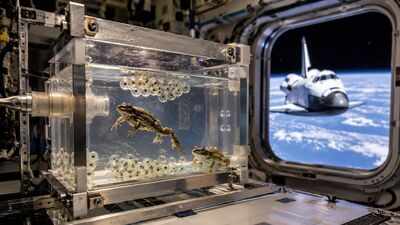
In 1992, Nasa put live frogs and their eggs aboard the Space Shuttle; the eggs were fertilised and developed in microgravity |

For a developing frog embryo, gravity is more than the force that keeps it on the ground. It can provide a reference for how the egg is oriented as development begins, helping establish the direction in which the embryo will form. Nasa wanted to find out what would happen if that reference disappeared. During a…

Read More

Bheem Habitat Mars: Living beyond Earth: Astronaut Shubhanshu Shukla unveils BHEEM concept for setting up habitat on Mars, Moon, other planets

The habitat concept emerged from research undertaken during the Indian leg of Shukla’s astronaut training in Bengaluru NEW DELHI: Indian astronaut and ISS-returned Group Captain Shubhanshu Shukla has shared details of his academic research project exploring how future Indian astronauts could live on Moon, Mars and other extraterrestrial destinations, proposing a concept called Bharatiya Habitable…

Read More

Meet Hu Jiahao, the 17-year-old Chinese student who spent 40 nights searching for a snake and helped identify a species new to science |

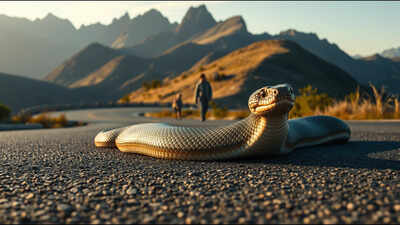
​Representative Image of an adult female snake with distinctive scales crossing a mountain road after being discovered by a persistent youth (AI-generated image) On October 18, 2024, Zhou Jiajun of the Zhejiang Forest Resources Monitoring Centre and local biology enthusiast Chen Haojun found the incomplete remains of an unusual snake while surveying the Kuocang Mountains…

Read More

Tomato plants grown in space switched thousands of genes; Nasa study reveals how light helps replace gravity as a growth signal |

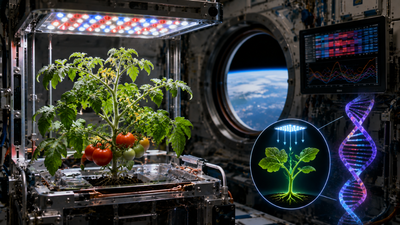
A tomato plant carries thousands of genes that stay largely quiet under normal growing conditions. Send that plant into orbit, however, and a striking number of them switch on or off within weeks. New research examining ‘Red Robin’ tomatoes grown aboard the International Space Station has found that once gravity is taken out of the…

Read More

Scientists found a fungus that turns ants into ‘zombies’, forcing them to bite leaves and die so the parasite can spread |

PC: Natural History Museum of Utah A fungus can turn an infected ant into what scientists describe as a real-life ‘zombie ’, taking over its behaviour in a way that helps the parasite reproduce. The phenomenon is linked to Ophiocordyceps unilateralis, a fungus that infects several ant species. After infection, the ant may continue behaving…

Read More

Scientists discovered Mars’ southern interior is 200-400°C hotter than its northern half; the planet may be partly molten beneath the surface |

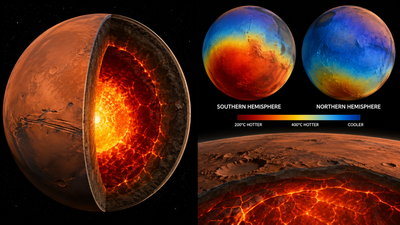
Scientists have found that Mars is not the geologically uniform ball of rock it might appear from orbit. New analysis of nearly two decades of spacecraft tracking data shows that the mantle beneath the planet’s southern highlands runs between 200°C and 400°C hotter than the mantle beneath its northern lowlands, a temperature gap wide enough…

Read More

Scientists released up to 45,000 cubic feet of water per second from Glen Canyon Dam for 8 days in 1996; the artificial flood rebuilt Grand Canyon sandbars

Glen Canyon Dam (Image Credit: Canva) For eight days in 1996, the Colorado River through the Grand Canyon experienced something unusual: a deliberately created flood. Scientists working with the U.S. Geological Survey (USGS) and other agencies used Glen Canyon Dam to release water at rates reaching 45,000 cubic feet per second, creating a massive controlled…

Read More

In 1894, two scientists independently used snake venom to create the world’s first antivenoms; one discovery changed treatment of deadly bites |

A snake bite in the late 19th century offered little certainty about what would happen next. There were attempts to counter venom with chemicals and other remedies, but no established treatment could directly neutralise the poison. Then, in France in 1894, two research teams arrived at a very different idea. Albert Calmette, working within the…

Read More