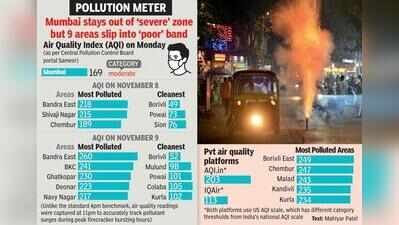
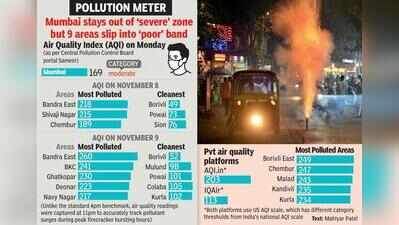
Mumbai: The city’s air was much cleaner overall on Monday after Diwali, with govt and private trackers showing low pollution numbers. However, firecrackers burst late in the night caused sharp spikes in a few areas.Overall, Mumbai logged an official average air quality index (AQI) of 172 for the 24-hour period beginning 4pm on Sunday—an 18.5% improvement compared to last year, when the AQI hit 211 the day after Diwali. While the citywide average stayed out of the severe zone, at least nine locations slipped into the ‘poor’ category, with AQI readings crossing 200. Bandra East was the most polluted area for the second day in a row, with a PM10 level of 194. Although still high, it was a big drop from Sunday, when readings crossed 400.As the night went on, pollution shot up suddenly in select spots. Deonar’s PM10 went from 93 in the evening to 426 at 11pm. Andheri East saw PM2.5 jump from 39 at 8pm to 145 by 11pm. On the other hand, areas like Ghatkopar, Colaba and Byculla saw no major jump at night, ending the festival on a cleaner note. While firecrackers can temporarily drive up local pollution by 50% to 60% for a few hours, experts noted that their overall contribution to the city’s yearly average is tiny—around 1%. “Firecrackers can temporarily dominate local pollution levels, sometimes contributing 50-60% or even more of the particulate pollution during peak hours in severely affected locations. Their impact can last 6-8 hours, depending on meteorological conditions. But, their contribution to annual average pollution is considerably smaller. The exact contribution varies by location, emission inventory and averaging period,” said independent meteorologist Abhijith Modak. Weighing in on how citizens should read extremely high local pollution numbers, Gufran Beig, chair professor at Indian Institute of Advanced Studies, said: “Cracker-induced pollution numbers are bad for 1-2 hours only, giving figures like 600 momentarily. While publishing AQI numbers, rolling 24-hour averages should be captured instead of hourly readings. The 24-hour average helps in understanding if the high numbers are a perennial high or just momentary.” He said hourly readings “don’t really mean much and they only lead to momentary outrage for 2-3 days and a complete lack of interest thereafter throughout the year”.Beig asked that a regulatory body look into the numbers being put out by private portals. “On the other hand, govt AQI data needs to be more citizen and layman friendly so that common people understand what it represents.”