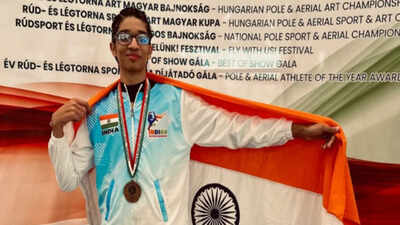
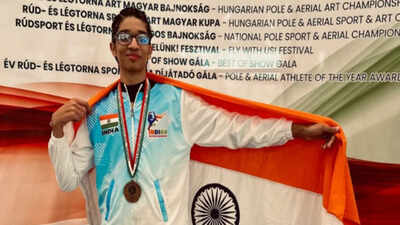
MUMBAI: Last December, in the town of Budaors, Hungary, 16 year old Vir Gahrotra from Worli, climbed a length of suspended fabric and changed the trajectory of a sport few in India recognised.Competing at the Pole and Aerial Sports World Championship, Gahrotra secured a gold medal in the Junior B Amateur Men (age 15–17) category, the country’s first ever podium finish at the event.Back home in Mumbai, the ripples were immediate. At Rajmudra Loke Aerial Art India — where Gahrotra trained for eight years — a 12 year old boy recently walked in with his parents to sign up.His reason was, “If Vir can do it, I can too.” For a discipline often misidentified as a circus act or a niche fitness trend, the gold medal was a loud, necessary declaration of legitimacy.Gahrotra’s journey began when his mother, intrigued by a festival performance, signed him up. At eight, he watched performers drop 20 ft through the air, supported only by the friction of cloth. “I was mesmerised by the mix of pure power and storytelling,” he says.Guided by long time instructor Rajmudra Loke, Gahrotra soon began a rigorous training regimen that mirrored Mallakhamb, a traditional Indian sport of rope and pole acrobatics, complicated further by an international ‘code of points’.To clinch the top spot, Gahrotra mastered the “crocodile pose” in which a horizontal plank is supported entirely on a single elbow while balancing 14 feet above the ground.“The first time I attempted it, I fell 5 ft,” he says. “I still have bruises where the elbow pressed into my body to maintain that balance. It was the most difficult pose I’ve ever attempted.”Despite such displays of raw power, aerial silk remains haunted by a persistent gender stereotype.In India, as in much of the world, participation is skewed heavily towards girls. Loke notes that cultural perceptions often serve as a barrier for male athletes.“Strength, flexibility and artistic expression are often wrongly labelled as feminine,” she says. “That mindset discourages boys from seeing this as a sport, even though it requires immense upper body power and endurance.”Gahrotra’s winning routine, themed ‘energy’, pointedly challenged these conventions. He traded flowing grace for sharp, explosive movements and controlled power. “I played to my strengths,” he explains.Yet, beyond the gender divide lies a steeper institutional climb. While the sport is recognised by the Indian Pole Sports Association, it lacks the formal backing of mainstream bodies like the Indian Olympic Association.This lack of a national framework manifests most clearly in the infrastructure. While European competitors train in facilities with 30 ft ceilings, finding a studio in India with even 18 ft of clearance is a rarity.Cost remains another hurdle; coaching, specialised rigging, and international travel are largely self funded, limiting the sport to those with private means. “Indian athletes struggle to adapt to international standards simply because we lack exposure to that scale of infrastructure,” observes Loke.Gahrotra’s gold has not cleared these hurdles overnight, but it started a vital conversation. His journey proves that with sustained training and unconventional approach, Indian athletes can rise to global stages.As the sport gradually finds its footing, Vir’s journey reflects both the challenges ahead and the hope for change.