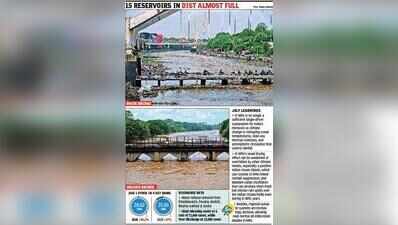
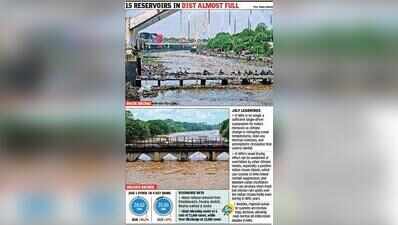
Pune: Residents in Pune and Pimpri Chinchwad’s flood-prone low-lying areas heaved a sigh of relief on Saturday after the state irrigation department sharply reduced water release from major reservoirs, including the Khadakwasla, Pavana and Mulshi, to below 10,000 cusec.Just a day earlier, Khadakwasla dam was releasing water at a peak rate of 43,571 cusec, while discharge from Pavana and Mulshi dams was increased to 15,000 cusec and 10,000 cusec, respectively. The high rate of discharge had prompted the evacuation of residents from Ektanagari on Sinhgad Road, while flooding was reported in the Pulachi Wadi and Warje areas.Irrigation department officials confirmed that the situation improved considerably on Saturday. “Water discharge into the Mutha river from the Khadakwasla dam was brought down to 1,000 cusec, while release from Pavana dam was stopped completely late in the evening. Outflows from Mulshi were also reduced to 6,000 cusec,” an official said.Pune Municipal Corporation, however, maintained a high level of preparedness. Disaster management teams remained deployed at flood-prone areas across the city as a precautionary measure. Civic officials said alternative arrangements for affected residents were kept ready at 49 locations.“We are in constantly in touch with the irrigation department regarding water release. No major alert was received on Saturday regarding discharge from upstream dams. The situation remains under control across the city,” a PMC official said.The irrigation department officials cautioned that the respite could be temporary and water releases might be increased again if rainfall intensified in the catchment areas. “There is a possibility of sporadic rain spells over the next few days. We are continuously monitoring dam water levels,” another irrigation official said.Meanwhile, the Bhima river basin remains virtually saturated after heavy monsoon rains through July. Of the basin’s 25 major dams, 20 were reported to be at or near full capacity on Saturday. “Almost all dams in the Bhima basin registered a significant rise in storage levels in July. Except for five dams, most reservoirs released water after reaching 100% storage. We expect steady rainfall during Aug and Sept, the remaining months of the monsoon season,” the official said.