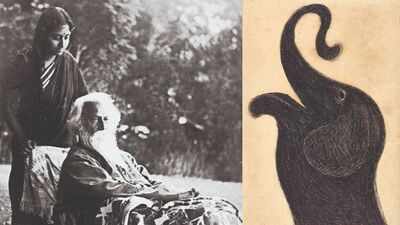
I was very happy to receive your gift of oranges. Orange juice is now my principal drink.” (Translated from Bengali.)It is Dec 13, 1940, and Rabindranath Tagore is writing from Santiniketan to his younger friend, Bengali writer Maitreyi Devi, who is in Mungpoo, a quiet hill settlement near Darjeeling. The 79-year-old poet is recovering from illness, “still surrounded by nursing care. I have not yet been able to use all my limbs independently. So I remain confined in the distant land of illness,” he writes. There’s been a visitor, too. “The Chinese ambassador… His warm, smiling face seemed to reflect the graciousness of ancient China. There is much we can learn from him.” Outside, the sky is overcast, with a little rain falling. “My mind is waiting for sunlight and a cloudless sky,” he writes, before inquiring after her ailing mother-in-law and admitting, “Writing has not yet become easy for me.”It is an unexpectedly domestic glimpse of the Nobel laureate, far removed from familiar portraits of the bearded sage. And the letter is among 150 pieces of correspondence, alongside manuscripts, paintings, first editions, photographs and personal effects preserved by Maitreyi Devi’s family for three generations. Much of it is being shown publicly for the first time at Christie’s private selling exhibition, ‘Rabindranath Tagore and Mungpoo: The Collection and Archive of Maitreyi Devi’, in Mumbai from Nov 10 to Dec 18.“I’d call it a once-in-a-lifetime exhibition of Rabindranath Tagore in India,” says Nishad Avari, head of Christie’s South Asian Modern and Contemporary Art department.Maitreyi’s father, philosopher Surendranath Dasgupta, had introduced her to Tagore, who wrote the preface to her first poetry collection when she was 16. “I think the frequency of the letters and everyday exchanges speak to that bond,” says Avari. “In some of them he calls himself ‘Rabindra Kaka’ and addresses her as ‘Kalyaniyeshu’. It’s a close, almost fatherly bond where he saw himself as this mentor figure, and she saw herself as a protege.“That friendship deepened during Tagore’s four visits to Mungpoo between 1938 and 1940. Away from the public gaze, he stayed with Maitreyi and her husband, Manmohan Sen, finding it conducive to writing and painting. “He wrote ‘Janmadin’ there on his 79th birthday in 1940, a year before his death. So attached was he to the place that he designed a chair, desk and bed to sit up and work,” says Avari. His son Rathindranath got the furniture made and installed in the bungalow, now the Rabindra Bhavan museum.Among the more than 25 artworks on display is ‘Asana’, which captures this practical imagination. “It’s almost like his doodles developing into a full-fledged design for the chair he made for himself,” says Avari. There is also an unusually identifiable portrait of Maitreyi Devi, while the drawing ‘Mungpoo Pahare’ reflects his engagement with the surrounding hills, as does a handwritten English poem dated June 28, 1940, on the letterhead of Uttarayan, Tagore’s residence in Santiniketan. It speaks of mist lifting over the mountains and the morning sun, before invoking a voice to “sweep away the silence of ages”.Tagore drew on whatever was at hand, from notebook pages to book covers. “He didn’t have a studio practice. He would paint as and when he could, and ink on paper was his forte,” says Avari.The collection also includes 36 first editions of Tagore’s books, among them ‘Tasher Desh’, ‘Khapchhara’ and ‘Chirakumar Sabha’, several bearing handwritten messages or signatures. Among the more unusual objects is a copy of ‘Rabindra Rachanabali’ that lost its cover to Tagore’s artistic impulses after Tagore painted on it.His manuscripts bear similar traces of his hand. A manuscript of ‘Chelebela’, dictated to Maitreyi, was later corrected and embellished with doodles by Tagore himself.The poet was also remarkably particular about printing. On a manuscript’s first page, he specifies “12-point type, a 26-em measure” in handwritten instructions. “A border may be given, but in that case it should be in a 24-em measure. It would be better to have a single line on all four sides, without a decorative border.”The archive also records the poet’s declining health in his final months. Among the exhibits are telegrams sent to Maitreyi and her family about his declining health, one describing his “serious condition”, another announcing his death on Aug 7, 1941: “Gurudev expired after twelve.”“The collection survived mainly because Maitreyi and her descendants understood its significance,” says Avari. The artworks were preserved in trunks at the family’s Kolkata home, while Maitreyi meticulously catalogued and dated the letters. Over the past year, Christie’s has framed the artworks and placed the letters in archival sleeves.The exhibition is also a private sale, with artworks offered individually and the manuscripts and remaining archive grouped into lots. “The sum of the whole is more than its parts in a way,” says Avari.Private collectors and institutions have already shown interest. “As time progresses, care becomes more difficult,” says Avari. The family hopes the material will find long-term custodians while drawing renewed attention to Maitreyi Devi’s own literary legacy, particularly as a writer and chronicler of Tagore’s later life.