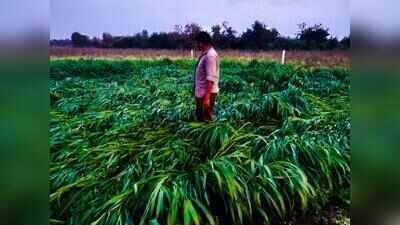
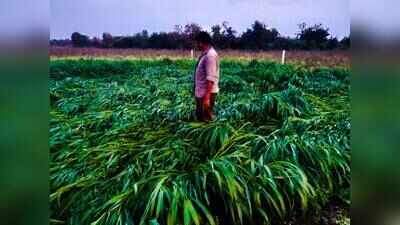
Pune: Maharashtra’s worsening drought is threatening to severely disrupt rabi jowar cultivation, with Solapur, the state’s largest jowar-growing district, staring at a steep decline in sowing due to depleted soil moisture.Jowar is a critical crop for the state, central to the daily diet across large parts, particularly in the drought-prone districts of western Maharashtra and Marathwada. In fact, bhakri made from jowar is a daily staple in lakhs of households, commonly consumed with pitla, thecha and vegetables. Nationally, the state’s jowar output in 2023-24 was 17.8 lakh tonnes, nearly 37% of India’s total production of 47.4 lakh tonnes.But this year, agriculture officials fear Solapur district may record less than 50,000 hectares of jowar sowing this year compared to its average area of 2.75 lakh hectares, which is the highest acreage in a single state district.The crisis extends beyond Solapur: several other districts, including Ahilyanagar and Dharashiv, are facing uncertainty over sowing. Overall, officials in the state agriculture department estimate Maharashtra’s jowar area could shrink by 40-50% or more from its average of 13.25 lakh hectares if the dry conditions persist. “There is no soil moisture in several jowar-growing tehsils. We cannot even recommend sowing this season,” Solapur district agriculture officer S Bhosale told TOI.The department is now urging farmers who still have water in their wells and borewells to cultivate jowar in any sustainable area. But response to the appeal has been poor, officials said, as farmers remain increasingly reluctant to take risks due to poor soil moisture.For Solapur, the threat is particularly serious because jowar is not merely another rabi crop. The district is widely known as Maharashtra’s jowar granary, with Magalveda town famous for its ‘Maldandi’ jowar, a GI-tagged variety valued for flavour and its use in making bhakri. The variant takes roughly four-and-a-half months to mature, but its famous taste has helped sustain a certain reputation among consumers, making the prospect of a poor crop particularly worrying for growers in Magalveda.“Solapur’s situation is extremely grim,” said another senior agriculture department official from the district. “We don’t foresee a positive picture this season. Area under jowar will decline sharply and disturb the local economy in Magalveda,” the official said.Farmers TOI spoke to said jowar, to them, is much more than just a crop. “It’s part of our tradition,” said Vaibhav Godale, a farmer from Magalveda tehsil. “We cannot imagine not having jowar in our fields. It’s an unprecedented situation. I will still try sowing some in a few gunthas, symbolically,” he said.The Maldandi variant of jowar takes roughly four-and-a-half months to mature. Its taste has helped sustain a certain reputation among consumers, making the prospect of a poor crop particularly worrying for growers in Magalveda.For generations, Jowar has been sown in Maharashtra’s rain-shadow regions where it grows with relatively little irrigation. It’s this ability to survive in dry conditions that has made it an important source of food and income in the state’s drought-prone districts.But drought tolerance does not eliminate the need for moisture during early growth. “If soil is too dry, seeds may fail to germinate uniformly and lead to low yields. Sowing without adequate moisture can also mean additional expenditure on seed and field preparation without any assurance of a harvest,” an agri scientist from the region told TOI.The crisis has also sparked concerns at markets. Jowar prices have risen in some markets, with traders reporting rates touching Rs 10,000 per quintal for certain varieties. “Prices could rise further if there’s a supply shortfall. It may then become difficult for ordinary consumers to afford what is essentially a staple,” a trader from Pune said, adding thatMaharashtra is among India’s leading jowar-producing states, alongside Karnataka and other states in the semi-arid Deccan region. “A steep contraction in Maharashtra’s sowing could therefore affect supply to households and wholesale markets. Impact would be felt particularly in regions where the grain is a staple and where local varieties command a premium,” said another senior official from the agriculture department.