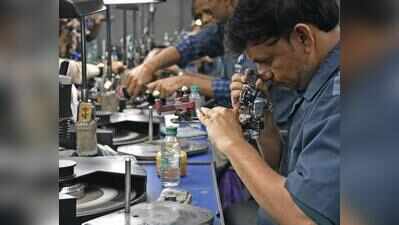
Surat: For the past three years, the diamond cutting and polishing industry has been enduring a prolonged slowdown, forcing units to observe extended Diwali vacations. This year, however, improving demand in global markets is expected to keep the shutdowns relatively short.Export orders and domestic demand are providing support to the industry, which employs a large workforce from Saurashtra. With business better than during the previous two Diwalis, most units have announced reopening dates within 20 days. In the past two years, units had refrained from announcing reopening dates at the start of the vacation, with several extending the shutdown beyond 30 days.Lab-grown diamond (LGD) units are expected to resume operations within 15 days, while natural diamond units are likely to reopen in 20 to 30 days.“Demand for LGDs has remained strong over the past few years, supporting both units and polishers. This year too, most LGD units will reopen within 15 days,” said Babu Vaghani, president, Surat LGD Association.However, the availability of workers could determine how quickly units resume operations. Diamond artisans travel to their native places during Diwali and often schedule family functions around the festival, making their return difficult even if units have orders to fulfil.“Even units willing to resume production earlier may struggle to find workers. If artisans agree to return, some units could operate with shorter vacations. The industry’s average Diwali break is around 15 to 20 days,” said Jagdish Khunt, president, Surat Diamond Association (SDA).Bhavesh Tank, vice-president, Diamond Worker Union Gujarat (DWUG), said units had announced vacation-end dates this year in view of orders. “During the previous two Diwalis, vacations were extended beyond 30 days,” he said.Textile weaving opts for vacation amid market uncertaintyThe textile sector had emerged as an alternative source of employment and investment for diamond industry workers and unit owners during the diamond trade slowdown. However, global factors have now put the weaving industry under pressure, with unstable yarn prices and weak market conditions prompting units to consider vacations and curtail production.In recent months, high yarn prices had forced weaving units to reduce operating hours, keep machinery idle for two days a week and cut yarn purchases. These measures helped moderate yarn prices. Now, with crude prices declining and yarn expected to become cheaper, weavers are reluctant to manufacture fabric using costlier yarn that could leave them at a disadvantage when prices fall.“Demand is weak and fluctuating yarn prices have forced the weaving sector to curtail production and consider vacations. Most weavers have substantial stocks, and a shutdown will help them clear inventories,” said Vijay Mangukiya, president, Surat Weavers Association.Weavers are also being advised to exercise caution in yarn procurement amid expectations of a price correction. The Rapier Jacquard Weavers Association of Surat (RJWAS) has urged members to restrict purchases at prevailing rates as crude prices decline.“By reducing yarn purchases, we are advising weavers to cut production and take a short vacation. Yarn prices are expected to fall with crude prices. Those manufacturing fabric using yarn bought at current rates could struggle to sell it competitively once prices decline,” said Chetan Maniya, president, RJWAS.