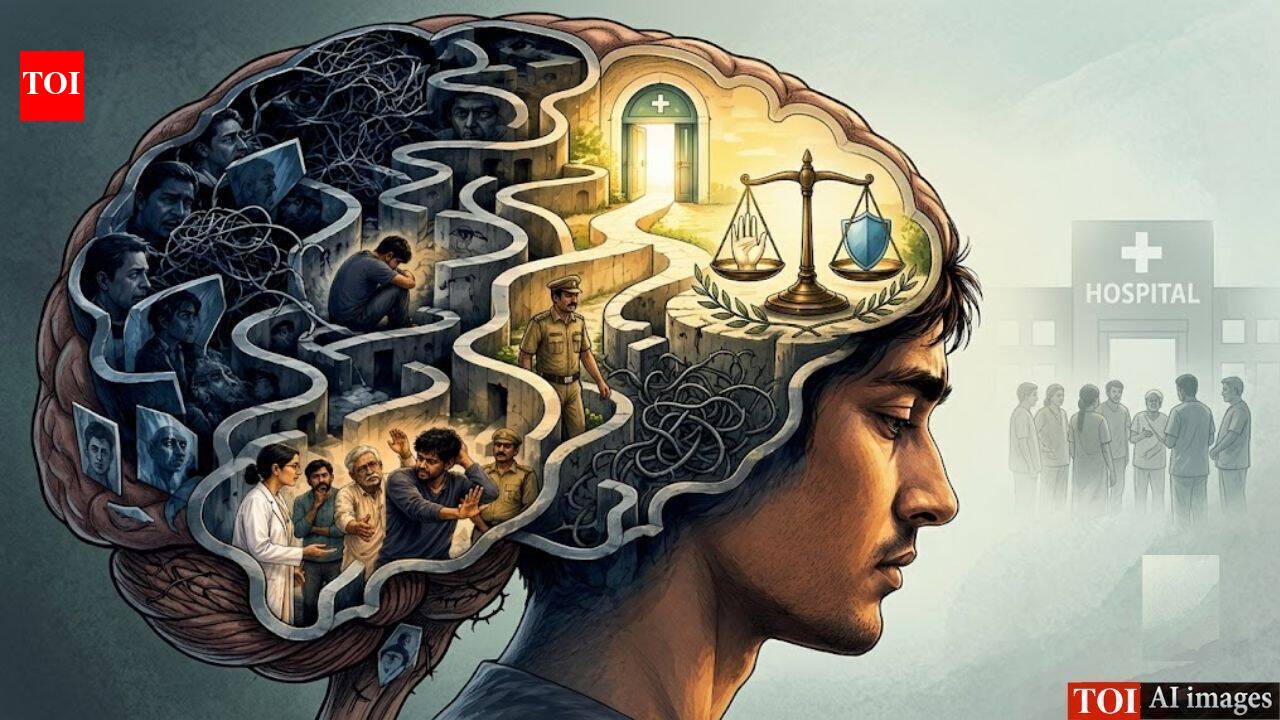
A 60-year-old man and his friend were recently arrested for allegedly killing his schizophrenic son (38) ‘as he had become aggressive and unmanageable’. The incident has thrown up a larger question: When a person with severe mental illness becomes violent or refuses treatment, what options does the family have? Caught between an urgent need for medical help and legal safeguards meant to protect the patient, here’s what they can do — and where the system falls short.
Get help, don’t use force
If a person is acutely disturbed and unsafe to transport, families can seek police assistance rather than trying to physically move them, says former AIIMS professor and ex-director Institute of Human Behaviour and Allied Sciences (IHBAS), Dr Nimesh Desai.They can also approach the nearest hospital emergency department, a psychiatric inpatient facility, Tele-MANAS — govt’s 24×7 mental-health helpline — or Delhi’s Mobile Mental Health Units, adds Dr Paramjeet Singh, consultant psychiatrist at PSRI Hospital.
What the law allows
Under the Mental Healthcare Act, 2017, an unwilling adult can be admitted in specified circumstances, but it is not simply the family’s decision. Supported admission requires clinical assessment and safeguards, including conditions involving risk of harm.The Act also permits emergency treatment where there is a serious and immediate risk.
Role of police
Police are required to take under protection a person they believe has a mental illness and poses a risk to themselves or others, and take them to a public health establishment for assessment within 24 hours.
The consent dilemma
In severe illnesses such as psychosis, a patient may genuinely believe nothing is wrong and refuse treatment. Families and doctors may see an emergency, but intervention must balance the need for care with the patient’s rights.Experts caution that making involuntary admission too easy also carries risks: allegations of mental illness can be misused in marital, dowry or property disputes.
Delhi has emergency care, but capacity is tight
Major Delhi hospitals have 24×7 emergency services, including psychiatric care.IHBAS runs a dedicated round-the-clock psychiatric emergency, has a 10-bed short-observation facility and more than 200 psychiatric beds. Doctors, however, say govt psychiatric emergencies are overstretched.Quality inpatient options in Delhi-NCR are also limited and can be prohibitively expensive, says Neha Kirpal, co-founder of Indian Mental Health Alliance (IMHA) and mental health organisation Amaha.
When families can’t cope
Long-term severe mental illness can take a heavy financial, social and emotional toll on families.Ageing parents may face an even greater burden because of their own health problems, limited resources and the difficulty of transporting or caring for an adult child, points out Prof Sanjeev Bagai, a paediatricic nephrologist who runs his own mental wellness clinic, adding that this can can lead to caregiver burnout, abandonment and homelessness.
The treatment gap
The National Mental Health Survey estimated that nearly 15% of adults required active intervention for one or more mental-health conditions.Depending on the disorder, the treatment gap ranged from 70% to 92%. NCRB recorded 1,70,746 suicides in India in 2024, including 2,905 in Delhi.
What’s missing
Experts say Delhi needs a smoother crisis-response mechanism connecting families, police, psychiatrists and the law — one that allows quick intervention in genuine emergencies without opening the door to wrongful detention or treatment.
And a crucial distinction
Mental illness should not be equated with violence. People with mental illness can themselves face neglect, abandonment, stigma and inappropriate care.