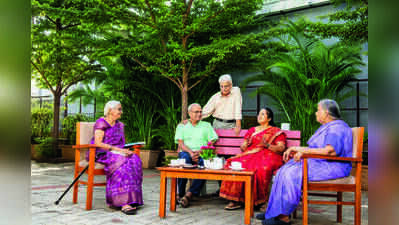
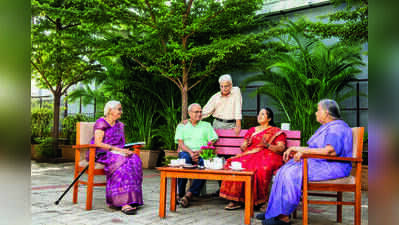
Meet Anuradha Jagannathan, 79, who has made Athulya Senior Care’s facility in Maduravoyal, Chennai, her home since 2023, after her husband’s death. Her three sons live in the US, but she never wanted to move in with them. What she values most is the reassurance of having care close at hand. “If I were in my own home and suddenly fell seriously ill, an ambulance might come, but the doctor would not reach me as quickly as one does here,” says the Chennai-born woman, who speaks seven languages.She is among more than 170 residents at the Maduravoyal facility, which offers assisted living, memory care and transition care. All are above 75, including a 100-year-old resident. About 240 doctors, nurses, caregivers and support staff look after them. For the residents, senior living is no longer synonymous with an old-age home. It offers medical supervision, companionship, security and independence. That shift is creating a new healthcare and services industry around India’s ageing population. According to RBI data, Kerala, Tamil Nadu, Himachal Pradesh, Andhra Pradesh and Punjab have the highest shares of people aged 60 and above. Tamil Nadu’s fertility rate has fallen to about 1.3, well below the replacement level of 2.1. The share of people aged 60 and above is expected to nearly double, from 10.6% in 2011 to 20.8% by 2036.“This means we will have fewer young people to care for the elderly,” says TN government family welfare director Dr K Thilagam. The demographic shift is raising concerns among public health officials. “We must see what we can do to ensure the population does not drastically drop. At the same time, we must ensure the elderly get access to affordable healthcare and living,” says TN health minister K G Arunraj.By 2036, the specialised senior-care market could reach about $35 billion a year. Southern states currently lead, driven by a larger elderly population and higher per-capita incomes, according to Care Edge Ratings. The traditional model of children caring for ageing parents at home is weakening as families shrink, people migrate and life expectancy rises. The question is who will provide care when families are no longer physically available.R Karthik Narayan, founder and MD of Athulya Assisted Living, encountered this gap when his family searched for assisted living for his aunt. “What we found were old-age homes,” he says. “There was a stigma attached to them, and most were not professionally run.” After studying senior-care models in the US, Britain and Singapore, Narayan left his job in California and returned to Chennai. He launched Athulya in 2016 from a three-room apartment in Mylapore. The company has since grown into a roughly 1,500-bed platform, including a geriatric hospital. Around 80% of Athulya’s early residents were parents or grandparents of NRIs who wanted professional care for relatives. The customer base has since broadened. The pandemic accelerated acceptance of organised senior living as families became more conscious of the risks of leaving elderly relatives alone.“Senior citizens are increasingly opting to move into assisted living — with or without an underlying medical condition — because they want to be around peers and feel a sense of belonging,” Narayan says. Yet many enter the system only after a crisis such as a fall, surgery or serious illness. Often, the immediate need is supervised recovery rather than permanent assisted living. That is where healthcare and senior living are beginning to overlap.Dr N Lakshmipathy Ramesh, founder and MD of Geri Care Health Services, which is pioneering an integrated healthcare model for the elderly, believes India cannot address ageing through hospitals alone. It needs a continuum stretching from preventive geriatrics and home care to hospitals, rehabilitation, skilled nursing, assisted living, dementia care and end-of-life support.“In a country such as India, we need 100 Gericare-type models,” he says. Ramesh’s approach was shaped partly by his father’s cancer treatment nearly two decades ago. While the hospital treated the disease, the family struggled after discharge. “I had studied medicine and was doing everything I could, but I did not know what to do. That was the main issue,” he recalls. His experience convinced him that conventional hospitals are poorly suited to elderly patients with multiple chronic conditions. “For elderly people, recovery takes longer. Multiple systems are involved, and other issues can develop,” he says. Prolonged hospitalisation also means higher costs, infection risks and stress for attendants.Geri Care has therefore built a network spanning community clinics, home care, hospitals, skilled nursing and assisted living. A patient can move from a hospital to transitional care, then skilled nursing or assisted living, and home care. “We create an ecosystem around them,” Ramesh says.Senior care, however, does not have the economics of conventional tertiary healthcare. A hospital bed can generate `35,000-40,000 a day, Ramesh says, compared with roughly `5,000-6,000 for assisted living. The value lies in moving patients to the appropriate level of care rather than keeping them in expensive acute-care beds.For operators, this can create a recurring relationship with patients through hospitals, rehabilitation, pharmacy, diagnostics, home care and assisted living. But building such an ecosystem requires capital — and patience, he adds. India’s insurance system remains underdeveloped in supporting long-term care, rehabilitation and assisted living. About 70% of elderly people depend on families for day-to-day care, while a large majority of workers have no meaningful pension protection. Coverage is improving after the Centre expanded Ayushman Bharat to people aged 70 and above, but long-term assisted living and post-acute care remain poorly covered.