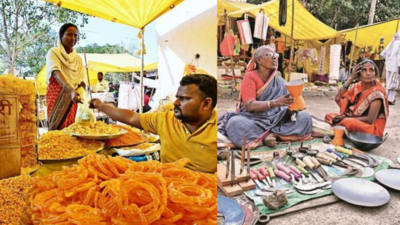
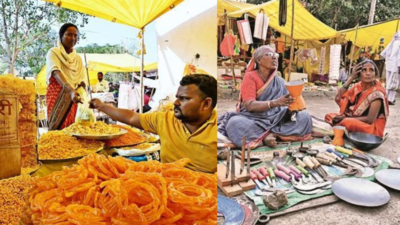
DHARASHIV: At the Kasbe Todwale market, eager vendors lay out Diwali treats: baskets of spicy chivda, grated coconut laddoos and the glazed rows of balushahi mithai. There are stalls of sequinned frocks and saris, mounds of luminous glass bangles, brass cattle bells and even farm tools and seeds.But the market is still, like a film set waiting for actors to enter. Even though the festive season is approaching, only a handful of customers loiter at this weekly bazaar in Dharashiv, which caters to as many as 10 villages.Pooja Pawar, a farm labourer, has not found work for over two weeks. She carries a limp plastic bag with a scattering of vegetables: some kothimbir stalks, a handful of potatoes, chillies and a few pieces of brinjal.“I had only Rs 100. So, I bought vegetables. This will have to last us a week,” she says. Her two sons could get a karanji and a laddoo each for Diwali if the family’s money stretches for another week.Dharashiv falls in arid Marathwada, among the worst-hit regions in one of the most widespread droughts the state has ever seen. With the El Nino factor resulting in a rain shortfall, the drought covers 85% of the state (304 of 358 talukas). In Dharashiv, which had a 41% rain deficit, the drought has ravaged cotton and soyabean crops, the mainstay of the local economy.Till a few months ago, the market was so packed that there was barely space to move. But its customers are mainly farmers and farm labourers. With their crops destroyed and no income, their purchasing power has plummeted.Muzaffar Alam Todwada, who sells Diwali sweets and savouries, has earned only Rs 1,500, although the market day is almost over. He used to make around Rs 10,000 daily in the run-up to the festival. “Customers have halved. Those who spent Rs 150 earlier are now spending Rs 40. They are avoiding sweets, which are more expensive than faral,” he says. Others like Sanjay Patil Dudhgaonkar from Shetkari Sangharsh Samiti estimate that the footfall is down by 60%.Farmer Ganesh Gadkari lost his entire soyabean crop this year and faces a loss of Rs 3 lakh. He says there is “no Diwali mahaul (atmosphere)” this year. “No one is thinking of Diwali. Even the children are not demanding clothes, sweets or firecrackers because no one has them,” he says.What do the people here think of the state’s announcement of pre-Diwali relief of Rs 5,000 each for drought-affected farmers? “Given how much we have lost, it is almost a joke. But things are so bad that anything will help,” says Gadkari.For Rishikesh Thombre, who has a stall selling saris, the poor Dussehra sales were an indicator of the flattened demand for Diwali. “People are only replacing clothes which are torn or the children have outgrown. I used to sell goods worth Rs 25,000 per day during this season. Today, I do not have a single customer,” he says. His goods worth Rs 1 lakh will remain unsold till the wedding season next May.The only place that’s doing brisk business is the machine repair shop owned by Dhairyasinh Nimbalkar. “Farmers cannot afford to buy new equipment. I am mainly repairing pumps for wells and fields,” he says. He used to earn around Rs 1,000 per day; it’s now down to Rs 500. “At least I have customers,” he says. But this is just the beginning of the drought and its economic shock is set to intensify in the long dry months till the next monsoon.