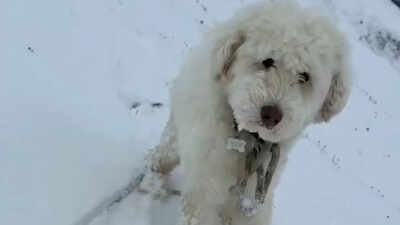
A dog that went missing after an avalanche in Alaska has been found alive after spending nearly 50 hours alone in the freezing wilderness. The four-year-old poodle-husky mix, LouLou, was eventually rescued with help from an Apple AirTag and a group of volunteers who refused to give up looking for her.LouLou was on a mountain trip with two experienced climbers in Chugach State Park on October 10 when an avalanche swept both men roughly 500 feet down a ridge, Scripps News reported. The two climbers survived but suffered serious injuries and were taken to hospital. LouLou, however, vanished in the chaos.
A desperate search from thousands of miles away
Lauren Padawer, whose boyfriend Brian was one of the injured climbers, was overseas celebrating her father’s 80th birthday when she heard about the accident.Brian had suffered a broken jaw and a serious hand injury. His climbing partner had three broken ribs and a fractured vertebra. With both men receiving medical care, finding LouLou became another urgent concern.Padawer couldn’t return to Alaska to join the search, so she began reaching out to local rescue organisations, hiking groups and anyone who might be able to help. More than 20 volunteers eventually took part in the effort, including a dog trained to track scents.Speaking to People, Padawer explained why she kept pushing for help: “I just wanted to exhaust every resource I had and only give up [knowing] I did everything I could do.”LouLou was wearing an Apple AirTag, which gave rescuers a possible starting point. But there was a problem. Its initial estimated location was nearly half a mile away from where she actually was.In the mountains, that kind of error can make a huge difference. Steep ridges, deep valleys and changing weather can turn a relatively short distance into a difficult search across entirely different sections of terrain.Padawer later described the challenge in a Facebook post, explaining that half a mile in the Chugach Mountains could mean searching the wrong ridge, drainage or mountainside, especially when storms were moving through the area.
How an AirTag helped bring LouLou home
The search took a turn when pilots Amanda Barker and Dave Beckett picked up another AirTag signal during an aerial search.Padawer was still coordinating efforts from overseas. She studied satellite images and compared them with maps to help narrow down the area where LouLou might be stranded.After around 50 hours alone in the wilderness, LouLou was finally spotted alive on a mountainside. Barker and Beckett brought her to safety, ending a search that had left her owner fearing the worst.When Padawer received a photograph of the rescued dog, she could hardly believe it.“I was shocked!” she told People. “I couldn’t believe what I was seeing. It was too good to be true. I cried.”LouLou had apparently suffered a broken toe and a broken canine tooth, but she was otherwise recovering well. After the ordeal, she was back home enjoying the comforts she had missed for two days.“She’s amazing,” Padawer said. “She’s enjoying the couch and naps. Otherwise back to normal.”
A tough little dog with a lot of luck
Padawer believes LouLou’s thick coat, her habit of sleeping outdoors and her familiarity with mountain trails may have helped her survive the harsh conditions.Still, the rescue depended on more than the dog’s ability to withstand the cold. Volunteers kept searching despite the difficult terrain and uncertain location data, while the aerial team continued looking for clues that could lead them to her.Padawer was especially grateful to Barker and Beckett, whom she called “the heroes of LouLou’s rescue.”LouLou’s story is a remarkable example of how a small tracking device can help in an emergency. An AirTag isn’t a dedicated wilderness rescue beacon, and its location estimates can be limited in remote areas. But in this case, the signal gave rescuers a vital lead – and, combined with the persistence of everyone involved, helped bring a missing dog home.