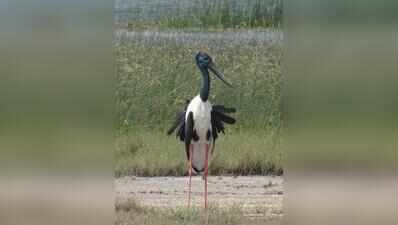
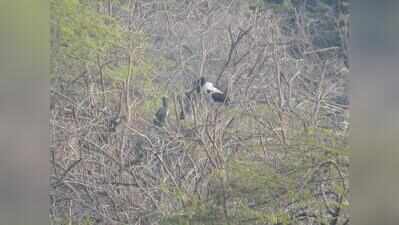
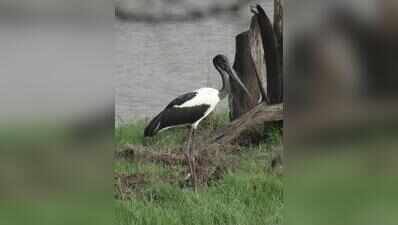
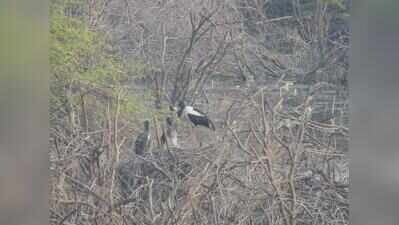
Ahmedabad: The Khijadiya Bird Sanctuary in Jamnagar has emerged as a significant breeding stronghold for the black-necked stork (Ephippiorhynchus asiaticus) in Gujarat, with a new scientific study recording four active nests and 100% fledging success.The study, conducted by researchers from Gujarat Ecological Education and Research (GEER) Foundation between July 2024 and March 2025, found that each of the four breeding pairs successfully raised two fledglings, resulting in eight juveniles. Along with five regularly observed non-breeding adults, the sanctuary recorded a peak seasonal population of 21 black-necked storks.Published in the peer-reviewed Journal of Threatened Taxa, the research assessed the species’ population status, breeding ecology, nesting sites and reproductive performance. Researchers conducted surveys at 48 georeferenced sampling points across eight management zones, generating more than 320 hours of observations.“All four active nests successfully produced two fledglings each, resulting in a total of eight juveniles,” said B P Pati, director, GEER Foundation.The study found that all four nests were built on Neltuma juliflora, commonly known as gando baval, at heights of 3m to 4.5m. This highlights the species’ adaptability to structurally suitable nesting trees where native trees are limited, the study says.The nesting sites were located near shallow wetlands with water depths of 0.3m to 0.7m, surrounded by open water, emergent vegetation and elevated ground. These habitats provide prey such as fish, amphibians, crustaceans and aquatic invertebrates.Researchers also documented strong parental care. During 89 nest-monitoring visits, adults attended nests for an average of 62 minutes per visit. In 94% of the observed foraging departures, one parent replaced the other at the nest.No nest abandonment, predation or chick mortality was recorded, resulting in a 100% fledging success rate. The findings reinforce Khijadiya’s importance as a Ramsar Site along the Central Asian Flyway and underline the need to protect its shallow wetlands, nesting trees and low-disturbance breeding habitats, experts said.