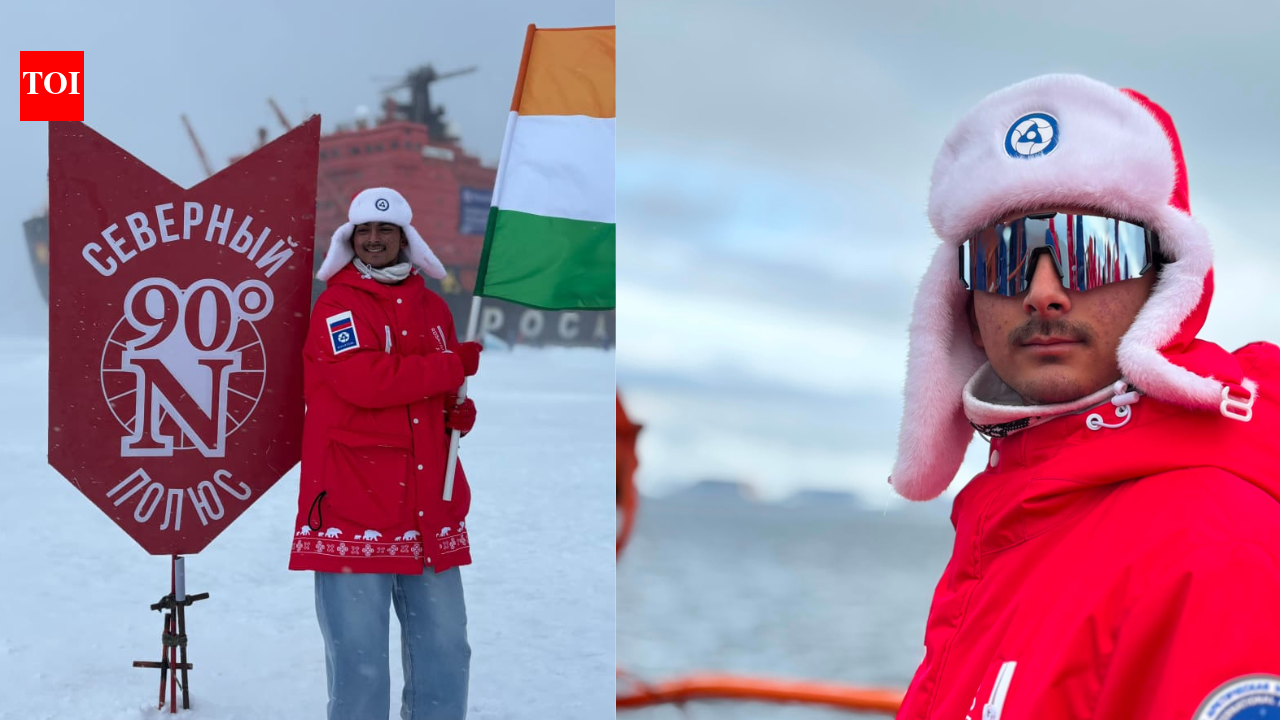
NEW DELHI: When Lucky Rawat looks out from his Moscow hotel window, the Arctic already feels almost like a dream. Outside are trees, an open stretch of road, a parking lot lined with cars, something the 15-year-old Class 10 student from Chakrata, Uttarakhand, loves. After days aboard a nuclear-powered icebreaker in the Arctic Ocean, Lucky is set to fly back to India on Aug 15.Just days ago, he stood at 90° North, the geographic North Pole, as India’s sole youth representative among students from 22 countries on Russia’s ‘Icebreaker of Knowledge’ expedition. It began with a three-stage competition—natural-sciences quiz and project defences—from which Lucky emerged as India’s sole student among nearly 5,000 applicants.He reached it aboard the 50 Let Pobedy (50 Years of Victory), the world’s largest, most powerful nuclear-powered icebreaker ship, with the group departing from Murmansk on Aug 4.“Before going to the North Pole, I watched many videos,” Lucky says. “But it was beyond anything I had seen. There was no dawn or darkness. It was always bright and shiny.”The Arctic was a vast, continuous sheet of white, with snow dust sometimes making someone standing 100 metres away appear blurry. Unlike the South Pole, which sits on land, the geographic North Pole lies atop constantly shifting sea ice in the Arctic Ocean.Organised by Russia’s state nuclear energy corporation Rosatom, the expedition was a floating university, with workshops, polar-scientist lectures and hands-on experiments.Growing up in the hills, Lucky climbed mountains almost as naturally as other children played; family treks became sibling races over “who climbs first”. His hometown also meant he was among the 2-3 students who had seen snow before the expedition.“Students came from places such as Egypt, Tanzania and South Africa,” he said. Showing village photographs to students from across the world, he felt proud explaining that India has mountains, deserts, forests, seas, rivers and snow—and that he came from the Himalayas.Mentors taught students about icebreakers, safety and science—and a lesson Lucky will carry beyond the Arctic: first dream, then understand how to make it reality.Between lectures on climate change, marine ecosystems and nuclear science, polar scientists who asked him to call them by their first names but later praised the “Indian culture where elders are shown such respect”, and 24-hour daylight, Lucky says the journey taught him not just how to reach a dream, but what to do the day after it comes true: “Set a new one”.