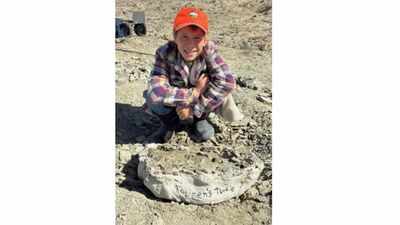
In 2025, 11-year-old Touren Pope spotted a fossil exposed on the ground in Wyoming; it turned out to be a nearly complete 48-million-year-old turtle shell, and he was allowed to name it

11-year-old Touren Pope finds 48-million-year-old turtle fossil in WyomingPhoto credit: Craig Thomas, BLM Rock Springs Field Office What began as a routine family rock-hounding trip in southwest Wyoming turned into a paleontological headline when 11-year-old Touren Pope noticed something unusual poking out of the ground. What he’d spotted was the fossilized shell of a softshell…
Read More

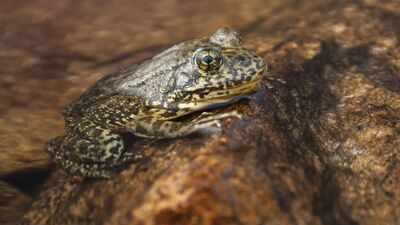
California releases more than 3,000 endangered mountain frogs into the wild, restoring a species that has lost most of its home |

Mountain yellow-legged frog. Image Credit: US Fish & Wildlife Service More than 3,000 endangered mountain yellow-legged frogs and tadpoles have been released into California’s mountain ranges in 2026, giving a once widespread amphibian another chance to survive in the wild. The reintroduction, carried out by the ‘San Diego Zoo Wildlife Alliance’ and its partners, is…

Read More

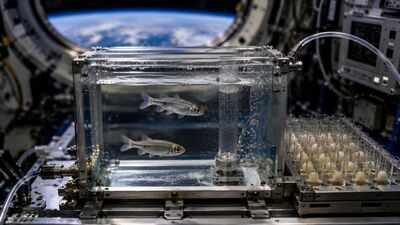
In 1973, Nasa sent two fish and 50 eggs into space; the unusual experiment helped reveal what happens to living organisms without gravity |

When humans leave Earth, even something as basic as knowing which way is up can become confusing. That made fish surprisingly useful subjects for space research. In 1973, Nasa sent two mummichogs and 50 eggs aboard Skylab 3, giving scientists a chance to watch both adult fish and young that developed entirely in orbit. Soon…

Read More

In 1926, a 10-foot rocket rose just 41 feet from a Massachusetts farm; 35 years later, NASA put its creator’s name in space |

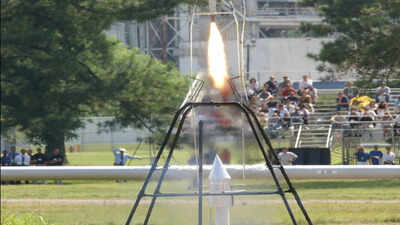
A replica of the world’s first liquid propellant rocket, PC: Wikimedia Commons On March 16, 1926, on a snowy farm in Auburn, Massachusetts, physicist Robert H. Goddard set up a slim, 10-foot rocket he had nicknamed Nell on a launch frame in an open field. Fueled by gasoline and liquid oxygen, the rocket climbed just…

Read More

Scientists turned plastic bottles and corn waste into protein-rich cookies; the food could help tackle hunger problem and also feed space crews

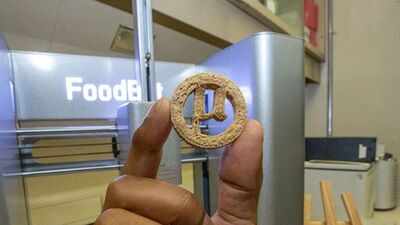
The technology could also potentially be used in places such as submarines and future human settlements on the Moon or Mars (American chemical society photo) Researchers at Southern Illinois University Carbondale (SIU Carbondale) are working on a technology that turns plastic waste from a water bottle into part of a cookie. For this, they programmed…

Read More

For 30 years, the “Kerry cow” bones were seen as proof of early farming in Ireland; scientists now say they belonged to a bear and wild boar

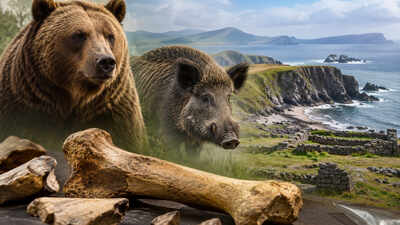
Representative Image (AI-generated) For more than three decades, a collection of animal bones from Ireland’s Ferriter’s Cove was considered some of the earliest evidence that farming had reached the island. But new research has now overturned that interpretation. According to University College Dublin (UCD), bones once identified as cattle have instead been identified as belonging…

Read More

Scientists turn undersea internet cables into giant whale detectors that can track even silent whales through tiny changes in water movement |

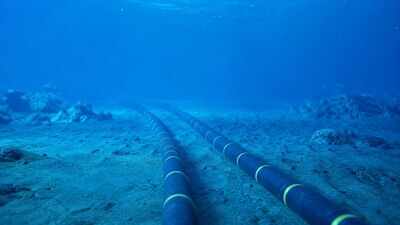
Subsea fibre-optic cables. Image Credit: AI Generated Fibre-optic cables spread across the seafloor have long carried internet traffic between countries, but researchers are discovering another surprising use for this global network; detecting whales. A 2022 study in ‘Frontiers in Marine Science’ showed that existing submarine fibre-optic cables could be turned into vast underwater sensors capable…

Read More

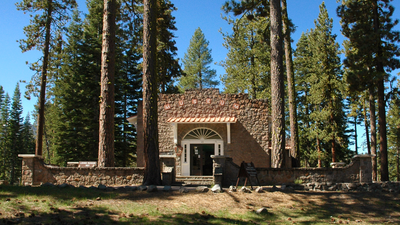
In 1929, Benjamin and Estella Loomis gave Lassen Volcanic National Park 40 acres, a museum and a seismograph building; they kept only a tiny lifetime lease, while their museum became the first privately built one donated to a US national park

In 1929, local homesteader and photographer Benjamin Loomis and his wife, Estella, formally gave 40 acres of valuable mountain land to the United States government. The donation included a hand-built museum and a working seismograph station beside Manzanita Lake. The deal was the first known case in American history of a privately built museum being…

Read More

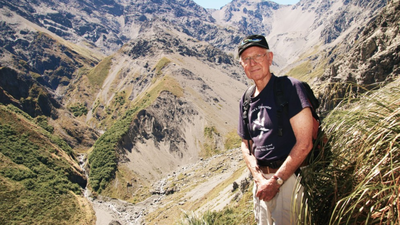
In 1965, a mountaineer found a dead seabird high in New Zealand’s mountains. Then, spent next 50 years to save its species from extinction |

PC: New Zealand’s Forest and Bird In 1965, Geoff Harrow walked into the Kaikōura mountains following a story about an unusual seabird nesting somewhere high above the valleys. He did not find the colony on his first attempt. The next morning, on a steep deer track, a decomposing bird provided the clue he needed. It…

Read More