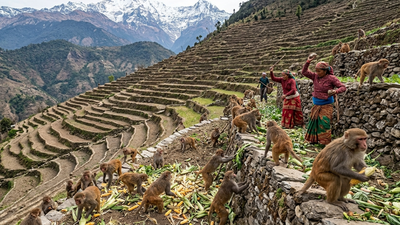
Nepal’s farmers built terraces into steep Himalayan slopes; now growing macaque populations are making it harder to keep their harvests |

Nepal’s mid-hills are places where farming has long meant working with the landscape rather than against it. Terraces cut into steep slopes turn difficult ground into fields for maize, millet, rice and other crops, with generations of farmers maintaining the walls and soil that make cultivation possible. But the balance between people, farmland and wildlife…
Read More

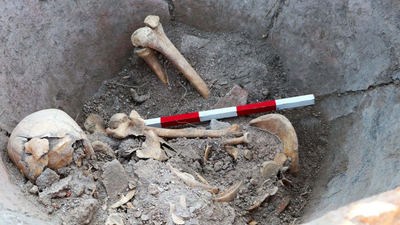
A man climbed inside a giant Roman storage jar around 1,600 years ago and never came out; archaeologists think they know what he was hiding from

Archaeologists have uncovered skeleton inside the jar at the ancient Roman colony of Deultum (Image Credit: Archaeologia Bulgarica via Live Science) More than 1,600 years ago, as violence swept through a Roman settlement in what is now Bulgaria, a man appears to have made a desperate attempt to survive. He climbed inside a huge ceramic…

Read More

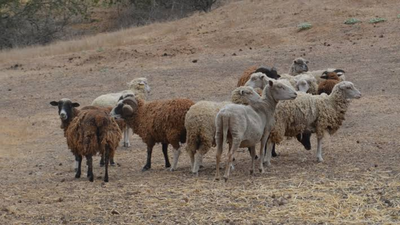
In 1980, conservationists began eradicating feral sheep to restore California’s Santa Cruz Island; by 1987 numbers fell from 21,500 to under 100, then 12 lambs were rescued to save the breed

In 1980, conservationists began an ambitious ecological restoration programme on Santa Cruz Island, off the coast of Southern California. The main goal was to remove tens of thousands of feral sheep whose uncontrolled grazing was damaging native plants and threatening wildlife habitats. Over the next seven years, organised eradication efforts dramatically changed the island’s landscape….

Read More

Scientists found an unexpected second product while making cleaner hydrogen; the leftover material was high-quality graphite |

Liquid hydrogen Tank at NASA Kennedy Space Center. Image Credit: US Department of Energy Scientists working on a cleaner way to produce hydrogen have discovered an unexpected second product which is high-quality graphite. The finding emerged from research into methane pyrolysis, a process that splits methane into hydrogen and solid carbon instead of producing CO2…

Read More

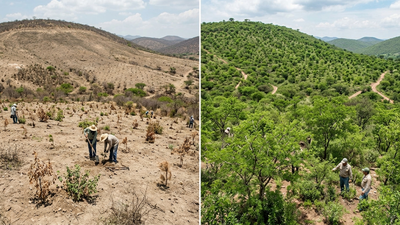
In 2014, Mexico began a massive 1 million-hectare restoration drive; 4 years later plant survival had risen from just 33% to 64% |

Restoring damaged land can look straightforward on paper: plant trees, repair soils and wait for vegetation to return. On the ground, the work is less predictable. Young plants have to survive drought, poor soils, fire, grazing and the other pressures that caused landscapes to deteriorate in the first place.Mexico’s National Forestry Commission, known as CONAFOR,…

Read More

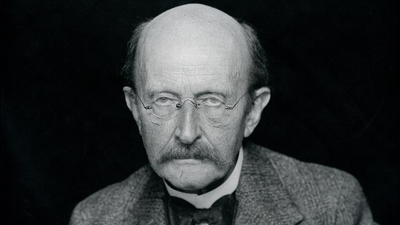
Quote of the Day by Max Planck: “The search for the absolute is the noblest task of science” |

Max Planck, the German physicist whose work helped lay the foundation for quantum theory, believed that science was ultimately a search for deeper and more fundamental truths. His reflections on scientific discovery reveal how strongly he valued the pursuit of universal principles rather than simply solving individual problems. In his Scientific Autobiography, Planck wrote about…

Read More

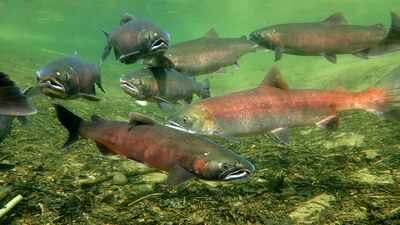
In 2024, four Klamath River dams came down, reopening habitat blocked for over a century; in two salmon runs, 21,052 Chinook moved upstream and reclaimed 88% of their historic range

Four concrete barriers blocked the way for salmon that once swam freely between the Pacific Ocean and the high desert reaches of Oregon and California for more than a hundred years. The dams were removed in 2024 as part of one of the largest dam removal projects in U.S. history, letting the river flow freely…

Read More

Princeton put AI in charge of a fusion-plasma control loop running every 20 milliseconds; in one test it predicted a damaging instability 200 ms early and stopped it before it began

Nuclear fusion illustration Photo: Canva Inside a steel vault at the Princeton Plasma Physics Laboratory, a superheated whirl of charged particles spins in near vacuum, held in place by invisible magnetic fields. This is a fusion plasma, the same kind of matter that powers the Sun, and it is notoriously difficult to control.In a recent…

Read More

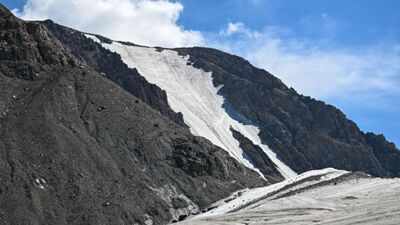
In 2018, scientists seeded clouds over China’s Muz Taw Glacier to make snow; the brighter surface was followed by 14% to 17% less ice loss in a preliminary experiment

This photo taken on Aug. 10, 2026 shows a view of the Muz Taw Glacier in Altay, northwest China’s Xinjiang Uygur Autonomous Region (Photos: Xinhua net) Researchers in China have tried to make artificial snow over China’s Muz Taw Glacier to slow its melting. The experiment conducted in 2018 involved seeding clouds with silver iodide,…

Read More

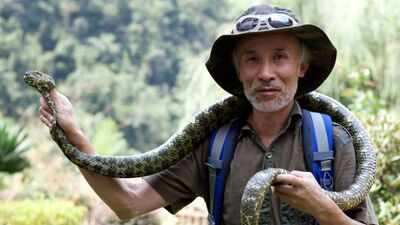
China’s ‘Snake Doctor’ continues conservation work for a rare viper, despite 9 snake bites, divorce threat from wife and even after losing a finger |

Chen Yuanhui. Image Credit: South China Morning Post Chen Yuanhui has spent more than four decades studying one of China’s rarest venomous snakes, even though his work has cost him part of a finger and repeatedly put his life in danger. The 77-year-old, widely known as the ‘Snake Doctor,’ discovered the ‘Mangshan pit viper’ and…

Read More