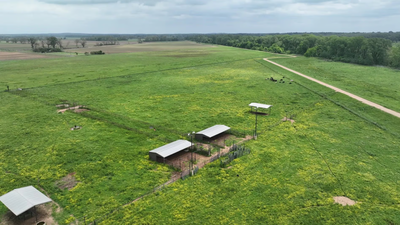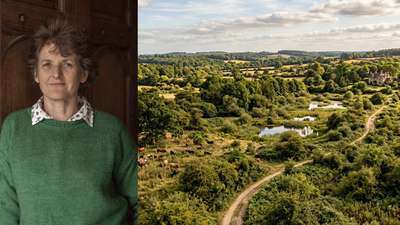
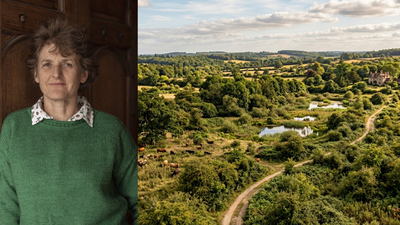
On a 3,500-acre estate in Sussex, the decision to stop farming conventionally did not mean simply leaving the land untouched. Isabella Tree and her husband, Charlie Burrell, began changing the way the Knepp Estate was managed, allowing large grazing animals to move across areas of the farm while reducing the interventions that had shaped the land for generations, as reported by Rewilding Institute. The change was partly driven by economics, but it also became an experiment in what might happen when natural processes were given more room. Over time, Tree describes soils recovering, earthworms returning and species that had become scarce appearing again. The estate became a working example of a different approach to land management.
A 12th-century estate takes a new path under Isabella Tree
Knepp had been part of the English countryside for centuries. Its history stretches back to the 12th century, while the Burrell family has been connected with the estate since the 18th century.By the late 20th century, however, farming the estate on its relatively small scale had become increasingly difficult to sustain. Tree and Burrell faced a choice between selling the land to larger farming operations or finding another way of making a living from it.They chose the second option. The decision was not presented as a plan to recreate some untouched version of the English countryside. Instead, the couple wanted to give natural processes more space while still managing the estate sufficiently to allow those processes to develop. Tree described the decision as a leap of faith.
How grazing animals helped change the Knepp landscape
The Knepp project used grazing animals to help reshape the landscape. Fallow deer, Old English Longhorn cattle, Exmoor ponies, Tamworth pigs and red deer were introduced to parts of the estate. Fences were removed in some places and added in others. A management plan was developed for the naturalistic grazing project, while Tree and Burrell sought advice from ecologists, ornithologists, foresters and other specialists.The animals were not being used merely as replacements for farm machinery. Their movement and grazing were intended to recreate some of the disturbances that would once have been produced by large herbivores moving through a landscape.Tree’s account describes this as a way of restarting ecological processes rather than trying to dictate exactly which species should appear and where. That made the project different from a conventional conservation scheme with a fixed list of targets.
When Knepp’s weeds became part of the natural process
The shift required a different attitude towards what a farm should look like. Areas that might once have been kept tidy were allowed to become more untidy. Vegetation could spread. Some changes that appeared undesirable at first were left to develop rather than immediately being treated with chemicals or machinery.This approach was not always popular with neighbours. Tree recounts how the appearance of weeds, including a major spread of creeping thistle, prompted pressure to intervene. The concern was that the plants would spread beyond the estate and into neighbouring fields.Instead, the thistles eventually became part of another unexpected ecological sequence. Painted Lady butterfly larvae fed on them, helping to deal with the infestation without the herbicide treatment that had been considered.
Earthworms return as Knepp’s soil begins to regenerate
Some of the most important changes were less visible than the returning birds and butterflies. The tree devotes particular attention to the soil. With fertilisers and pesticides no longer being routinely applied as they had been under conventional farming, earthworms returned and the soil began to regenerate.That shift mattered because the project was not simply about creating habitat on the surface. The condition of the soil was part of the wider ecological system being rebuilt. Instead of treating soil as a medium that could be maintained through continual inputs, the Knepp experiment allowed biological activity to become a larger part of the process.There was no single point at which the land suddenly became a functioning wild landscape. Tree describes a series of developments, some anticipated and many not.
Wildlife began appearing in places where it had become scarce
The effects were visible across the estate. Tree describes increases in rare purple emperor butterflies and greater numbers of birds including nightingales and turtle doves. Species that had previously been absent or present only in small numbers began to return as the habitat became more varied. The grazing animals played a part in creating this complexity. Their movements helped produce a mixture of habitats rather than a uniform landscape, with different conditions developing alongside one another.That variety became one of the central features of the Knepp approach. Tree writes that introducing the right number and species of grazing animals could provide the initial push needed for natural processes to begin operating again. The idea was less about designing a finished landscape and more about setting conditions in which change could continue.
A different relationship between farming and conservation
Tree’s experience also challenges the idea that agricultural production and conservation necessarily have to occupy opposing sides of a land-use argument. Her account suggests that some land can be managed less intensively while still contributing to food production. Pasture-fed meat remained possible within the wider system, while areas less suited to intensive agriculture could be given greater freedom to develop ecological functions.That approach has also been presented as potentially useful to farming itself. Restored ecological processes can contribute to soil health, water resources and insect populations involved in pollination. For trees, conservation is therefore not only about protecting individual species. It is also about maintaining the systems on which landscapes and agriculture depend.
Knepp became an experiment rather than a fixed blueprint
The estate’s story between 2000 and 2018 forms much of Wilding, Tree’s account of the transformation. What makes the experiment unusual is the extent to which its managers accepted uncertainty. They still monitored what was happening and worked with scientists and conservation specialists, but they did not attempt to control every outcome.A species might appear in unexpected numbers. A plant that looked like a problem could become food for an insect. Changes underground could precede more obvious changes above it. The result was a landscape shaped partly by intervention and partly by what happened after intervention was reduced.