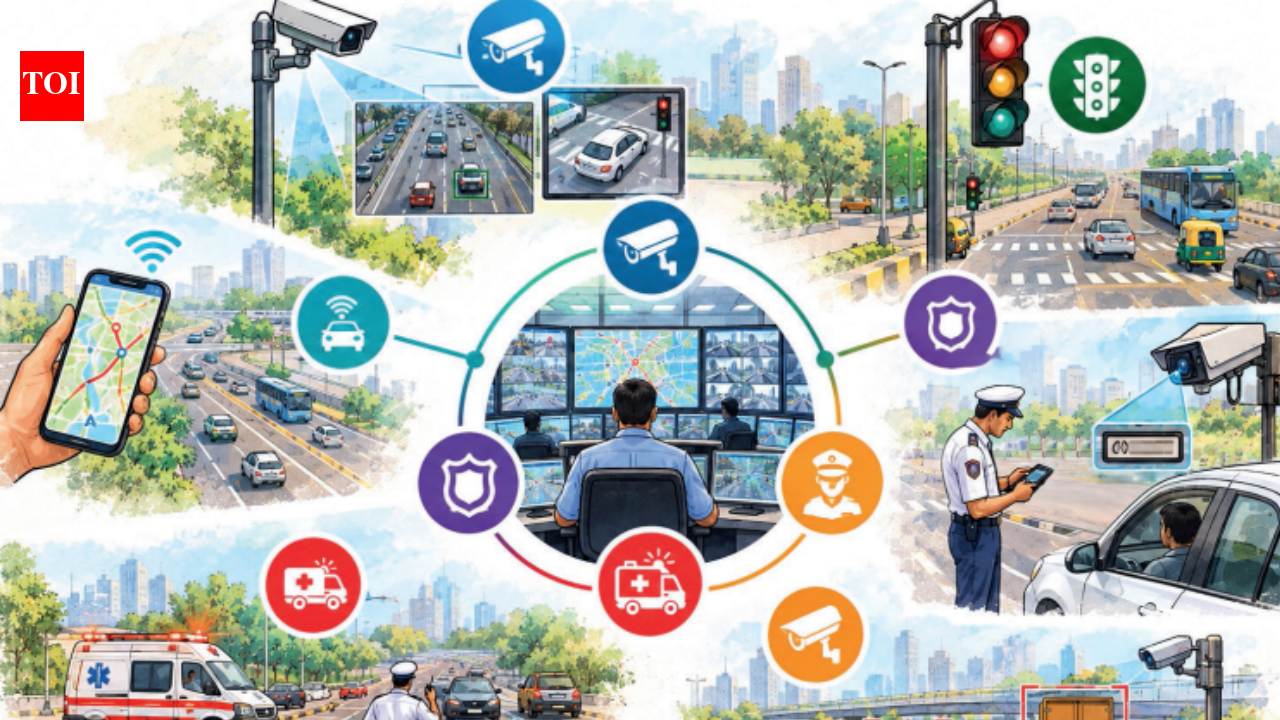
(AI image) The Integrated Traffic Management System is designed to significantly improve both traffic safety and flow across Delhi’s roadways
A day after Integrated Traffic Management System (ITMS) got Union Cabinet nod, TOI’s looks at tentative timelines and some of the key features planned under the system and what they could mean for Delhi’s daily commute.1. What may change if plans move from paper to roadSmarter signals, adaptive traffic control systems
- If one road has a long queue and another is relatively empty, the signal can automatically give more green time to the congested side
- If a main corridor is designed for 50 kmph, signals can be timed to support that movement, while feeder roads with lower traffic volumes get shorter green phases
Signals that talk to each other
- If a vehicle gets a green light at one junction, the next signal can be timed to turn green as the vehicle approaches, helping traffic move with fewer stops
Jam or accident? Detect it
- If traffic suddenly slows because of an accident or a stalled vehicle, cameras can detect the disruption and alert the traffic control centre
Ambulance on way? Clear the road
- The system can detect the emergency vehicle, likely through the audio and adjust the signal to give it a clear passage through the intersection
AI watches violations
- If a vehicle jumps a red light, an AI-enabled camera can identify the violation and flag it for enforcement
ANPR | Read the number plate
- As a vehicle passes a camera, its number plate can be automatically read and the registration number recorded. The system can also identify two-wheelers
Automatic violation detection
- If a vehicle exceeds the prescribed speed or enters a restricted lane, the system can detect and flag the violation automatically
Live route suggestions
- If a corridor is heavily congested, digital signboards and other platforms can alert motorists and provide alternative-route information
2. How and when 42 corridors will come under one traffic systemTentative timelines8 Months | Build the system
- Bidder and implementation details finalised; one citywide ITMS to bring traffic control, surveillance and enforcement onto a common platform
12 Months | Work begins on the first five priority corridors
- Ring Road
- Outer Ring Road
- Rao Tula Ram Road–Shanti Path–Teen Murti Marg–C-Hexagon Road
- NH-48
- Vande Mataram Road–Faiz Road–Rani Jhansi Road
18 Months | Next 7 corridors
- Mehrauli-Gurgaon Road–Sri Aurobindo Marg–Prithviraj Road–Shah Jahan Road–Subramania Bharti Marg
- Mathura Road–Bahadur Shah Zafar Marg–Netaji Subhash Marg
- NH-9 (NH-24)
- Deen Dayal Upadhyaya Marg–IP Marg–ITO Bridge–Vikas Marg
- Rohtak Road
- Kali Dass Marg–Road No. 40–Moti Nagar Flyover–Najafgarh Road–Bahadurgarh Road
- Jawaharlal Nehru Marg, Ajmeri Gate to Rajghat
24 Months | Remaining 38 corridors