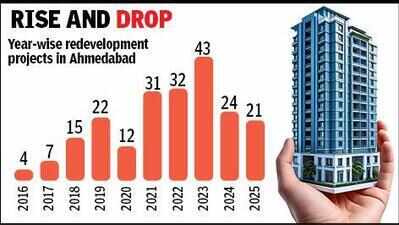
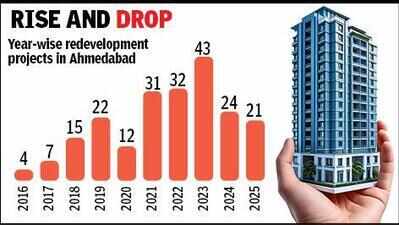
Ahmedabad: What is the age of the city’s residential societies? An analysis by CEPT University indicates that 26% are above 30 years old – while 19% are between 30 and 40 years, the rest, 7%, are above 40 years. According to current regulations, a residential society can undergo redevelopment after 25 years, making these societies eligible for the same.The current projects registered with RERA authorities indicate that 70% of redevelopment projects are concentrated in five areas – Navrangpura, Paldi, Vasna, Maninagar, and Naranpura – that account for 70% of total redevelopment projects in the city.The study, titled ‘Enabling Private Housing Redevelopment’, was carried out by Paramsinh Chauhan, a master’s student in urban housing, under the guidance of Prof Sejal Patel and visiting faculty Amruta Patel.According to an analysis of RERA-registered projects by the researcher, Navrangpura had 44 projects, followed by 36 in Paldi, 26 in Vasna, and 18 each in Maninagar and Vasna.Chauhan said the DRP examined both the pace of redevelopment and the city’s broader potential. “Analysis of the building age indicates that about 26% of the residential buildings are above 30 years, out of which 7% are above 40 years of age. While the redevelopment is concentrated in certain areas, we argue that the city has a lot of potential if certain conditions are met,” he said.The study’s dataset also points to a strong link between redevelopment activity and the regulatory environment. It found that 45% of redevelopment projects fall within transit-oriented zones (TOZ), where the permissible floor space index (FSI) is 4. Plot size and access conditions appear equally significant: about 71% of plots were under 2,000 sq metres, and 61% were located on roads narrower than 18 metres.Prof Sejal Patel, dean of Faculty of Management at CEPT University, said that the imperative for redevelopment is the gap between max consumable FSI on that plot and the current consumed FSI. “Higher the gap, higher the negotiation between society and the developer in terms of larger units for elbow space,” she said.While it is lucrative for the developers as it is already served by the existing infrastructure and saves the cost of a greenfield project, parking is a major issue, she added. “Those societies built under the 2001 regulations are finding it slightly difficult – balconies are not exempted from FSI, and thus the net gain for builders is only 20%,” she added.Prof Patel pointed to constraints that can limit the ability to utilise FSI even where it is available. “Some of the factors that came up in the recommendations include utilization of the increased FSI, physical and regulatory constraints such as road-width requirements, margins/ setbacks linked to road width and height restrictions among others,” she said.Residents’ preferences and growing confidence in completed projects are also shaping the market, according to Jitendra Shah, president of Urban Redevelopment Housing Society Welfare Association.“Areas such as Navrangpura, Naranpura, Paldi, Vasna and Vadaj have maximum old societies with redevelopment potential. If residents get parking space and amenities at the same location, they want to continue living there. This has created huge potential for redevelopment. With successful redevelopment projects, trust is increasing among residents and market awareness is also increasing. Now, societies have realistic expectations and it is resulting in faster deals.”