

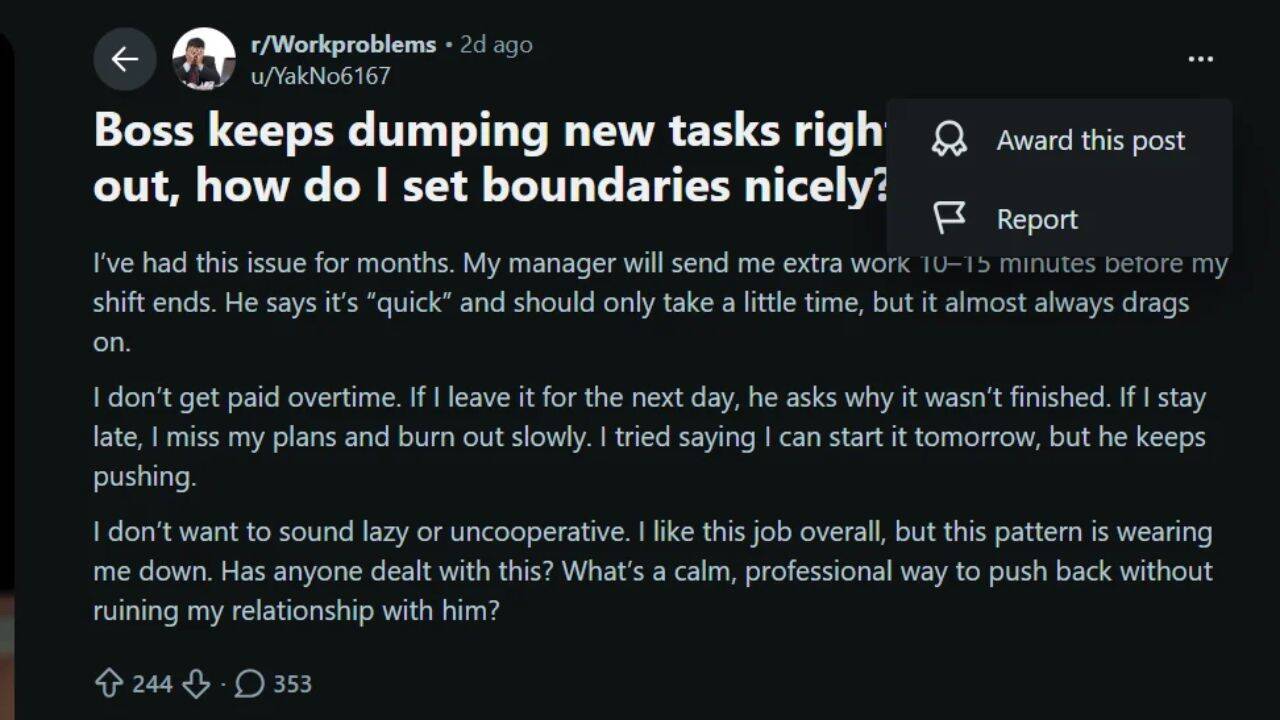
A workday is supposed to end at a scheduled time, allowing employees to switch off from their jobs and focus on their personal lives. But what happens when a manager repeatedly assigns new tasks just minutes before the shift ends, expecting everything to be completed without offering overtime pay? This question has sparked a discussion on Reddit after an employee shared their frustration over a manager’s habit of handing out last-minute assignments. What the manager reportedly describes as “quick” work often takes longer than expected, leaving the employee caught between staying late and risking criticism for unfinished tasks.The employee shared the experience on the subreddit r/Workproblems in a post titled “Boss keeps dumping new tasks right before I clock out, how do I set boundaries nicely?” The post highlights a common workplace dilemma: how can employees protect their personal time without being labelled uncooperative?
When a ‘quick task’ turns into an extended workday
According to the employee, the manager has been assigning additional work around 10 to 15 minutes before the end of their scheduled shift. Although these tasks are presented as small jobs that should not take long, they frequently require more time than the employee has left in the workday. The pattern has reportedly continued for months, making it increasingly difficult for the employee to manage personal commitments. Staying back to finish the assignments means disrupting plans outside work, while leaving them unfinished creates another problem the following day.The employee said the manager questions why the tasks were not completed, even when they were assigned shortly before the shift ended. This leaves the worker feeling pressured to finish the work despite having no overtime pay. The situation has also started affecting the employee’s well-being. While they said they generally enjoy their job, the repeated last-minute requests have become difficult to handle and are contributing to burnout. The employee has reportedly tried suggesting that some assignments be started the next day. However, the manager continues to push for their completion, leaving the worker unsure how to establish boundaries without damaging their professional relationship.
Reddit users suggest setting boundaries without unnecessary conflict
The post attracted advice from users who suggested being clear about workload, available time and expectations instead of repeatedly staying late. One commenter recommended explaining the situation directly if the manager asks why a task remains unfinished. The user suggested pointing out that the assignment arrived only 15 minutes before the shift ended and that overtime was not paid.Another person shared a simple approach to handling additional work near the end of the day: acknowledge the request, add it to the task list or complete as much as possible before leaving. If the work remains unfinished, the employee can explain that there was not enough time to complete it during the scheduled shift. The suggestion focuses on communicating what is possible within the available working hours rather than treating every last-minute request as an immediate obligation.Other users advised the employee to avoid making a habit of automatically accepting new assignments at the end of the day. They recommended discussing priorities with the manager and clarifying which tasks genuinely need to be completed before leaving. One commenter also suggested that managers should plan workloads according to employees’ scheduled hours or arrange overtime when additional work is necessary.
‘Do not allow wage theft’: Why unpaid extra work raised concerns
Some Reddit users viewed the situation as more than a simple scheduling problem. They raised concerns about employees being expected to work beyond their agreed hours without compensation. One commenter warned against allowing unpaid work to become routine, arguing that employers should not expect staff to repeatedly extend their working day without pay. Another advised the employee to make their availability clear by explaining that they would leave at the scheduled time unless overtime was approved and paid.However, the discussion also included speculation about the manager’s intentions. One user suggested that the repeated behaviour might be about exerting control or creating grounds for dismissal, although the post does not establish why the manager behaves this way. The comments reflect different experiences and opinions rather than verified conclusions about the manager or the workplace. Whether the issue stems from poor planning, unrealistic expectations or a lack of respect for personal time, the employee’s account highlights the difficulties workers can face when the boundaries between paid work and personal time become blurred.
A workplace lesson in planning, communication and work-life balance
The discussion points to a practical problem that can arise in many workplaces: a task may be described as urgent or easy, but that does not mean it can always be completed within the remaining minutes of a shift. Clear communication can help employees explain what they can realistically finish, while managers can reduce unnecessary pressure by assigning work earlier and setting priorities. If a task genuinely requires additional time, both sides need clarity about expectations and applicable overtime arrangements.Employees should also understand their workplace policies and the labour rules that apply to their employment, since overtime entitlements vary by jurisdiction, role and employment arrangement. For the Reddit user, the challenge is not simply deciding whether to finish one more task. It is finding a way to remain responsible at work without allowing repeated last-minute demands to take over personal time. The wider discussion serves as a reminder that a healthy working relationship depends on more than completing assignments. Respecting scheduled hours, communicating realistic deadlines and planning workloads fairly are also important parts of a sustainable workplace.