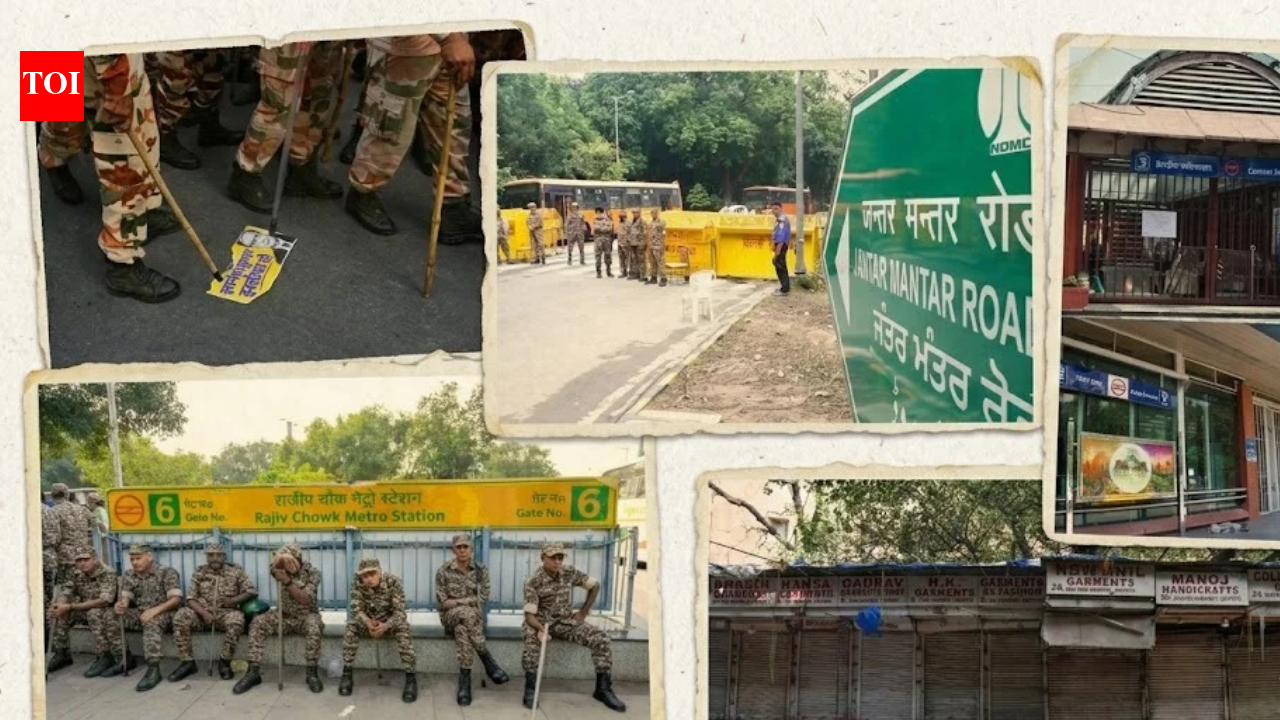
NEW DELHI: The protest may have a destination; its disruption doesn’t. A barricade goes up in central Delhi, a Metro station shuts, a market empties out, and suddenly, people with no part in the demonstration are paying for it in lost sales, longer commutes and a less certain journey home.As the Cockroach Janta Party (CJP) continued its protests over the removal of chief election commissioner Gyanesh Kumar, the effects rippled beyond the sites where its supporters gathered.Traders reported falling sales during the festive season, commuters struggled to navigate closures and diversions, and workers found their daily earnings caught in the disruption.A familiar question thus comes into focus: how does a city accommodate the right to protest without leaving people who have no part in the demonstration to absorb the consequences?For businesses, the timing has been particularly difficult. October marks the beginning of the festive trading season, when markets typically see increased footfall ahead of Diwali and the wedding season.Meanwhile, for commuters and workers, the restrictions have affected something more immediate, i.e., their ability to get to work, travel across the city and return home safely.
CP: The heart of New Delhi
In Connaught Place, where shops and restaurants depend on evening crowds, traders say the protests have coincided with a crucial period for sales.Atul Bhargav, president of the New Delhi Traders Association, said the association advised shopkeepers to close at 6.30pm on one of the protest days after assessing the situation with other office-bearers.He said that the decision was driven by concerns over the safety of employees and customers as well as the decline in business.“There’s no point in losing eight rupees to earn four,” Bhargav said, explaining why traders chose to shut early rather than continue operating amid the disruption.He said sales that would normally account for 20-25% of business had fallen to around that level on the first day, before dropping to 35-40% over the following two days, according to his account. The closure of multiple Metro stations at different times also affected the movement of customers and made it harder for employees to get home.The concern was not limited to Connaught Place. Sanjeev Mehra, president of the Khan Market Traders Association, said road closures and security arrangements had kept customers away from the market. He said traders had written to the Prime Minister, the home minister, the commerce minister and other representatives seeking intervention.Mehra claimed the association had suffered losses of around Rs 200-300 crore so far during the festive period. The figure is the association’s estimate and has not been independently verified.The impact, traders argue, goes beyond a single day’s sales. A customer who avoids a market because of traffic restrictions may choose to shop online instead, while a restaurant or shop that closes early loses not only the evening’s business but also the opportunity to serve its usual customers during peak hours.The Confederation of All India Traders (CAIT) has also warned of the potential economic impact. Its secretary general, Praveen Khandelwal, said disruptions could put business transactions worth more than Rs 400 crore a day at risk, with the figure potentially reaching Rs 4,000 crore over 10 days if they persisted.He clarified that these were indicative estimates of business activity at risk, not a verified calculation of actual losses.
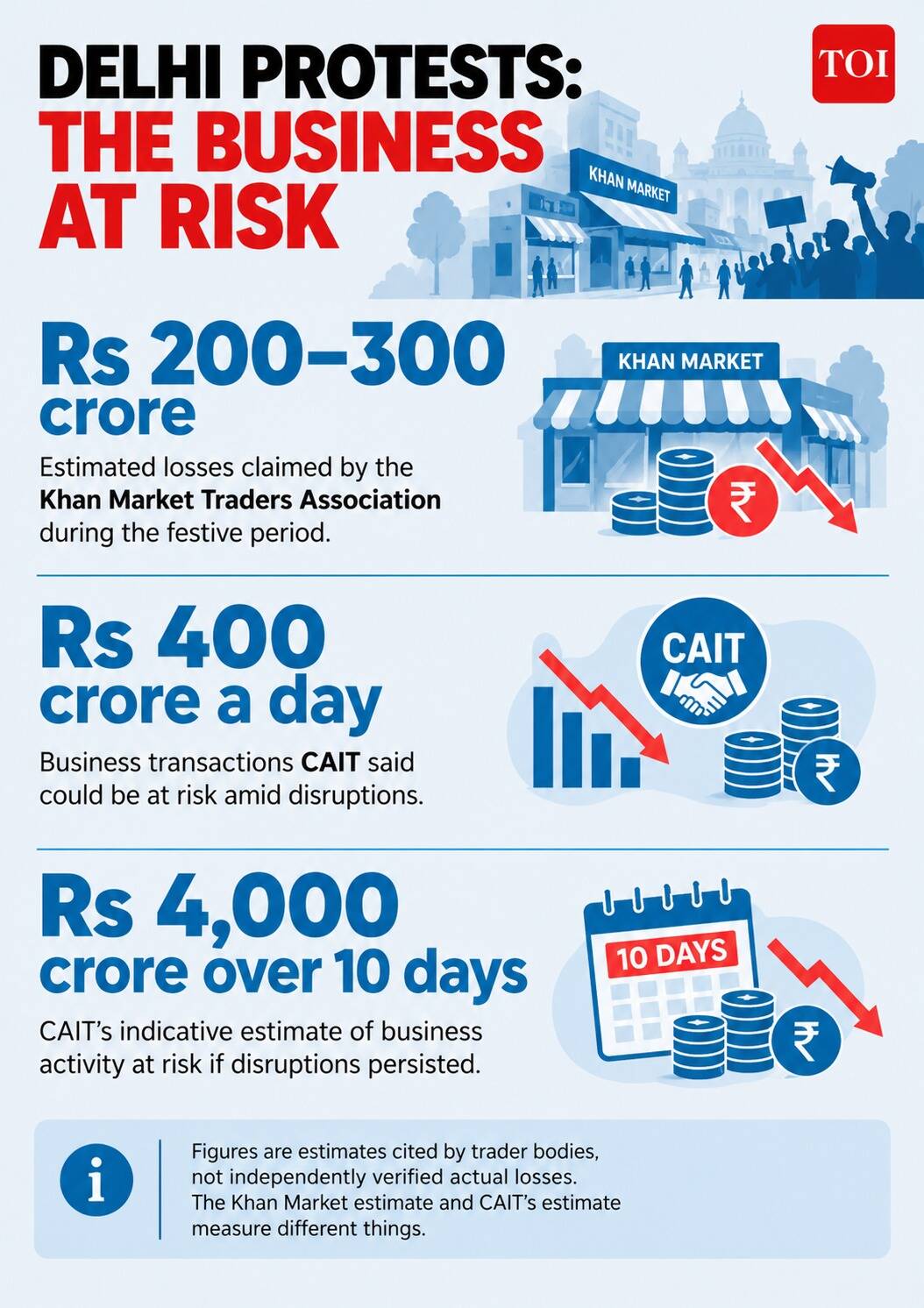
Impacted businesses
A restaurant owner has also approached the Delhi high court seeking an assessment of losses suffered during the October 10 agitation and compensation from those responsible.The petition by Aayush Chopra, whose family runs Minar Restaurant in Connaught Place, also sought to prevent a proposed gathering at Central Park on October 16.The petition contended that traders’ rights to carry on business must be considered alongside the right to assemble peacefully. The court directed that the matter be listed with connected petitions; the claims in the plea remain the petitioner’s submissions.For traders, the issue is not simply whether a protest should take place. It is whether businesses and their workers should have to bear the financial consequences when customers cannot reach them or when safety concerns force them to close.
Caught between barricades
The cost of the protests has also been measured in delayed journeys, missed connections and uncertainty over how to get home.
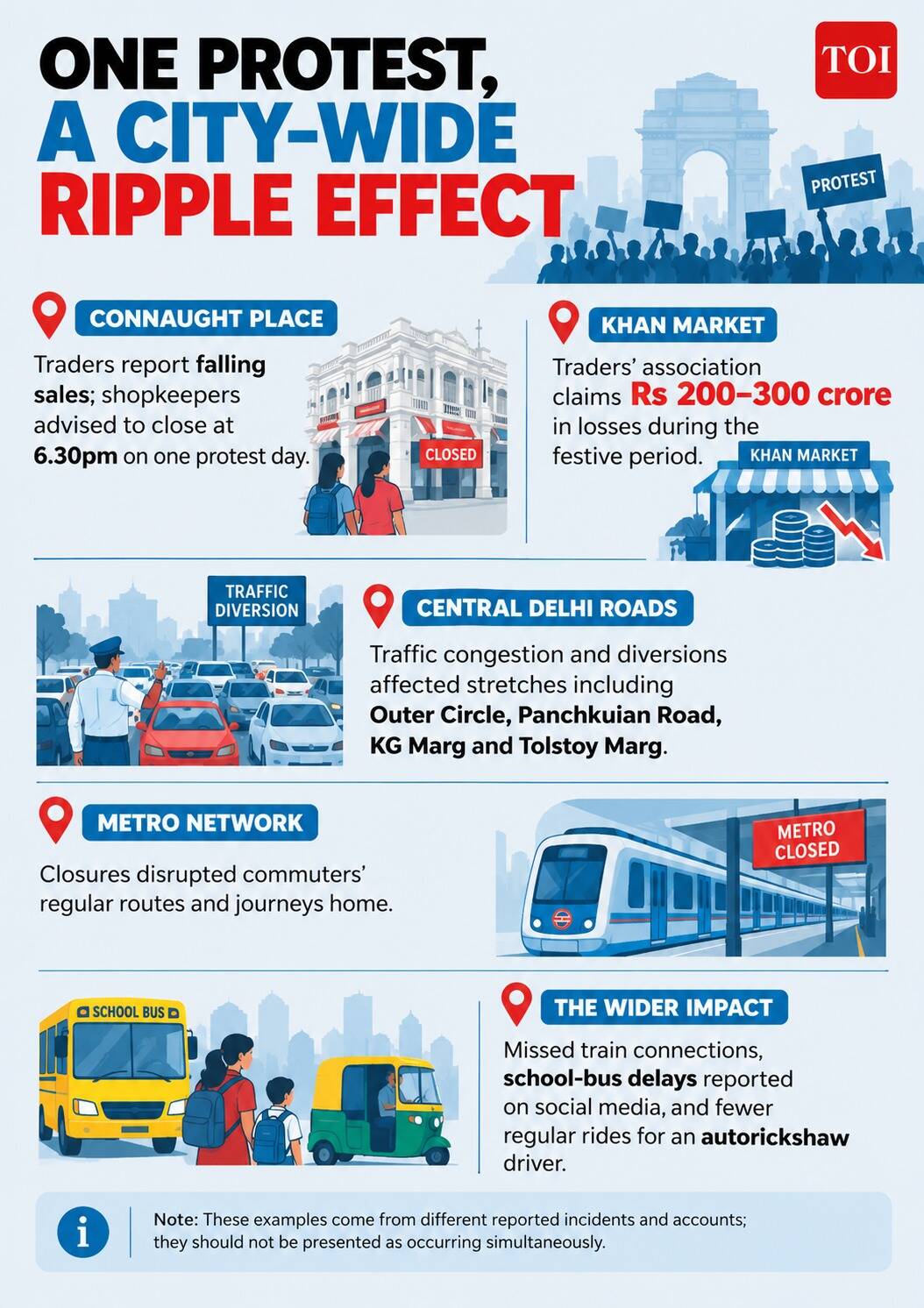
Protest and effects with no one address
During a separate day of political mobilisation in central Delhi, traffic congestion spread from Connaught Place towards Rajghat, with vehicles crawling along Outer Circle, Panchkuian Road, KG Marg and Tolstoy Marg.Barricades narrowed roads, while diversions pushed traffic from blocked stretches onto adjoining routes. Some people reported missing trains, though no official figure was available.The disruption also left parents worried about children caught in traffic. Social media posts described school buses stuck for extended periods, including one account of children being stranded for nearly an hour.For Siddhi, the problem was not the idea of protest itself but how it affected people going about their daily lives.“As a citizen, I have always welcomed the idea of protests. However, there is a disciplined way to organise and conduct them,” she said.Siddhi recalled having to wake up earlier than usual because the Metro route she uses to get to work was closed. She also said autos were charging high fares for short distances, making the commute more difficult.“By all means, hold protests and fight for your rights. However, please ensure that doing so does not disrupt the lives of others,” she said.For another commuter, Prachi, the disruption was also a question of safety. She described Metro gates being sealed, cabs cancelling and having to walk through chaotic crowds.“When you’re trapped in that kind of crush with zero open transit or secure spaces, the fear of groping and stampedes is constant,” she said, describing the experience of trying to get home.Such accounts point to a problem that is harder to capture in estimates of lost business: the time, uncertainty and anxiety faced by people who have no direct involvement in the protest.While restrictions may be imposed to manage security risks, commuters can find themselves navigating sudden changes to transport and traffic without knowing how long the disruption will last.
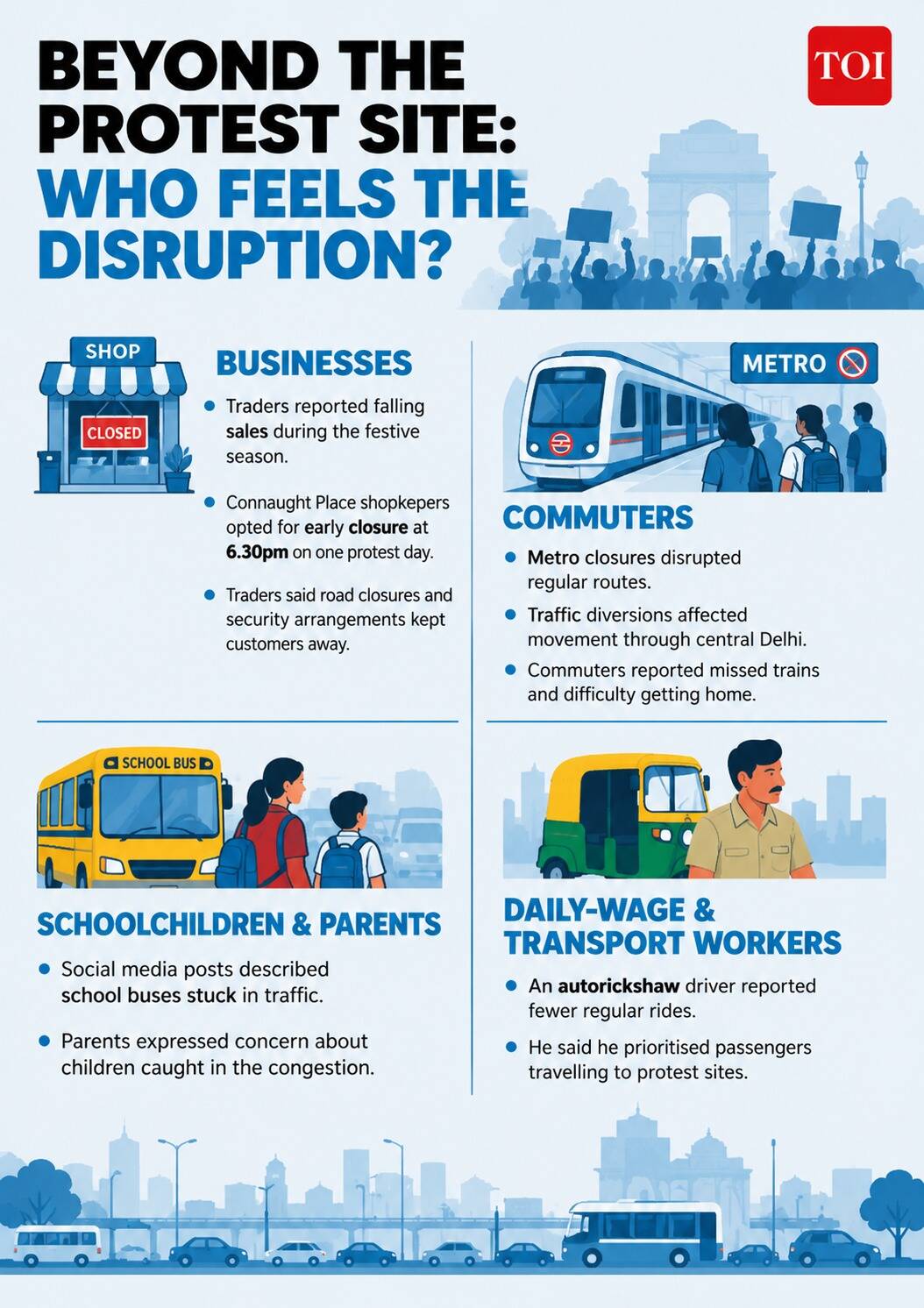
Those affected
Every ride comes with a ‘cost’
For workers whose earnings depend on people moving through the city, the effects can be more direct.Praveen, an e-rickshaw driver, said the disruption affected the number of passengers he could pick up during a day.“Earlier, I would usually get four or five passengers one after another, but when the Metro stations shut and fewer people were out on the roads, the number of rides went down. I had to spend more time looking for passengers and drive around more for fewer fares,” he said.Sonu, an autorickshaw driver, said the protests and the resulting traffic disruption had reduced the number of regular rides available to him. He said he chose to prioritise passengers travelling to protest sites, where he saw an opportunity to find fares.“With fewer passengers available, we had little choice but to charge extra and focus on trips to protest sites,” he said.While some may find passengers around a protest site, others may lose time and fares as traffic slows or familiar routes become inaccessible.The effects are not uniform. A trader may lose sales because customers stay away; a commuter may spend more time and money reaching work; a driver may find fewer regular passengers but more demand near a demonstration. Yet each is responding to a city whose usual rhythms have been interrupted.
Right to protest vs right to go about daily life
The restrictions have also brought the question of designated protest sites back into focus. In its plea before the Delhi high court, the Connaught Place restaurant owner cited the standing order of April 28, 2022, which regulated protests in central Delhi and identified Jantar Mantar as a designated site, subject to conditions including advance permission.The plea also referred to the subsequent de-notification of Jantar Mantar and the designation of three other venues on October 11. It argued that Central Park had not been identified as a protest site and raised concerns about a gathering announced at short notice. These are arguments advanced by the petitioner, not findings on the merits of the dispute.The wider question is how authorities can manage demonstrations without making ordinary movement and livelihoods collateral damage. Restrictions may be necessary to address security concerns, but they can also extend the disruption to people far removed from the protest itself.Traders have sought an assessment of losses and compensation, while some have called for tighter limits on demonstrations in market areas during the festive season. Such demands raise their own questions about how restrictions should be framed without unduly curtailing peaceful assembly.The competing concerns are not abstract. A protest is a means for people to make their demands heard; a market is where people earn their living, and roads and public transport are how a city functions. When one is disrupted, the consequences travel well beyond the site of the gathering.For those caught in the middle, the question is not only whether a protest can go ahead, or whether authorities can restrict it. It is who gets to decide how much disruption is acceptable, and whose time, safety and livelihood are expected to pay for it.