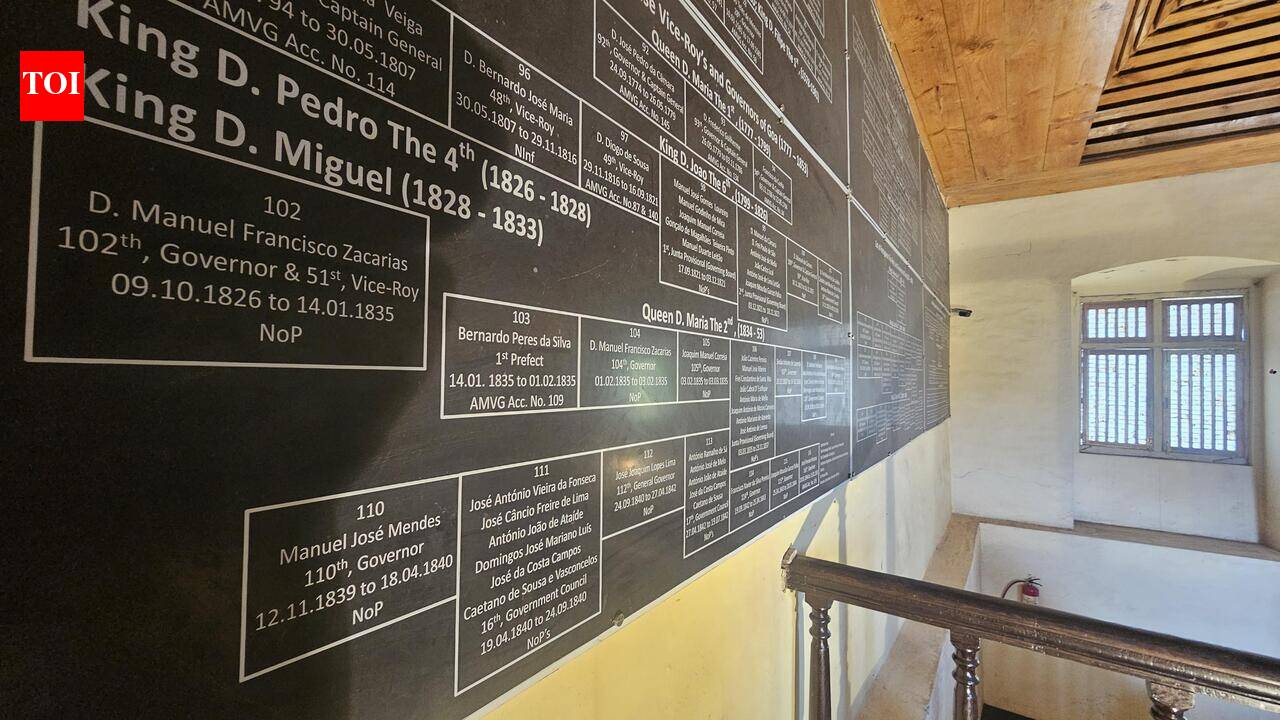
Panaji: Goa houses a collection of 120 life-size portraits of Portuguese governors and viceroys who administered the then-Estado da India. The chronological reorganisation of the portrait gallery at the ASI Goa circle’s Archaeological Museum of Goa is set to make the collection easier to explore for researchers, scholars and visitors.The revised arrangement places the rulers in chronological order, linking the viceroys to the Portuguese monarchs under whose reigns they served. The display also groups the paintings according to their historical periods, allowing visitors to observe how portraiture evolved over the centuries.“The reorganisation helps visitors follow the succession of rulers more easily, while enabling researchers, including PhD scholars, to study the collection systematically,” a museum official said.One of the most interesting aspects of the collection is the change in materials used to produce the portraits.The earlier paintings were executed on wooden panels, while those from later periods increasingly appeared on canvas. The updated arrangement offers a visual indication of how artistic practices and materials changed over time.“The new system helps visitors appreciate these differences as they move through the galleries, rather than viewing the portraits as an isolated succession of historical figures,” a museum official said.The portrait gallery dates to 1547, when Dom João de Castro, then viceroy of Portuguese India, commissioned the artist Gaspar Correia to paint portraits of himself and his 12 predecessors.The practice continued, and the collection expanded over the centuries, giving Goa a remarkable collection of 120 portraits documenting the succession of Portuguese governors and viceroys across 177 tenures.“The early portraits of rulers who had served before João de Castro were based on existing miniature representations. The tradition of commissioning portraits thus developed into a visual record of successive administrations,” the official said.The paintings also document the history of artistic production in Portuguese India.“The involvement of local Goan artists in producing the portraits also adds an important dimension to their interpretation. While the figures represented the Portuguese administration, the works themselves form part of Goa’s art history,” the official said..