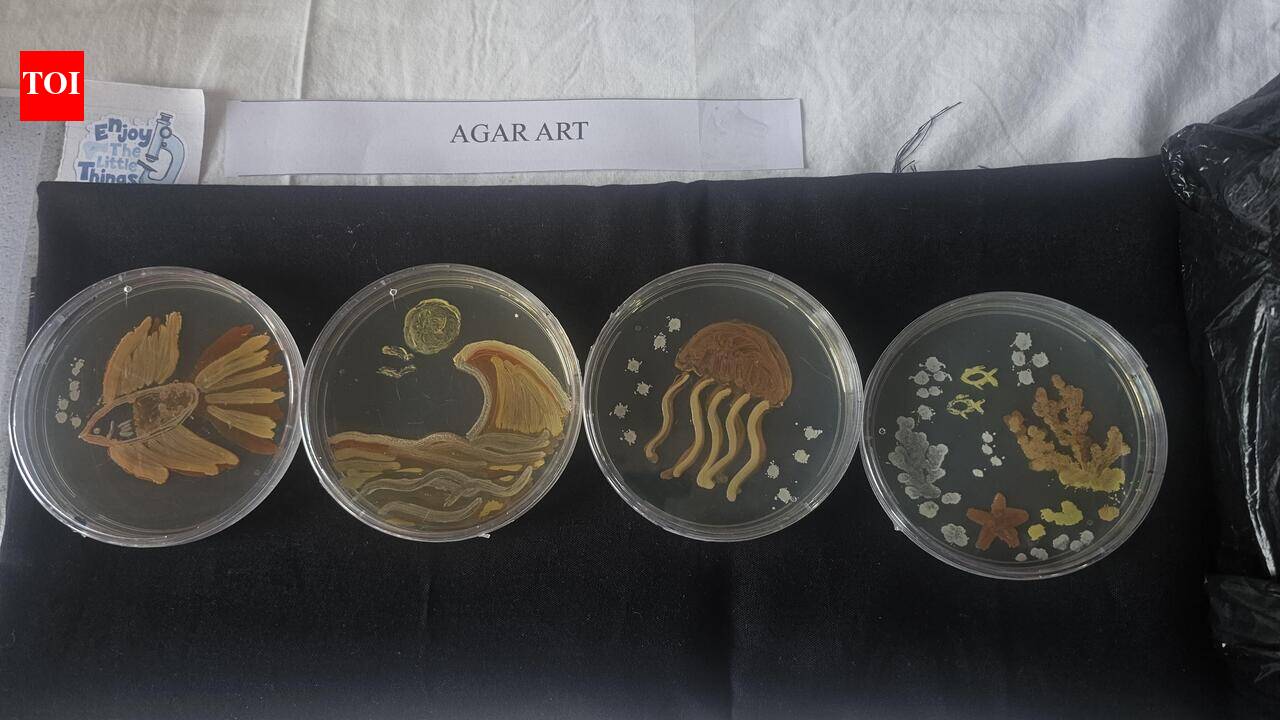
Panaji: The petri dishes at Goa-based National Institute of Oceanography (CSIR-NIO), Dona Paula, on Monday featured artwork made with colourful bacteria, forming jellyfish, coral reefs and marine life. At CSIR’s 85th Foundation Day, three young researchers from NIO Goa — Vaishnavi Balaji, Anmol Verma and Yolanda Menezes — demonstrated how microorganisms produce pigments, light and gases, helping school students understand their role in marine ecosystems and the environment.One of the exhibits featured ocean-themed illustrations created on agar plates using pigmented bacterial cultures. Using a sterile nichrome loop, the researchers transferred selected cultures onto the growth medium to create designs resembling miniature paintings of jellyfish, coral reefs, ocean waves and fish.“The colours are produced by bacteria,” Balaji said. “This experience offers students a different perspective on microorganisms they typically encounter in textbooks or through microscopes.”Menezes said the bacterial cultures had been sourced from different environments, including mangroves on Chorao island and Arabian Sea. Microbial pigments, including carotenoids, are being investigated for potential applications in medicine and industry. Certain microorganisms and their products are also studied for use in aquaculture, including fish-feed formulations and probiotics.Another demonstration showcased bioluminescent bacteria isolated using squid ink. The researchers collected squid specimens from a Panaji market, isolated the ink and cultured the bacteria on suitable media. After incubation overnight in the dark, they identified glowing colonies and maintained them in two different media, including one supplemented with glycerol.The exhibit introduced students from Classes VIII to XI to bioluminescence — the ability of living organisms to produce light through biological processes.“Marine microorganisms have a very important role in ecology,” Verma said.A third experiment highlighted microbial activity in mangrove sediments. Mud was placed in a sealed bottle fitted with a balloon, which inflated as microorganisms produced gas.The demonstration opened a discussion on microbial processes that influence greenhouse-gas exchange. Certain microorganisms, known as methanogens, produce methane under suitable conditions, while other microbes consume methane or participate in sulphur cycling.These processes are particularly relevant to mangroves, which store substantial amounts of carbon and support complex microbial communities in their waterlogged sediments.By combining art, simple experiments and environmental science, the researchers gave an opportunity to students to explore how invisible microbial life shapes the ocean and influences the wider environment.Box:Colourful bacterial art: Sterile nichrome loop used to transfer pigmented bacterial cultures onto agar plates, creating illustrations of jellyfish, coral reefs, ocean waves and fish. The bacteria also have potential applications in medicine, industry and aquaculture.Bioluminescent bacteria: Squids from a Panaji market collected and the bacteria isolated from their ink. Samples cultured and incubated overnight in the dark to identify bioluminescent colonies. Glowing bacteria then separated to demonstrate how certain microorganisms produce light naturally.Gas production by mangrove microbes: Mangrove mud placed in a sealed bottle fitted with a balloon. As microorganisms in the sediment produced gas through their metabolic activities, the balloon inflated. This showed the role of microorganisms in methane production and consumption, greenhouse-gas exchange and climate change.