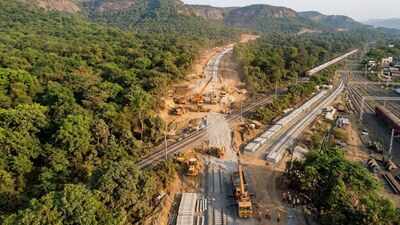
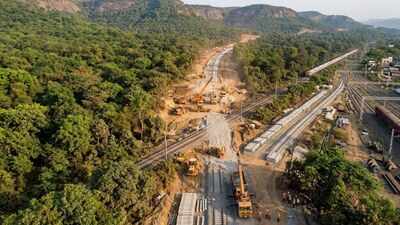
MUMBAI: Around 6.5 hectares of forest land in Thane and Shahapur forest divisions will be diverted for the construction of the fourth railway line between Kalyan and Asangaon, a 32.23-km project aimed at increasing the carrying capacity of Central Railway’s crowded mainline corridor.Central Railway (CR) has submitted an application on the Parivesh portal seeking approval for the diversion of forest land for the project. Under the Forest (Conservation) Act, 1980, as amended, diversion of forest land for non-forestry purposes requires prior approval from the central govt through the Union environment ministry.According to project documents, the estimated cost is Rs 1,619.96 crore.The cost will be shared equally by the railways and the Maharashtra govt. The Kalyan-Asangaon section currently has two electrified tracks, with work on a third line under way. Suburban locals, mail and express trains, and freight services use the same pair of tracks, leaving limited flexibility to accommodate additional services or recover from disruptions.The proposed fourth line is part of CR’s broader capacity-augmentation programme. The railway network beyond Kalyan remains a bottleneck because suburban and long-distance trains share tracks, particularly beyond Ambernath, where the corridor narrows to two lines.The proposed fourth line will run largely parallel to the existing and proposed railway lines, making maximum use of railway’s existing right of way to minimise additional land requirements. The alignment passes through Kalyan, Shahad, Ambivli, Titwala, Khadavali, Vasind and Asangaon. Existing railway yards at Kalyan, Titwala, Khadavali, Vasind and Asangaon will be connected to the fourth line.According to project documents, forest diversion is necessary because the alignment follows the existing railway corridor and cannot feasibly be shifted elsewhere without increasing land requirements. Non-forest land has been used wherever possible to minimise forest diversion.