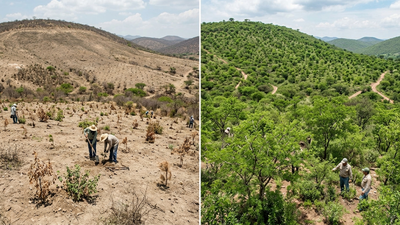
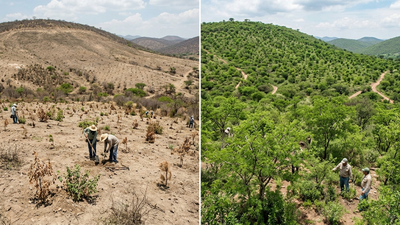
Restoring damaged land can look straightforward on paper: plant trees, repair soils and wait for vegetation to return. On the ground, the work is less predictable. Young plants have to survive drought, poor soils, fire, grazing and the other pressures that caused landscapes to deteriorate in the first place.Mexico’s National Forestry Commission, known as CONAFOR, took on that problem at a national scale in 2014. It set out to begin restoring 1 million hectares of degraded land, directing support towards communities and landowners in areas where forests had been lost or damaged. Reportedly, four years later, the programme had recorded a marked change in what happened after planting: average plant survival had risen from 33% to 64%.
Mexico’s 1 million hectare restoration plan went beyond tree planting
The 1 million hectares formed part of a much larger restoration effort. Mexico had committed almost 7.5 million hectares to restoration through the Bonn Challenge and Initiative 20×20, with the wider national approach extending beyond forest planting.CONAFOR’s programme concentrated on degraded forest land, including places affected by forest loss, fires, pests and other disturbances. Priority was also given to watersheds and areas where soils had deteriorated significantly. Rather than treating restoration as a single activity, the approach linked financial assistance with technical support and local participation.That distinction mattered. A tree planted on degraded ground is only the beginning of a restoration project. Whether it remains alive long enough to become established depends on what happens afterwards.
Financial incentives helped communities restore degraded Mexican land
CONAFOR used incentives to encourage landowners and communities to carry out restoration on their own land. The programme provided periodic financial support as well as technical assistance, giving participants help with the practical side of establishing and maintaining restoration sites.This was particularly relevant in rural areas where much of the land is managed collectively or by individual landowners. Instead of relying entirely on a centrally managed planting operation, the programme placed some of the responsibility for restoring damaged areas with the people living and working there.The financial commitment was substantial. CONAFOR spent about 12 billion pesos, equivalent to roughly US$591 million, on the effort.
Survival rose from 33% to 64%
The clearest measure of progress came not from the number of hectares treated, but from what happened to the plants put into the ground.In 2014, only around 33% of planted vegetation was surviving under the programme. By 2018, that figure had reached 64%. The results were independently verified by the Universidad de Chapingo.That is an increase of 31 percentage points, bringing the survival rate close to twice its earlier level. It also meant that restoration work was becoming less dependent on simply replacing plants that had failed to establish.
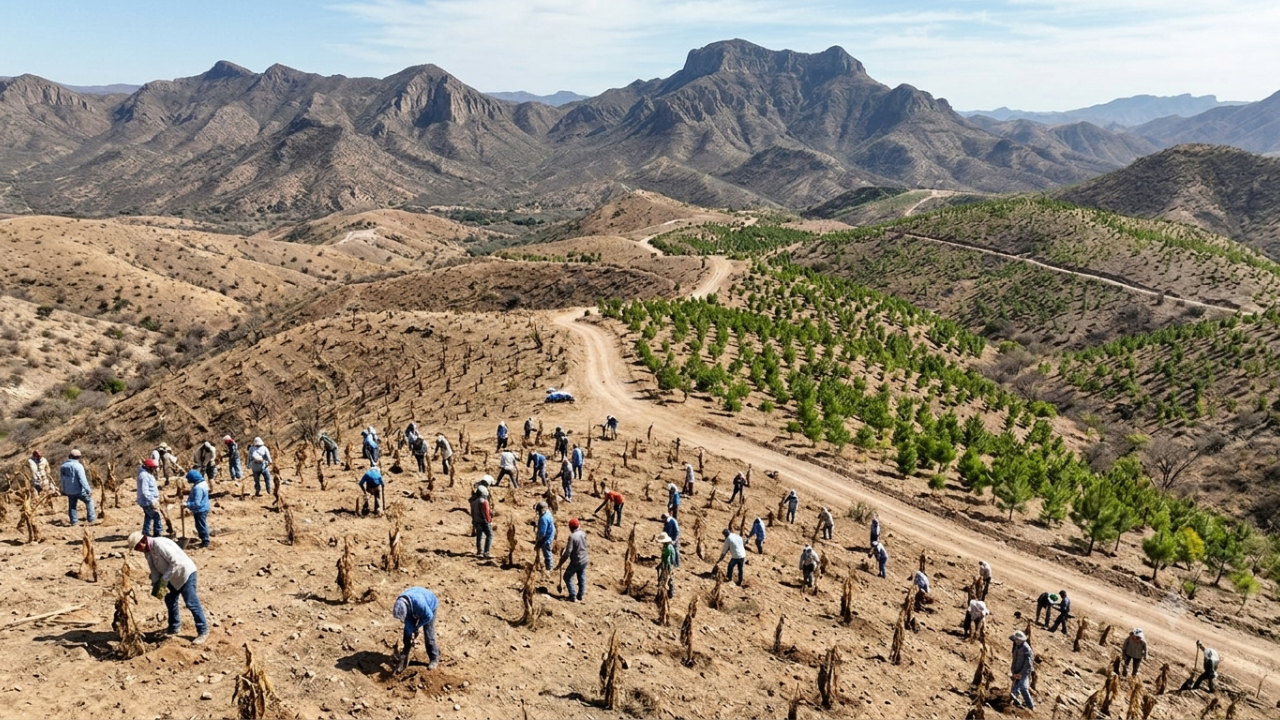
Mexico’s restoration plan connected forests, watersheds and farmland
The Mexican approach also extended beyond individual planting sites. Its broader restoration framework included biological corridors, active forest restoration and efforts to encourage natural forest succession in degraded areas.Watersheds were treated as useful planning units because damaged land rarely functions in isolation. Changes to vegetation, soil and water movement can affect areas beyond the boundaries of a single restoration plot.Agricultural land was part of the picture as well. Mexico’s restoration plans included productive reconversion, protected agriculture and improved irrigation, alongside incentives intended to make agricultural land more productive. The aim was not simply to increase tree cover, but to recover ecosystem services while maintaining or improving rural production.
Farming was included in the wider restoration plan
Under Initiative 20×20, Mexico’s broader target was to restore nearly 8.5 million hectares of degraded land by 2020. CONAFOR’s 1-million-hectare forestry commitment was accompanied by a much larger agricultural restoration programme.Agricultural measures included about 3.5 million hectares targeted through agro-incentives and another 3.5 million through productive reconversion. A further 840,000 hectares were associated with irrigation technification, while the National Commission on Arid Zones had a rehabilitation programme covering hundreds of thousands of hectares.There was also a smaller protected-agriculture component. Together, these measures reflected a wider idea of restoration.
Funding came from several directions
Government support formed the main financial foundation. Agricultural incentives were set out through SAGARPA’s rules of operation, with provisions covering areas such as land productivity, contaminated soils and irrigation.Other public institutions also had roles. Fideicomiso de Riesgo Compartido (FIRCO), provided support connected with agribusiness and rural development, while Financiera Nacional de Desarrollo Agropecuario, Rural, Forestal y Pesquero supplied development finance.The framework also allowed significant incentives to be combined with financing from development banks and other public or private financial institutions, including international sources.International funding added another layer. Grants from organisations including the Global Environment Facility, the Food and Agriculture Organization and the World Bank supported restoration-related projects in Mexico.Reportedly, one Sustainable Productive Landscapes programme, for example, involved a US$21.8 million GEF grant alongside US$139 million in co-financing.
The change was measured in more than hectares
Counting hectares can show the scale of a restoration programme, but it says less about whether the work is lasting.Mexico’s 2014–2018 programme provides a different measure. The country reached its stated target of beginning restoration on 1 million hectares, while the proportion of planted vegetation surviving in the programme rose from 33% to 64%.The figures do not mean every restoration site followed the same pattern. Conditions vary widely across Mexico, and survival can be affected by drought, frost, grazing, rainfall, temperature and the quality of planting material.That makes the national increase from 33% to 64% significant as a programme-level result rather than a guarantee for every individual planting site.