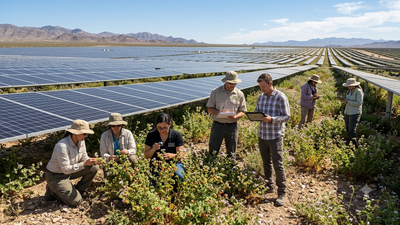
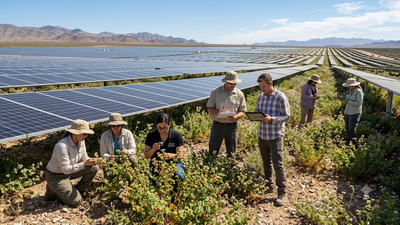
On the edge of the Mojave Desert, rows of solar panels now cover ground that once looked much like the surrounding landscape: pale sand, scattered vegetation and long stretches of exposed soil. The Gemini solar project, northeast of Las Vegas, was built across about 20 square kilometres and contains roughly 1.8 million panels. Before construction, botanists searching the site found just 12 threecorner milkvetch plants, a small annual species already considered uncommon enough to attract conservation attention.Two years after the solar array was operating, the plant was still there. There were far more of them, too. Surveys in 2024 recorded 93 individuals within the project area, while plants growing among the panels were producing substantially more flowers and fruit than those in nearby undisturbed desert.
A rare desert plant found room to grow beneath the solar array
Threecorner milkvetch is a small member of the pea family, adapted to the difficult conditions of the Mojave. Its name comes from its distinctive three-sided seed pods. Like many desert annuals, it has a narrow window in which to grow and reproduce, taking advantage of moisture when it becomes available before heat and dryness return.That makes the amount of usable water in the soil particularly important. A rainstorm can briefly transform a patch of desert, but the benefit does not last indefinitely. Once temperatures rise and the surface dries, plants have to make do with what remains around their roots.The Gemini site presented an unusual situation for the species. Its habitat had been identified before construction, so the project was developed with measures intended to reduce damage to the existing vegetation and soil. Rather than completely stripping and grading the area, much of the vegetation was retained or crushed in place.The construction did not simply create a new landscape for the milkvetch. Some of the conditions and seeds already present in the soil remained when the panels went up.
The solar panels turned rainfall into a longer-lasting resource
The panels altered something the plant could not control: how quickly water disappeared after rainfall.Open desert receives the same rain but is exposed to intense sunlight and wind. Between the solar rows, conditions were different. Panels provided periods of shade, reducing the amount of direct sunlight reaching the soil, while the rows also interrupted airflow close to the ground. Water running from the panels could collect along their edges, concentrating some of the rainfall rather than allowing it to spread evenly across the site.For a plant living from one rain event to the next, those small changes can add up. The milkvetch was not simply thriving in deep shade. In fact, the plants largely avoided the permanently dark areas directly underneath the panels. About 94 per cent were found in the brighter spaces between rows, where they could still receive plenty of sunlight while benefiting from the altered moisture conditions.
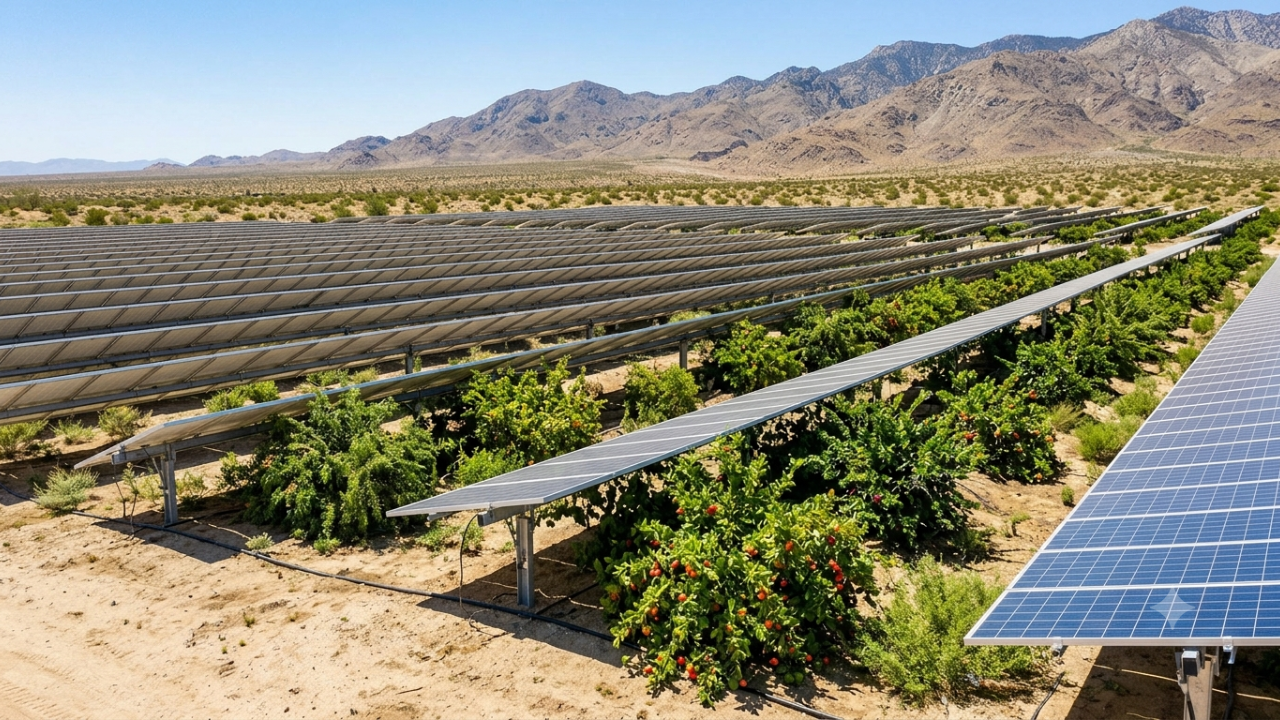
Plants inside the farm began growing differently
The difference became clearer when ecologists compared milkvetch growing within Gemini with plants in an undisturbed population on nearby federal land. Tiffany Pereira of Nevada’s Desert Research Institute led the work, tracking plants through the growing season and comparing their development and reproduction.The plants growing inside the solar facility became larger, both wider and taller, and they began producing fruit almost three weeks earlier. By the end of the season, the difference in reproduction was particularly striking.The study published in Frontiers in Ecology and Evolution, titled ‘Rare milkvetch (Astragalus) persistence at a utility-scale solar energy facility in the Mojave Desert’ reveals that the plants within the array produced around eight times as many flowers as those outside it. Fruit production was roughly ten times higher.Survival itself was not significantly different between the two groups. The distinction was what the surviving plants were able to do with the growing season they had.For an annual plant, reproduction is the part that carries a population forward. Flowers lead to fruit, fruit contains seeds, and those seeds may remain in the soil until another suitable season arrives. A population that produces substantially more seed has more opportunities to persist when conditions change.
How the panels helped soil hold moisture longer
The rainfall itself was not increasing. Instead, the panels changed where water went and how quickly it was lost. Soil beneath and between the rows could remain moist for longer, extending the period during which the milkvetch could make use of a rainfall event.That is especially relevant in the Mojave, where the difference between a brief pulse of moisture and moisture that remains available for several additional weeks can affect the entire reproductive cycle of an annual plant.The panel layout therefore became part of the plant’s environment. Row spacing, panel height, shade and drainage were no longer simply engineering considerations. They also influenced the small-scale conditions experienced by vegetation growing around the infrastructure.
The answer was buried beneath the desert floor
There is another detail behind the unexpected result. The milkvetch did not appear on a completely cleared and reconstructed site.The decision to limit disturbance meant that existing soil and vegetation were left in place across much of the development area. That gave seeds already held in the ground a chance to remain viable. The 12 plants recorded before construction were only the individuals that botanists could see at the time; the soil could contain many more seeds from previous generations.Once the solar array changed the conditions at ground level, some of those seeds were able to germinate in a setting that proved favourable to the species.This is part of why the finding is difficult to reduce to a simple claim that solar panels are good for desert plants. The outcome depended on both the physical effects of the panels and the way the site was constructed.A solar project that removed vegetation, heavily graded the ground and disturbed the seed bank could produce a very different result.
The rare plant’s comeback came with a few big uncertainties
The numbers at Gemini provide a useful measure of what happened. Before construction, only 12 threecorner milkvetch plants were recorded. By 2024, surveys identified 93 within the fenced solar facility.The increase does not by itself prove that the solar installation will secure the species for the long term. The follow-up period was still short, and annual desert plants can respond strongly to changing weather from one year to the next.There are also limits to applying the result elsewhere. Different plants may respond differently to shade, altered rainfall patterns or changes in temperature. Even within the same species, panel height and spacing could change the balance between useful shelter and excessive shade.The researchers therefore treated the Gemini result as a site-specific observation with implications for how future solar developments might be designed, rather than evidence that solar farms universally improve wildlife habitat.