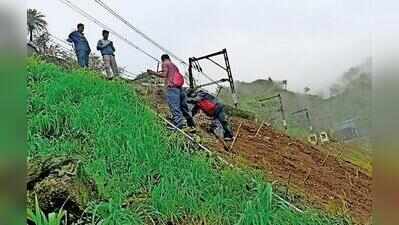
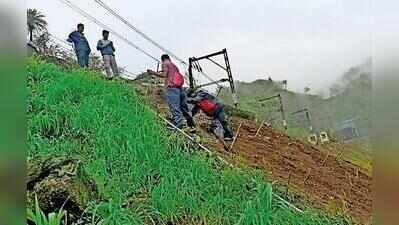
As Nepal counts the cost of its recent disaster, a humble grass, with roots in India, is drawing fresh attention as a low-cost line of defence against floods and landslides.Vetiver, known for its essential oils and herbal remedies, is being revived today for another application of its dense and deep root system: its ability to bind soil, slow runoff and hold slopes together, even in heavy rain.Last week, in a pilot project commissioned to an agribusiness firm, Central Railways had 10,000 slips of vetiver (Chrysopogon zizanioides) planted across 5,600 sq m of hill slope in the Bhor Ghat section, between Karjat and Lonavala. On July 6, a landslide triggered by heavy rain tore through a portion of the tracks here, halting train services for 23 days.According to the Geological Survey of India, 12.6% of the country’s land area (excluding snow-covered regions) is prone to landslide hazards — a figure that climate change and unchecked development could push higher.Central Railways has conventionally relied on grey engineering — concrete and steel — to stabilise slopes and reinforce embankments after such disasters. For the first time this year, its toolkit also includes vetiver, the living nail, whose roots have a tensile strength one-sixth that of mild steel.“Central Railways hasn’t used bioengineering before (engineered solutions derived from nature), but we’re using it now on high embankments compromised by rain, where the soil has lost its shear strength,” says a CR official. Two sites, 1 km and 15 km from the landslide, have been chosen for the ongoing Rs 5 lakh pilot, with slips planted along the hill contours.Hedges formed by close-set clumps of vetiver slow surface runoff above ground, letting it percolate, while binding soil below with a contiguous bulwark of roots. It’s a sustainable, cost-effective solution Central Railways plans to study over the next few monsoons before expanding it to more slopes.“When rainwater infiltrates the ground, pore water pressure rises. The goal is to relieve that pressure and allow water to drain out speedily,” says Chandan Ghosh, former head of the Resilient Infrastructure Division at the National Institute of Disaster Management. “Vetiver roots form a porous infrastructure that channels rainwater through the slope face, reducing the chance of instability.”At a nursery in Neral, 45 km from the Lonavala ghats, millions of C. zizanioides shoots wave stiffly in the breeze. This belongs to Saguna Sustainability Solutions, the company running Central Railways’ pilot.Its founder, Chandrashekhar Bhadsavle — who also runs the agrotourism resort Saguna Baug in Neral — has studied vetiver for over a decade and calls it a wonder-grass for keeping ground intact.“Vetiver slows wildfires, increases rainwater percolation, and improves soil health, benefiting surrounding plants,” he says, adding that the zizanioides variety is fast-growing and non-invasive.In a study on vetiver’s ability to boost rainwater conservation and reduce runoff, Bhadsavle and his associates Anil Nivalkar and Parshuram Agival found the grass absorbed nearly 100% of incident rainfall, compared to 40% on barren soil. “The tall shoots intercept rainwater falling both vertically and laterally,” explains the farmer-innovator, who is now studying the plant’s effectiveness in reducing soil salinity.Governments, too, are giving the grass a go. To secure vulnerable slopes, the Himachal Pradesh State Disaster Management Authority launched a bioengineering pilot with vetiver last year, setting up a nursery in Solan to supply slips for large-scale plantation.Its benefits, however, cover more ground. Vetiver is a natural soil revitaliser that enhances surrounding plant growth by raising soil organic carbon and water retention and generating mulch. It also wards off pests, filters toxins, and blocks weeds — a kind of samurai of the soil.Last week, the Central Industrial Security Force (CISF) deployed it in a land restoration drive, planting a lakh vetiver slips alongside 1,000 trees across six acres of the Yamuna’s riverbanks in Delhi, to turn the site into an urban forest. Praveer Ranjan, DG, CISF, hailed it for its ability to provide flood protection, stabilise riverbanks and even treat contaminated water. “It is also of immense use to hill states, where a number of landslide zones have developed due to construction of roads and hydropower projects,” he said.Ranjan credited Patanjali Jha for driving its uptake. Jha is a retired Indian Revenue Service officer whose no-till regenerative farm, Vanya Organics, near Indore, is grounded in vetiver science. His advocacy has spurred the plant’s use by the Ecological Task Force, tea producers Amalgamated Plantations Pvt Ltd, and now CISF.CISF’s proof of concept for the plantation was a 3-acre coal dump in Dhanbad—a bio-remedial project undertaken by Vinay Kalja, IG Training, in 2021 that transformed a barren hillock into forest. A home ministry endorsement this year has placed vetiver at the heart of several plantation drives, with nurseries set up at several CISF Reserve Battalions and Regional Training Centres.(It was, incidentally, the World Bank that scaled Vetiver Grass Technology as a soil and water conservation solution in India in the 1980s.)Kajla, who has been part of disaster response operations including the 2013 Kedarnath floods, stresses the need to prioritise mitigation, “particularly in hilly areas being sliced almost vertically to build new roads quickly,” which heightens landslide risk. Meanwhile, encroached riverbanks, like in northern Nepal, disrupt natural hydrology and worsen flooding. “It’s cheaper to invest in mitigation than rehabilitation — nearly a 1:10 difference.”P.N. Subramanian, director of the India Vetiver Foundation, says vetiver and concrete carry a similar cost differential as soil-stabilising technologies. “It is also hardy — it can grow in acidic, sandy or saline soil, in flood and drought conditions, and across temperatures from -15°C to 55°C,” he says. It can even regrow after forest fires. “But the grass may have limited effectiveness as a landslide prevention measure in cities like Mumbai, because it needs space to spread” — something even humans here can barely manage.It’s not just soil, but water on which the plant works its magic. Sara Parwin Banu, Professor of environmental sciences at Tamil Nadu Agricultural University (TNAU), Coimbatore, has found that vetiver roots—suspended as hydroponic floats—can sequester up to 90% toxic chromium and heavy metals from effluents.“There are like special microorganisms around the roots which help this plant survive in different conditions, including industrial wastewater and polluted municipal waterbodies,” says Banu, who has deployed these floats in a pilot project on Ukkadam lake in Coimbatore.The TNAU Floating Wetland System, patented in 2024, has been found to significantly reduce the level of nitrates (62%), phosphates (50%) and coliform bacteria (80-85%) in polluted water. Banu is now working on converting the spent roots, after oil extraction, into biochar to secure carbon credits. “We’re also trying to find applications for it in the handicraft sector,” she says.Vetiver has a long history in India, the land of its birth, where it was used as a fence crop in ancient times for the same reasons it has been revived today.“It’s a simple solution to complex land and water problems,” says Ghosh. “Perhaps its simplicity led to its neglect, but that’s now changing. With growing awareness and field demonstrations, national and state agencies are beginning to recognise Vetiver’s potential as a cornerstone of ecosystem-based resilience.”