For decades, scientists have known that the Ontong Java Plateau, the world’s largest oceanic plateau, was created by an extraordinary burst of volcanic activity more than 100 million years ago. What remained uncertain was how enormous volumes of magma travelled through the Earth’s lithosphere during that event. According to the study published in Advancing Earth and Space Sciences, titled “Dike Swarms in the Oceanic Lithosphere Beneath the Ontong Java Plateau”, the answer may still be preserved beneath the Pacific Ocean. By analysing high-frequency seismic waves, researchers uncovered evidence of ancient magma pathways hidden deep inside the plateau’s lithosphere. Rather than disappearing after the eruptions ended, these underground dike swarms appear to have permanently reshaped the surrounding rocks, offering fresh insight into how one of Earth’s greatest volcanic provinces formed and evolved over geological time.
How seismic waves revealed hidden magma pathways beneath the Pacific Ocean
The Pacific Ocean conceals far more than underwater mountains and deep trenches. Beneath one enormous volcanic plateau, the rocks themselves appear to preserve the routes taken by magma more than 100 million years ago. Those pathways have remained buried ever since, offering little indication of their existence from the surface.According to a study, the interior of the Ontong Java Plateau contains evidence of ancient magma-filled fractures that once carried molten rock upwards during one of Earth’s largest volcanic episodes. Rather than relying on direct observation, the team reconstructed this hidden landscape by studying the behaviour of seismic waves travelling through the plateau. The results point to an underground structure unlike that found beneath typical oceanic crust, suggesting that the effects of the plateau’s formation extended much deeper than previously recognised.
Seismic study reveals ancient dike swarms beneath the Ontong Java Plateau
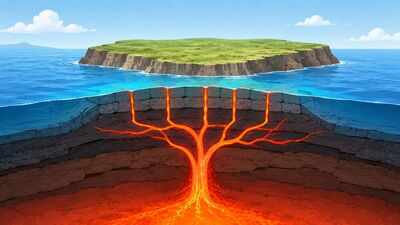
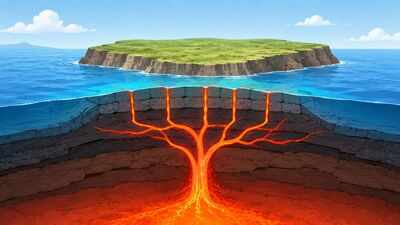
The Ontong Java Plateau occupies a vast area of the western Pacific and is regarded as the largest oceanic plateau on Earth. It formed during an immense burst of volcanism around 110 to 120 million years ago, yet many questions have remained about how molten rock actually moved through the older oceanic lithosphere beneath it.To investigate that problem, the researchers analysed high-frequency seismic waves generated by distant earthquakes. As these waves travelled through the plateau, they behaved differently from waves passing beneath ordinary oceanic crust elsewhere in the Pacific. Some waves weakened more rapidly, while others travelled at slower speeds.According to the study, these unusual seismic signals are best explained by a hybrid internal structure. Instead of containing only the layered rock fabric normally expected beneath oceanic plates, the lithosphere beneath the plateau also appears to include numerous vertical dike swarms. These dikes are interpreted as ancient magma conduits that became preserved within the surrounding rock after volcanic activity ceased.
Scientists model hidden dike swarms beneath the Ontong Java Plateau
The researchers used numerical simulations to test different underground structures capable of reproducing the observed seismic behaviour. Models containing only horizontal layering could explain ordinary oceanic lithosphere but failed to match the signals recorded beneath the Ontong Java Plateau.A better fit emerged only after introducing vertically oriented dike-like structures alongside the existing layered fabric. Reportedly, these preserved dike swarms represent the pathways through which magma rose from a deep thermochemical mantle plume before reaching the surface during the plateau’s formation. Rather than replacing the older lithosphere, the magma appears to have intruded into it repeatedly, creating a network of conduits that remained embedded long after the eruptions ended.The proposed model also helps explain how such a massive volcanic province could develop while leaving lasting signatures inside the underlying lithosphere instead of affecting only the crust above.
Ancient magma left a permanent mark beneath the Ontong Java Plateau
The investigation also found that seismic waves travelled more slowly beneath the Ontong Java Plateau than through neighbouring sections of normal oceanic lithosphere. Thickness differences alone could not account for that contrast.The slower wave speeds indicate that the lithospheric mantle was chemically modified when magma penetrated the older rocks. The researchers suggest that minerals carried by the melt may have changed the composition of the surrounding mantle, producing long-term differences that are still detectable through seismic imaging today.This interpretation points to a lasting geological imprint rather than a temporary thermal effect. Even though the volcanic activity ended millions of years ago, the mantle beneath the plateau still appears to retain evidence of that ancient episode.
How the plateau reshaped the oceanic lithosphere
Much of what lies beneath large volcanic plateaus has remained uncertain because direct sampling of deep oceanic lithosphere is extremely limited. High-frequency seismic waves provide one of the few ways to investigate those hidden regions without drilling through tens of kilometres of rock.According to the study, the Ontong Java Plateau preserves a combination of layered lithosphere and ancient magma-filled dike swarms that together record how a thermochemical mantle plume interacted with pre-existing oceanic crust.The researchers say this hybrid structure improves understanding of how large volcanic provinces reshape the lithosphere beneath them, leaving behind geological features that can survive for more than 100 million years after the eruptions themselves have ended.