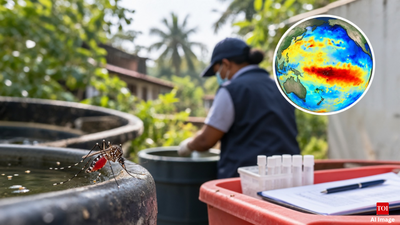
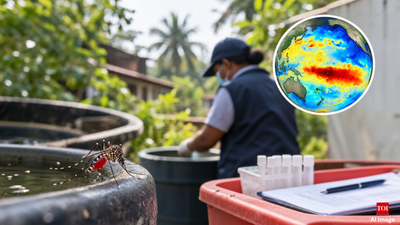
PUNE: El Niño-linked warming in the Pacific Ocean could increase dengue risk in Kerala, according to a study led by the Indian Institute of Tropical Meteorology (IITM), Pune.The findings could help health authorities get an early warning of dengue outbreaks months in advance.Kerala is currently experiencing a severe dengue season, with 7,188 confirmed cases recorded between June and August, around 60% above the decade-long average for the same period, according to data from the Kerala directorate of health services.Published in the GeoHealth journal on Wednesday, the study analysed 14 years of dengue and climate data from Kerala between 2006 and 2019. Researchers found a clear link between El Niño years and higher dengue incidence.The study found that warmer Pacific waters were associated with warmer and relatively drier pre-monsoon conditions in Kerala. These conditions can create a favourable environment for mosquito breeding before dengue cases rise during the monsoon.
El Niño linked to higher dengue cases in Kerala
The study was led by Sophia Yacob and Dr Roxy Mathew Koll of IITM, in collaboration with ICMR’s National Institute of Translational Virology and AIDS Research (ICMR-NITVAR) and Savitribai Phule Pune University.“In our model-based analysis, Kerala’s high dengue years coincided with El Niño, while mild dengue years fell in La Niña years,” Dr Koll said.Researchers also developed a machine-learning model to turn the climate link into a dengue forecasting tool. The model explained 72% of monthly variations in dengue cases in Kerala.The model suggested that climate-driven dengue cases could increase by 16-20% by 2040 and by up to 113% by the end of the century under a high-emissions scenario.
Kerala dengue risk can be forecast months in advance
The researchers found that Pacific sea-surface temperatures had their strongest correlation with dengue cases in Kerala about three months in advance.“When humidity and temperature patterns are included, the lead time extends to nearly five months, enough to allow authorities to strengthen mosquito-control measures and prepare hospitals ahead of seasonal spikes,” Yacob said.The researchers cautioned that the study period ended in 2019 and therefore could not directly attribute Kerala’s current dengue season to the ongoing El Niño event. Instead, the study identified a historical pattern that mirrored present conditions.
El Niño influence on dengue differs between Kerala and Pune
The findings build on the team’s earlier research focused on Pune, which projected that dengue risk in the city could rise by 13-112% under warming scenarios.Dr Koll said El Niño had a weaker influence on dengue risk in Pune than in Kerala.“We found that the role of El Niño in dengue risk over Pune is weak, while local weather conditions play a major role. In Pune, a combination of temperatures above 27°C, moderate and evenly distributed rainfall, and humidity between 60% and 78% during the monsoon (June-Sept) increases dengue incidence,” he said.
Climate only one factor in dengue outbreaks
The study also highlighted that climate was only one part of the dengue equation. Vector control, water storage practices, waste management, urbanisation and disease surveillance continue to play a critical role in determining the severity of outbreaks.“Climate signals can give us a head start by several months,” Dr Koll said, adding, “Combined with health and mosquito surveillance, they can help us intensify vector control, prepare hospitals and reach vulnerable communities before the seasonal surge.”Co-author Dr Sreelakshmi PR, scientist at ICMR-NITVAR, said the findings underscored the need to integrate climate indicators into routine dengue surveillance rather than relying solely on case counts.