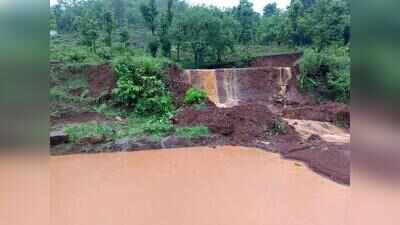
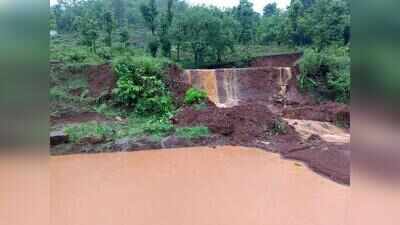
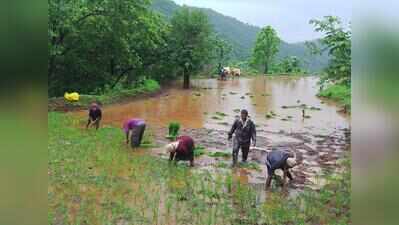
Pune: Tribal farmers of Ambegaon tehsil in Pune district have demanded that the Maharashtra govt redesign its padkai scheme to make it more scientific and implement it to ensure effective soil conservation.The demand has emerged from the western tribal villages of Ambegaon — including Malin, Bhimashankar, Ahupe and Patan — where agriculture depended on traditional earthen bunds that retain rainwater and prevent soil erosion on hill slopes. Farmers said heavy rainfall in July had destroyed hundreds of bunds damaging vast stretches of agricultural and threatening their livelihoods.The padkai scheme is a land development and agricultural initiative used mainly in the tribal hilly regions of Maharashtra, particularly in the Western Ghats, to create cultivable land on steep mountain slopes. It includes cutting and leveling sections of hill slopes, creating step-like terraces (padkai fields) suitable for farming, compacting the soil to reduce erosion and developing small, flat plots primarily for rice cultivation.The padkai scheme was prevalent in tribal areas until 2014. It focused on construction and strengthening of farm bunds, conservations of soil and water, reclamation of degraded land and generation of rural employment. After the Malin landslide in 2014 wherein 151 people died, the govt banned use of any machines and declared that all work regarding soil conservation would be done manually. The changed rule led to a decrease in participation of farmers in the scheme.Hundreds of farmers have now demanded that the padkai scheme be revised, allowing 60% of the project cost to be paid as wages to local workers, while the remaining 40% be earmarked for machinery and earth movers. They said the existing norm of a complete ban on the use of machines did not serve any purpose.Ambegaon tehsil agriculture officer Siddhesh Dhavale told TOI: “Farmers and other organisations have sent memorandums in this regard. Recent guidelines said the soil and water conservation department will implement the soil conservation works and schemes. We have sought clarification to determine which agency will be responsible. That done, we will table the farmers’ fresh demand before experts.”Farmers claimed that discontinuation of machines like earth movers had left them vulnerable to recurring climate-induced disasters. “Our demand is not the govt restart the old padkai scheme. Instead, we want a revised scheme based on scientific studies. Every monsoon, our bunds collapse, fertile soil gets washed away and we are forced to start from scratch,” said Vijay Lembe, a farmer from Malin village.Farmers said mechanisation had become essential because rebuilding damaged bunds required moving massive quantities of soil and rocks within a limited agricultural season. “The govt should redesign the scheme with geological surveys, engineering supervision and modern technology. Without financial support and machines, poor tribal farmers cannot restore their farms after every spell of heavy rainfall,” said Digambar Bhalchim, former sarpanch of Malin village.Farmers said traditional bunds are the backbone of paddy cultivation in the Sahyadri hills. “It slows the flow of rainwater, prevents soil erosion and retains moisture in terraced fields. Once breached, the fertile topsoil accumulated over decades is washed downhill, leaving behind rocky land that often takes years to recover,” said activist Budhaji Damse.Damse said, “Earlier, farmers would own bulls, which is not the case anymore. It is impossible to break and shift large rocks without machines. Shifting soil from one side of the farm to another is time-consuming and the quality of work remains poor. Proper quality is possible only through machines. Therefore, we have demanded the scheme be redesigned. However, it needs to be implemented under the supervision of the agriculture and revenue officials to prevent misuse of machines on hilly slopes.”Meanwhile, experts said the farmers’ demand deserves serious consideration, particularly as extreme rainfall events have become more frequent across the Western Ghats.“Soil and water conservation cannot be abandoned because of one tragedy. The lesson from Malin is that watershed works in ecologically sensitive regions must be preceded by detailed geological, hydrological and geotechnical investigations. Scientific planning, not discontinuation, is the solution,” a former director of extension education at Mahatma Phule Krishi Vidyapeeth, Rahuri, told TOI.Agricultural scientists said watershed structures, such as farm bunds, remained critical to conserve moisture and prevent erosion in rain-fed tribal agriculture areas.“Soil conservation has become extremely important with climate change increasing rainfall intensity. Farm bunds reduce runoff, improve groundwater recharge and help preserve fertile topsoil. Future watershed programmes should integrate scientific mapping, engineering standards and continuous monitoring,” said an tribal belt agricultural expert.Farmers said the earlier padkai programme had helped improve agricultural productivity across several tribal villages by reclaiming land, strengthening bunds and creating seasonal employment. They said a revised version would restore damaged farmland and provide employment to tribal communities during the monsoon.“We will not be able to cultivate paddy on hundreds of acres of land in tribal villages if we do not repair the damaged bunds and stop rainwater from flowing through our farms,” said Akash Lembe, another villager from Malin.Some farmer groups have urged the state govt to constitute an expert committee comprising geologists, agricultural engineers, watershed specialists and representatives of tribal communities to prepare guidelines to implement the revised padkai scheme in the fragile hill terrain.