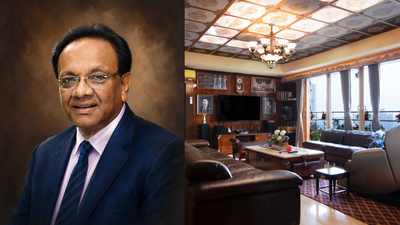
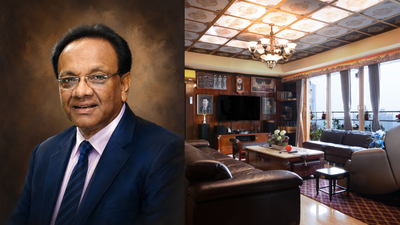
KOLKATA: In a city where old buildings, markets and memories are constantly being remade, a quiet group of Kolkata changemakers is proving that waste need not be the end of a material’s journey.They are architects, educators, entrepreneurs and recyclers who see discarded glass, plastic, electronics, agricultural residue and construction scrap not as rubbish, but as resources waiting for imagination.Their work goes beyond individual innovation.By turning reuse and recycling into homes, schools, furniture, infrastructure and responsible disposal systems, these waste warriors are reshaping how Kolkata thinks about consumption.They show that sustainability is not only about reducing harm, but also about creating beauty, livelihoods, resilience and value from what society has been trained to throw away.Pradip Chopra made his name building some of Kolkata’s plushest lifestyle apartments.As chairman and managing director of the PS Group, he understood glass, steel, marble and the language of luxury.Yet when it came to his own home, Chopra chose a different vocabulary: discarded glass, salvaged fittings, old microwave turntable plates, reclaimed wood and materials most builders would have sent to landfill.His house became a quiet rebellion against the idea that aspiration must always mean something new.Nearly everything in it tells a second-life story.Glass panels once used in Cadbury display units became part of the architectureObjects stripped from old buildings found fresh purpose. Waste was not hidden; it was designed into beauty.For Chopra, this was not a decorative experiment but a philosophy shaped over decades.Long before sustainability became fashionable, he was recovering tin from factory scrap, washing street plastic and exploring recycling as an enterprise.Later, through iLEAD, he began turning that conviction into education, offering courses in sustainable fashion and sustainable interior design.His book, Waste: A Great Untapped Business Opportunity, carries the same message: India’s growth story can be built not only by consuming more, but by wasting less.That idea is now echoed by others across Kolkata. Mukti Gupta’s Adhigam Bhoomi is one of the city’s most evocative examples. Designed as a modern gurukul, the school rejects the cold uniformity of conventional construction.Bamboo, cow dung, agricultural residue and discarded industrial material come together to create classrooms that are earthy, cool and alive.The glass in parts of the campus comes from old Cadbury mini-fridges. Gobar is used as natural plaster and insulation.Agricultural waste appears in panels, furniture and finishes. The result is not a compromise but a lesson in itself.Children learn that sustainability is not a chapter in a textbook; it is the wall beside them, the chair beneath them, the air they breathe.Ranjan Kumar Gupta is taking another route. His work with mixed municipal waste addresses one of the hardest problems in recycling: recycling plastic. Paving+ is converting low-value waste into durable, carbon-negative construction materials and road solutions.The technology blends circularity with performance, enabling developers, contractors, and governments to build stronger, greener, and more cost-effective infrastructure.This far, Paver+ claims to have cleared 50,447 cubic feet of landfills to create paver blocks, precast products, concrete wall panels, eco roads and different types of concrete flooring.Then there is Sriyam Mall, co-founder of Huladek, who, along with founder Nandan Mall, changed the way businesses thought about e-waste.Nandan passed away in August 2025, but not before he had built Huladek into a trusted name in responsible electronics collection and recycling.Their focus was practical: offices, schools and small companies upgrading laptops, printers, phones and other devices needed a safe, certified channel for disposal.Huladek provided that bridge. It collected e-waste, routed it through authorized systems and issued certificates of responsible recycling or upcycling.In doing so, it kept toxic metals and plastics away from soil and water while recovering valuable materials for reuse.Together, Pradip Chopra, Mukti Gupta, Ranjan Gupta and Sriyam Mall represent a Kolkata tradition of reinvention.They are Kolkata’s waste warriors who are turning scrap into sustainable futures.Their work demonstrates that a cleaner, circular and Viksit future will not be built only in boardrooms and factories.It will also be built from yesterday’s rejects, redesigned with imagination and returned to life with purpose.