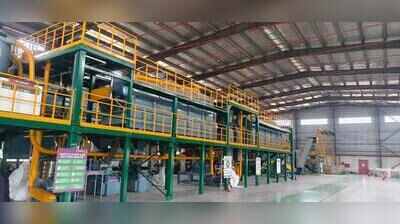

IREL (India)’s proposed mining and processing sites under a joint venture with TAMIN in Tuticorin will produce Neodymium-Praseodymium (NdPr) oxide, supplying for domestic NdFeB permanent magnets manufacturing programme, said S B Mohanty, chairman and MD of IREL (India), a central PSU under the Department of Atomic Energy. In an interview, he said the facility will attract mid-stream processing in rare earth oxides and Titanium supply chains for various applications, and the proposed rare earth corridor will have a significant clustering effect. Edited excerpts:What do joint ventures with TAMIN aim to do? What’s the current progress?The proposed joint venture between IREL and TAMIN was formed in June 2023 to set up integrated mining and processing facilities for mineral sands deposits at Sattankulam and Kudhiraimozhi teri deposits. The Atomic Minerals Directorate (AMD) has submitted the exploration report to the state govt and we are waiting for the state to demarcate the land. After that, the report goes to the Department of Atomic Energy, which will nominate the lessee to begin pre-project activities and statutory clearancesWhat will the focus of the new facility be?It will be an end-to-end facility for mining and refining beach sand minerals such as Ilmenite, Rutile and Monazite.
CJP Jantar Mantar Protest Updates
These deposits contain lighter rare earth elements essential for manufacturing, including Neodymium, Praseodymium, Cerium, and Samarium. We will process up to the intermediate oxide level, specifically producing NdPr (Neodymium-Praseodymium) oxide. This material will be supplied directly to private domestic manufacturers who are stepping in under the Ministry of Heavy Industries (MHI) incentive schemes to produce NdFeB permanent magnets. Magnets currently account for 80% of all rare earth usage. Establishing this domestic oxide-to-magnet manufacturing base is critical for supplying key downstream industries, including wind turbines, the automotive sector (EVs), medical scanning equipment, space exploration, and defenceDo you see any interest from private players?We are witnessing a lot of interest from companies. As we are solving the foundational raw material bottleneck, huge downstream industries will flock to the area to set up shop near our facility. There are two major opportunities. First is the rare earth supply chain, and eventually, TN auto manufacturers will be able to get their motors and rare earth magnets directly from this local ecosystem. Secondly, Ilmenite and Rutile pave the way for manufacturing synthetic Rutile, Titanium pigment, slag, and Titanium sponge. Currently, India has a massive deficit in this area. It is used in the paint, plastic, paper, and textile industry and due to its high strength-to-weight ratio, it is an essential component for aerospace and defence manufacturing.What kind of investment and timeline will the JV entail?We estimate an investment of around Rs 3,500 to Rs 4,000 crore just for the primary processing plant. Once we get all the final permissions, it will take about two to three years to set up the plant, from designing the basic engineering and getting the machinery, which can sometimes be delayed by supply chain issues. Once operational, we have enough reserves at these blocks to run for 20 to 30 years.How will this project benefit TN?The state will benefit from a clustering effect. For the JV itself, we expect to generate direct and indirect employment for about 3,000 to 4,000 people. To attract these private and foreign players, the state govt must provide plug-and-play facilities, which include offering land, electricity and specialised industrial incentives. The state must integrate its existing industrial incentive plans to fit the specific needs of the newly announced rare earth corridor. Furthermore, the state govt needs to move quickly to recommend statutory permissions, such as the Coastal Regulatory Zone (CRZ) clearances, so projects can actually commence early. States like Andhra Pradesh and Odisha are moving at a much faster pace.How do you respond to criticism of radiation?The perception that beach sand mining increases radiation and is carcinogenic is wrong. Studies by BARC show that mining reduces the local background radiation. This reduction happens because the mining process physically extracts monazite, which contains radioactive thorium. Once this radioactive element is removed, the remaining 90% of the sand is refilled into the ground, leaving the entire area radioactivity-free and significantly safer for the local community.Unlike hard rock mining, there is no blasting. We simply use excavators. The raw sand contains about 10% to 12% heavy minerals. We simultaneously extract that 10% and immediately refill the remaining 90% of the sand and plant vegetation over the refilled areas. This means there is absolutely no change to the local topography. Building this domestic supply chain is a massive national security imperative because single dependency is weaponised by different countries.What is the progress of the Inaiyam Midalam project?Inaiyam-Midalam is a completely separate project. We received the Letter of Intent from the government for this project back in 2021. The mining block covers 1,144 hectares of land. Once we extract the minerals from this location, we will send them to our existing Manavalakurichi (MK) unit. We are currently in the middle of obtaining statutory clearances.