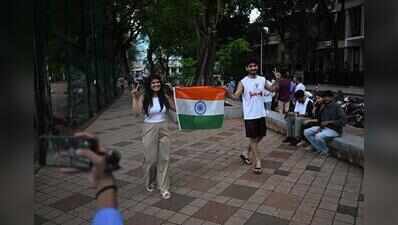
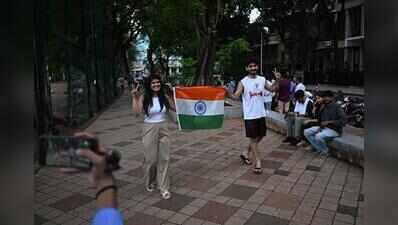
Mumbai: They balanced on the compound walls of Art Deco buildings, jumped on top of stationary police vans, and wore the national flag on their shoulders. The crowds at Friday’s Tiranga rally held cheeky placards and proud banners: “They said Gen Z only knows how to scroll. Turns out they know how to take a stand.”For much of the past week, they have taken that stand not at Azad Maidan, the officially designated space for protests at CSMT, or in Instagram-famous Bandra, but at Shivaji Park, a historic space closely associated with the city’s particular brand of street politics.The advantages of the neighbourhood are evident: a large open space; well connected by public transport, especially with the addition of the new Aqua Metro line; and, perhaps most importantly, accustomed to political gatherings, especially by the Shiv Sena and the Thackerays, who have thrown their backing behind the Cockroach Janata Party (CJP) movement to hold the govt accountable for the NEET exam leaks and other education failures.
CJP Jantar Mantar Protest Updates
The protests give the Thackeray cousins an opportunity to regain political relevance — even without hoisting their party flags. The Shiv Sena (UBT) had lost ground after Eknath Shinde split the party in 2022, and the MNS led by Raj Thackeray has been politically sidelined. But Sena (UBT) chief Uddhav Thackeray was an early supporter of both the CJI’s Abhijeet Dipke and the activist Sonam Wangchuk. Uddhav had received Wangchuk at his residence on June 12 and held a public rally in his support at the park on July 19. On Friday, Uddhav, son Aditya, and Amit Thackeray, Raj Thackeray’s son, shared a stage not only with CJP representatives but also one-time opponent Tushar Gandhi.With no impending elections, the Thackerays’ support had no political agenda, claimed a senior Sena (UBT) functionary. “But it has rejuvenated our party and made us more relevant, especially with the young,” he acknowledged. More importantly, he says, the movement has demonstrated that the BJP is not invincible.Young people at Friday’s protest certainly seemed conscious of the need for diverse political representation. “The problem is that all power is concentrated in the hands of one party, in the Centre and states. So, they don’t want to listen to anyone,” said Nilesh Sutar, a BCom student. For others, this protest may be the beginning of political engagement. Akanksha, 19, from Mumbra plans to take NEET next year—and register as a voter by the next election. “Now I know who not to vote for,” she said.Interestingly, this was also the first protest for many older people as well, from parents to working professionals. But for many residents of the neighbourhood, some of whom also showed up at the protest, the gathering was hardly strange.Politics of a ParkShivaji Park has a long history of being a space for political struggle, one that predates its use as a recreation ground, notes 86-year-old Shanta Gokhale, a writer who has lived in the neighbourhood for most of her life. That history dates to the Independence movement. “During one of Gandhi’s imprisonments, his wife, Kasturba, had to speak on his behalf, and it was at the park that she did so,” Gokhale says.But it was in the 1960s that the park really gained importance by hosting rallies for the Samyukta Maharashtra statehood movement. Uddhav’s grandfather, Prabodhankar Thackeray, lived south of the park, and the writer P K Atre, who was involved in the statehood movement, lived north of the park, Gokhale recalls. “Political culture was part of Shivaji Park culture at one time along with music, gymnastics and cricket,” she says.Later came Shiv Sena founder Bal Thackeray’s massive Dussehra rallies. Lakhs of people also camp out every year in and around the park in the run-up to Babasaheb Ambedkar’s death anniversary at Chaityabhoomi on Dec 6. Large crowds also flood the area during Ganpati Visarjan. And recently, the space has also begun to be used for state funerals like Lata Mangeshkar’s in 2022.The current protests are thus less a “revival” of the park’s political function but a “continuation”, Gokhale says. Most of Friday’s protesters came from distant suburbs, not the immediate neighbourhood, whose culture and demographics are changing as swanky new towers replace three-storey tenanted buildings. Gokhale lives in one of those buildings, and though she no longer steps out much, she’s been hearing the slogans from her window. “I sit and fume every time there’s a paper leak,” she says. “I am with the protesters. More power to them.”