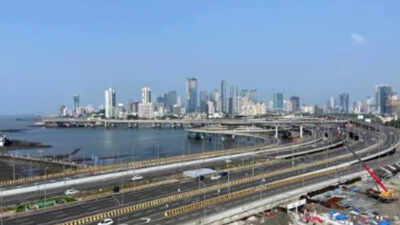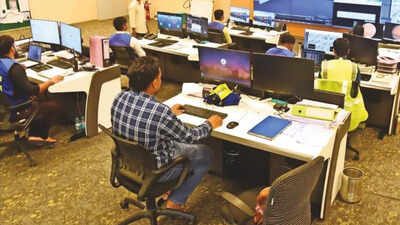
MUMBAI: At 12.08pm on July 15, an alert flashed across the 30×6-ft video wall inside the Coastal Road’s Integrated Command and Control Centre (ICCC) at Breach Candy.A car had caught fire inside the southbound tunnel. Within seconds, CCTV cameras zoomed in on the vehicle, the tunnel’s Linear Heat Detection System confirmed a rise in temperature, and an emergency call from a tunnel call box reached the control room.For the team manning the nerve centre of the Coastal Road, it was the biggest emergency since ICCC became operational in Oct 2025. The fire was brought under control without any casualties. But the incident exposed an equally important challenge, managing panic among motorists trapped in a confined underground space.TOI visited ICCC, located at the edge of the Coastal Road interchange at Breach Candy. The facility integrates traffic management, tunnel ventilation, firefighting, surveillance, and mechanical and electrical systems on a single platform.While Coastal Road has separate technical buildings housing equipment, ICCC serves as the central command point for monitoring and controlling the entire corridor, including the twin tunnels.“The centre is staffed round the clock by more than 100 personnel working in shifts. Representatives from police, traffic police, fire services and other emergency agencies are also stationed here to ensure coordinated decision-making,” said a BMC official.Unlike a conventional CCTV control room, ICCC continuously monitors thousands of data points generated by the tunnel’s critical infrastructure. Officials said the system has two key components: the Traffic Management Control System (TMCS), which oversees CCTV cameras, variable message signs and incident detection, and the Plant Management Control System (PMCS), which monitors electrical, mechanical, ventilation and firefighting systems.A key safety feature is the Linear Heat Detection System — a temperature-sensitive optical cable running through the tunnel that keeps monitoring heat levels and automatically triggers an alarm if temperatures cross about 60 degrees Celsius.“The moment the system detects abnormal temperatures, an alert appears on the control room screens. Operators verify it through CCTV feeds and activate the emergency response protocol,” said an official from L&T, the EPC contractor for the tunnel package that designed and built much of the tunnel infra and MEP systems.The tunnel is equipped with an Automatic Incident Detection System that analyses live camera feeds to detect stopped vehicles, wrong-way driving, pedestrians and unattended objects. “Once the fire alert was confirmed, the control room activated multiple systems. Public announcements were made in Marathi, Hindi and English, asking motorists to be calm, leave vehicles if necessary and go to the nearest cross-passage. The tunnel’s Saccardo ventilation system — comprising three reversible axial fans — switched into emergency mode to extract smoke from the affected section,” said an official from Tap Turbo Engineers, operations and maintenance contractor for Coastal Road’s mechanical and engineering systems.Officials said that under normal conditions, two of the three fans operate at around 70% capacity to maintain air quality. During a fire, the system automatically determines the direction in which smoke should be extracted and, if required, reverses the fans to push smoke away from evacuation routes. “Our priority is not only to extinguish the fire but to remove smoke quickly because smoke poses the biggest risk to human life inside tunnels,” an engineer at ICCC said.Officials said the biggest challenge during the incident was not equipment failure but human behaviour. Several motorists ignored repeated announcements to keep the emergency lane clear. Some abandoned their vehicles while others tried to reverse, blocking the route meant for fire engines and rescue vehicles. “Our systems worked exactly as designed. The delay occurred because rescue vehicles could not move freely due to panic among motorists,” said M Swami, chief engineer, Coastal Road.The incident prompted authorities to step up public awareness on tunnel safety. Additional signage on evacuation procedures has been installed, and officials said motorists must understand that saving lives takes precedence over saving vehicles. Drivers should switch off the engine, leave the key inside if instructed, evacuate through the nearest emergency exit and avoid reversing or making U-turns in the tunnel. “The systems can manage the fire. What they cannot manage is panic,” an official said.