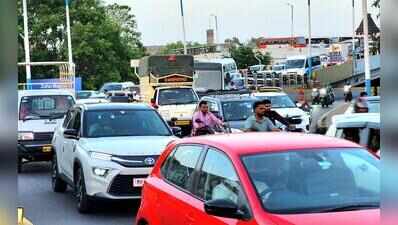
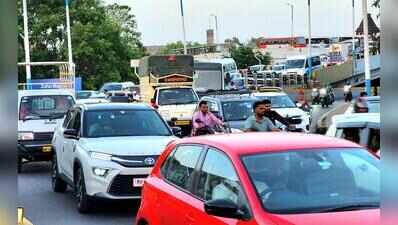
Pune: Commuters continue to face difficulties near Sancheti Junction months after traffic police barricaded the road under the CoEP flyover to regulate vehicle flow. Instead of reducing congestion, the closure has shifted bottlenecks to adjacent roads, with peak-hour queues often stretching from beneath the flyover to the U-turn near the old CID office and the JM Road approach, residents said on Saturday.“The bottleneck has been shifted from one location to another. Earlier, traffic would pile up at a single point. Now congestion stretches across the flyover, the old CID office U-turn and adjoining roads,” Mahesh Shindikar, a professor at CoEP and daily commuter, said.On Friday, traffic moved at a crawl on the CoEP flyover, while long queues were seen near the U-turn outside the old CID office. Vehicles heading towards JM Road also faced significant delays as multiple traffic streams converged near Sancheti Junction.Shindikar said the traffic around the CoEP hostel, Kalaniketan and Sancheti Junction functioned as an interconnected network, meaning disruptions at one point quickly affect the entire corridor. “The problem is not confined to a single junction. Any disruption in the surrounding network ends up choking traffic across the entire stretch,” he said.“The two carriageways near Sancheti Hospital have now been merged. Even if the barricades are removed, restoring the earlier arrangement will require redesigning the entire system. But the previous setup was certainly more effective than the present one,” the professor said.Commuter Ameet Singh said the one-way circulation loop from Shimla Office through Sancheti Chowk and the court complex had backfired, particularly for motorists trying to access JM Road. “Authorities continue to focus on road widening instead of intelligent traffic management. We have seen repeatedly that additional road space eventually gets overwhelmed by growing traffic volumes,” Singh said.He argued that transport planning should prioritise moving people rather than vehicles, warning that expanding road infrastructure alone encouraged greater dependence on private transport and led to more congestion and pollution. “Cities should be designed for pedestrians, cyclists, women, children, senior citizens and persons with disabilities. When infrastructure works for them, it works for everyone. Unfortunately, that is not the approach being followed,” Singh said.Wakdewadi resident Suhas Petkar said traffic conditions had worsened after the barricades were installed. “Queues now extend up to the CoEP gate. Instead of reducing congestion, the new arrangement has increased it,” he said, claiming that motorists unfamiliar with the route often mounted footpaths after realising they could not proceed because of the one-way system.“The narrow opening near the college gate and fast-moving traffic have increased accident risks. Simply removing the barricades will not solve the issue because the median has also been removed. The earlier traffic arrangement needs to be restored,” Petkar said.Residents of Wakdewadi have also been affected by restrictions on right turns, forcing them to take longer detours while navigating faster traffic from the opposite direction.Amid mounting complaints, Shivajinagar traffic division assistant inspector Sanjay Pandhare said the police were open to revisiting the plan. “If there is sufficient public demand, we can remove the barricades and introduce the earlier arrangement on a trial basis,” he said.