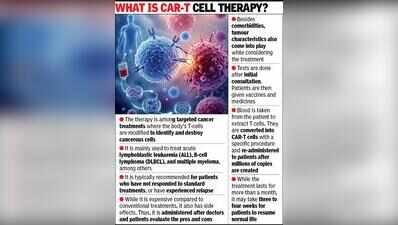
Ahmedabad: A woman from the city, in her sixties, was treated for lymphoma. Two years after she was declared cancer-free, the disease relapsed.Dr Velu Nair, chief consultant of hemato-oncology at Apollo Hospital, said she was advised CAR-T cell therapy. “We gave the therapy a few months ago. Her condition is now stable. At our centre, we have performed two procedures. A few more cases are in the pipeline. The results have been encouraging,” he said.Chimeric antigen receptor (CAR) T-cell therapy is a new-age targeted therapy that mainly works for patients with blood (haematological) cancers and a history of relapse or no response to conventional treatment protocols. According to haematologists, it is two years since the therapy was introduced, and hospitals in the city are inching closer to the 50-mark, with several private hospitals offering the treatment. The drawback is the higher cost compared with other protocols.“T-cells are the soldiers of the body. In the CAR-T cell therapy, they are extracted from the patient’s body and bioengineered before being placed back,” said Dr Nair.At HCG Aastha Cancer Centre, Dr Kaumil Patel, consultant of haematology and BMT, recently performed the first CAR-T therapy on a patient with primary refractory lymphoma, an aggressive blood cancer that did not respond to conventional treatment.“For patients with relapsed or refractory lymphoma, this therapy offers a meaningful opportunity when other treatment options have failed,” he said. “Conventional treatments available to blood cancer patients include immunotherapy and chemotherapy.”Dr Sandip Shah, a hemato-oncologist with HOC Vedanta, said that they have performed several successful procedures, and the results are encouraging. “The patients and doctors carry out analysis of pros and cons. It is not for everyone, and thus the merits of the individual case should be assessed,” he said.