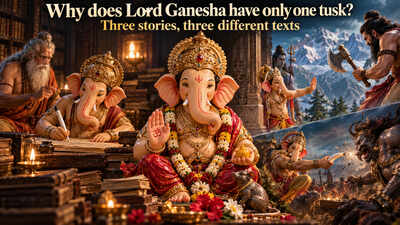
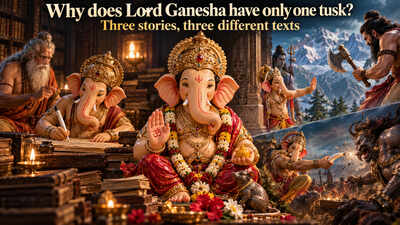
Ganesha’s single tusk is in his prayers before it is in his idols. The Ganapati Atharvashirsha, a short Upanishadic text recited in temples every day, carries the Ganesha Gayatri, which begins “ekadantaya vidmahe”, roughly, “let us know the one-tusked one.” Ekadanta, the one with a single tusk, is how devotees address him.So the missing tusk isn’t a detail an artist added to make a familiar god more interesting. It’s part of his name.Idols usually show the right tusk broken and the left one whole, though temple sculptors haven’t always agreed on which side, and older texts describing his iconography are inconsistent about it too.What nobody disputes is that three separate stories exist to explain how it happened, and each comes from a different part of the tradition, told for a different reason.
A Scribe with a Broken Pen
The most repeated version puts Ganesha in a library, not a battlefield.Sage Vyasa, composing the Mahabharata, needed someone who could write as fast as he could speak the verses. He is said to have asked Ganesha to be his scribe. Ganesha agreed on one condition: Vyasa’s dictation could not pause, or he would stop writing.Vyasa set his own condition in return: Ganesha had to understand each verse before setting it down, which gave the sage room to compose the trickier passages while Ganesha worked through their meaning.Partway through the epic, the popular retelling goes, Ganesha’s writing implement gave way. Rather than break the flow and lose the wager, he snapped off his own tusk and kept writing with it.It’s a marvellous story, and almost certainly a later one. The episode does not appear in the Bhandarkar Oriental Research Institute’s critical edition of the Mahabharata, the reconstruction scholars built by comparing hundreds of manuscripts to recover the epic’s earliest recoverable text.Because the scribe episode wasn’t present in enough of those manuscripts, it was left out, and it’s widely treated in scholarship as an interpolation added centuries after the core poem was composed.That doesn’t make it fake, exactly. It makes it a separate, later tradition that attached itself to the epic because the image was too good to resist: the god of wisdom sacrificing his own body to make sure knowledge got written down.
The Guard Who Wouldn’t Fight Back
A second story moves the scene to Mount Kailasa and gives Ganesha a different job altogether: not scribe, but sentry.Shiva was deep in meditation, and Parvati had set Ganesha at the door with instructions to let no one through. Parashurama, the warrior sage who carries Shiva’s own axe, arrived wanting to see his guru and found the way blocked by a young god who wouldn’t move.Accounts of what followed vary in their details, but the turning point is consistent: when Parashurama finally hurled the axe at him, Ganesha recognised it as his father’s weapon and chose not to defend himself against it. He took the blow on his tusk rather than dishonour something Shiva had given away.This version is most fully told in the Brahmavaivarta Purana, whose Ganesha section devotes a chapter to it, though the Padma Purana and the Brahmanda Purana carry related accounts, so the attribution isn’t as tidy as popular retellings suggest.What the story does that the Vyasa episode doesn’t is turn Ganesha into a son first. His obedience isn’t to a task but to a relationship, and the tusk is the price of that loyalty.
The Demon Who Became a Mouse
A third telling, stronger in Tamil temple lore and in the Ganesha-focused Puranas, drops the domestic framing entirely and makes Ganesha a warrior.Gajamukhasura, an elephant-faced demon, had won a boon that made him immune to any weapon forged by god or man. Every divine missile Ganesha threw at him simply bounced off.So Ganesha broke his own tusk, since it was neither forged nor a conventional weapon, and threw that instead. It worked. The demon’s boon had no answer for it, and a defeated Gajamukhasura begged forgiveness and was allowed to live on as the mouse who now carries Ganesha, his vahana, or mount.The Mudgala Purana gives this pattern a wider frame. It describes eight avatars of Ganesha, each one summoned to defeat a demon representing a specific human failing, and among them is Ekadanta, whose adversary is Madasura, the demon of arrogance and intoxication.Read against that structure, the single tusk stops being a wound and starts looking like an argument: that the whole self, undivided by pride into two competing halves, is what actually finishes a fight.Three texts, three reasons for the same broken tooth: to finish a book, to honour a father, to end a war.Whichever one your family tells, the idol on the chowki this Monday carries all three — and a fourth reading besides: that the thing he gave up was the half of himself that was proud.