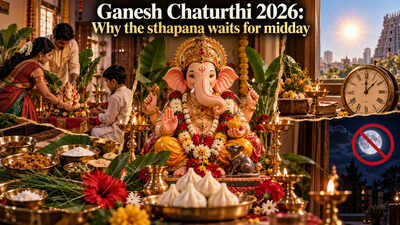
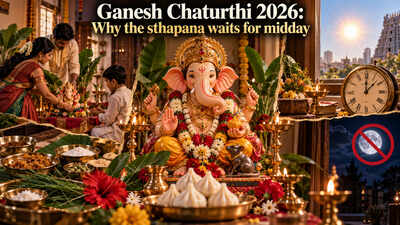
If you’re bringing Bappa home this year, put the alarm away. Most households rush to install the idol at sunrise, the way they would for any other puja, but Ganapati sthapana does not work that way. The idol goes in at midday, not dawn, and getting that one detail right sets up everything else correctly.In New Delhi, the window runs roughly from 11:02 AM to 1:31 PM on Monday, September 14, 2026. Mumbai’s window opens a little later, closer to 11:20 AM to 1:48 PM, and Chennai’s earlier, around 10:51 AM to 1:18 PM. Your local panchang will have the exact minutes for your city, and it’s worth checking rather than borrowing Delhi’s clock.
Quick Details for Readers
Date: Monday, September 14, 2026Madhyahna puja muhurat: Approximately 11:02 AM to 1:31 PM in New Delhi; check your city’s panchang, as timings vary by location.Moon-sighting period to avoid: 9:06 AM to 8:04 PM in New Delhi on September 14. Other published calendars give approximately 9:01 AM to 8:09 PM, so identify the relevant city and panchang rather than presenting both as Delhi timings.Visarjan: Friday, September 25, 2026 (Anant Chaturdashi)Best reader action: Prefer Madhyahna for Ganapati sthapana and puja, and confirm the exact local muhurat and your family tradition beforehand.
The Clock That Actually Matters
Hindu timekeeping splits daylight into five stretches: pratahkala, sangava, madhyahna, aparahna and sayankal.Puranic accounts place Ganesha’s birth in madhyahna, the third of these, which falls near true noon. That’s the basic reason the puja waits.Installing at dawn isn’t wrong, exactly, but it misses the scriptural logic behind the festival, and pandits will tell you the same thing if you ask.This year, the tithi itself starts at 7:06 AM on September 14 and runs until 7:44 AM the next morning, so you have the whole day, but the puja itself belongs to the midday hours.
What Actually Goes on the Chowki
Keep the samagri list simple, and you’ll manage fine without a priest.You need a low wooden platform, a fresh red or yellow cloth to cover it, panchamrit for the abhishek — milk, curd, ghee, honey and sugar mixed together; a small quantity of each is enough — chandan paste, kumkum, a garland and loose red flowers, ideally red hibiscus, and twenty-one shoots of durva grass, the three-bladed kind that grows wild near most compounds.Don’t offer tulsi.It’s a common mix-up, since tulsi appears in nearly every other Vaishnav ritual, but a Ganesha Purana story has the goddess Tulsi approaching Ganesha during his meditation and being turned away, after which the two cursed each other. Tulsi has stayed off his puja thali since.For naivedya, go with modak — twenty-one if you’re making them fresh — or laddoo; motichoor or besan both work.The white makhan-and-mishri combination belongs to Krishna’s puja, not Ganesha’s, so don’t borrow it here.The actual flow at home is simpler than it sounds. You invoke the presence into the idol, offer the seat, wash the feet and hands with a little water, dress and adorn the murti, apply chandan and kumkum, offer the flowers and durva, light incense and a ghee lamp, present the naivedya, and close with aarti and a short prayer asking forgiveness for anything done imperfectly.That’s the shodashopachara, the sixteen-offering worship, compressed into a rhythm any family can follow without memorising the full Sanskrit sequence.
Where Households Usually Slip Up
Three mistakes come up again and again.Installing the idol before madhyahna is the most common, simply out of habit from other pujas.The second is the durva count. People offer a handful without bothering to count to twenty-one. A few shoots short won’t ruin your puja, but it does matter to make a proper offering when the tradition specifies a number.The third, and increasingly relevant, is buying a Plaster of Paris idol because it looks glossy in the shop. POP doesn’t dissolve in water, and several states now restrict or ban its immersion for exactly that reason. A clay or shadu mitti idol saves you a headache come visarjan.
One Festival, Several Calendars
Maharashtra typically keeps Bappa for one and a half, five, seven, or the full ten days before visarjan.In Telangana and Andhra Pradesh, the same principles apply, but the scale tends to be more community-driven, with neighbourhood pandals running the show.Karnataka observes Gowri Habba the day before Chaturthi, welcoming the goddess Gowri ahead of her son.Tamil Nadu leans on kozhukattai, its own steamed dumpling, as the signature offering rather than the Maharashtrian modak, though the two are close cousins.
The Moon You Shouldn’t Look At
Avoid the moon on the night of the 14th.The story goes that Chandra once mocked Ganesha’s form, and Ganesha cursed him, decreeing that anyone who sees the moon that night invites mithya dosha, false accusation.Even Krishna reportedly fell victim to it, according to the Bhagavata Purana’s Syamantaka episode, before clearing his name.If you catch an accidental glance, the traditional fix is reciting the Syamantaka shloka:सिंहः प्रसेनमवधीत् सिंहो जाम्बवता हतः,सुकुमारक मारोदीस्तव ह्येष स्यमन्तकः।Keep the curtains drawn that evening, light your lamp instead, and let the modak plate do the talking.