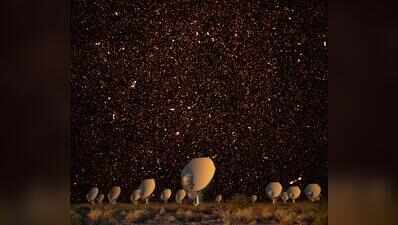
Pune: Researchers will now have easier long-term access to a massive dataset collected by Inter-University Centre for Astronomy and Astrophysics, Pune, after Germany’s Deutsches Zentrum für Astrophysik created a mirror of data from the MeerKAT Absorption Line Survey from MeerKAT radio telescope in South Africa.The survey, led by the centre, has generated about 1.5 petabytes of raw data, equivalent to roughly 1.5 million gigabytes, from observations of the radio sky. The data can help astronomers understand how galaxies grow and how the gas needed to form stars changes over billions of years.The MeerKAT Absorption Line Survey (MALS) completed all its planned 1,400 hours of observations by the end of 2025. Three major data sets have already been made publicly available, with more releases planned.The currently released data covers radio observations between 900 and 1,670 MHz. An upcoming release covering a lower frequency range of 580 to 1,015 MHz will allow scientists to study more distant galaxies and earlier stages of the universe.The collaboration between the IT teams of Inter-University Centre for Astronomy and Astrophysics (IUCAA) and Deutsches Zentrum für Astrophysik (DZA) will allow researchers worldwide to access MALS data through DZA’s infrastructure, providing an additional long-term copy of the data.“MALS is entering its most productive phase. The DZA mirror ensures continuous long-term access to outputs from this 1.5-petabyte dataset for the global scientific community,” Neeraj Gupta, IUCAA scientist and principal investigator of MALS, said.Dr Lars Haupt of DZA said, “MALS is a prototype for DZA as we build the systems needed for future large-scale astronomy projects. Reliable data services will be crucial for researchers worldwide.”The new facility is also expected to help scientists study magnetic fields in space. DZA scientist Aritra Basu said the MALS data would provide a detailed view of the radio sky and help researchers understand how the universe became magnetised.IUCAA officials said the collaboration would strengthen international access to Indian astronomical data and provide a foundation for handling the much larger volumes of data expected from next-generation radio telescopes.