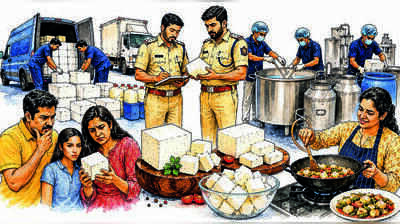
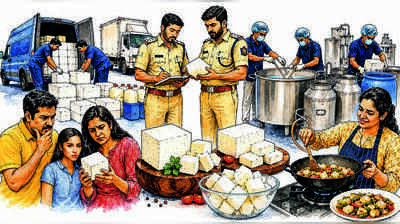
Until recently, Sonal Modi bought the paneer she needed from dairies. Not anymore. These days, the roughly 300 grams of paneer the family consumes every day is made at home. “In the past year, we have read about raids on paneer factories and dairies over adulteration,” says Modi, a Surat-based banker. “We have also seen visuals of unhygienic materials being used to make non-dairy paneer. When we heard that someone in Surat died after eating kaju-paneer curry, we decided not to buy paneer from dairies anymore. We now make it at home. Our paneer goes into chillas, stir-fries and curries.” The Modis made the switch amid growing scrutiny of the paneer sold in the market.Why Gujarat banned analogue paneerOver the past few months, food safety officials across the state have found cheaper substitutes, made with non-dairy fats and other ingredients, being sold as milk paneer. After a series of checks and raids, Gujarat has now banned the production, storage, transportation and sale of analogue paneer, becoming the third state after Chhattisgarh and Maharashtra to take such action. Industry representatives say analogue paneer has become far more common over the past five years, mainly because it is much cheaper than milk paneer.“Samples collected over the years showed vegetable oils such as palmolein and sunflower oil in nearly 25% of the paneer samples tested, while the products were being sold as milk paneer. The decision to ban analogue paneer was taken in the interest of consumers under Section 18(1)(A) of the FSSAI Act,” a senior official of Gujarat’s Food and Drugs Control Administration (FDCA) told TOI.Inside the crackdownIn one of the earliest major actions, the Surat civic body and police raided a Pandesara unit on March 3 and seized 1,401kg of paneer. Lab tests found vegetable oil and traces of industrial acid in the samples. In Ahmedabad, raids at eateries yielded 27 food samples containing analogue paneer.The action intensified in April, when the FDCA conducted a statewide drive covering 2,527 establishments and destroyed 703kg of adulterated paneer. About 270 units were issued notices, 18 establishments were sealed and 95 samples were sent for testing. During the drive, the state health department also directed eateries to disclose prominently whether they served milk paneer or analogue paneer. The order was widely ignored. AMC checks in May found several eateries still using the substitute without menu disclosure, leading to fines and closures.A new modus operandiWhen the Aug 6 ban took effect, the enforcement net widened further. On Aug 21, AMC officials seized 408kg of analogue paneer in Maninagar. Officials traced the consignment to manufacturing units in Jodhpur and Pali in Rajasthan. The seizure also brought to light what officials described as an emerging modus operandi in which illegal stock is brought into the city in luxury vans before dawn.Growing appetite for paneerBeyond the question of what is being sold as paneer are concerns over what goes into it. Vidhi Dave, chief clinical dietician at HCG Hospital, says, “Processes such as hydrogenation, used to solidify vegetable oils, can raise LDL cholesterol and pose cardiovascular risks. They can also trigger inflammation in the body.”Ahmedabad buys an estimated 60-70 tonnes of paneer a day, according to dairy industry players. “Restaurants account for 55% of this demand, while retail contributes another 25% and catering 17-19%. Roadside vendors make up a much smaller share of the market,” says a source.Paneer has moved well beyond its traditional North Indian base, with Punjabi cuisine becoming increasingly popular in Gujarat. “There has been a spurt in Punjabi food restaurants within municipal jurisdictions and along highways,” a senior FDCA official said.Restaurant consultants estimate that Ahmedabad sees about 70,000 food deliveries a day, with lunch packs accounting for about a quarter of the volume. By a rough estimate, paneer-based dishes feature in around 19,000 orders a day.The controversy has also benefited sellers of milk paneer. “Our demand has increased in Ahmedabad over the past two months. Sales have also picked up. People are more cautious and are therefore looking for high- quality and trusted brands,” says Nishith Shah, managing director of Jain Dairy.“Paneer has also gained traction as a convenient protein option, lifting volumes for quick-service outlets, caterers, and small restaurants,” says Dilip Thakkar, co-chapter head of the National Restaurant Association of India.Why analogue paneer caught onAccording to industry estimates, analogue paneer is 40-50% cheaper than milk paneer. That explains why it found a market. Sanat Relia of the Southern Gujarat Hotel and Restaurant Association says analogue paneer was available for up to Rs 250 a kg, compared with around Rs 400 a kg for milk paneer. “I believe the price was the major factor that attracted customers to analogue products,” he says.For eateries operating on tight margins, the lower cost can help keep prices competitive while leaving more room for profit. “The unorganised sector widely uses analogue paneer to retain profit and customers,” says Thakkar. He stresses that large food and restaurant brands do not use analogue paneer. They generally buy through authorised dealers and keep invoices. “There is also a risk of counterfeit packaging being used for well-known dairy brands, so businesses need to test the paneer they buy periodically,” says a director of a restaurant brand.The case for clear labellingAmul, the country’s biggest organised paneer player, says it has been raising the broader issue of dairy terminology and substitutes with food-safety authorities for years. “We had made multiple representations to FSSAI on the implementation of food safety provisions,” says Jayen Mehta, managing director of Gujarat Cooperative Milk Marketing Federation. “If there are no dairy ingredients, then dairy terms should not be used,” he says. “Branding must be clear so that customers are not misled.” He says the cooperative uses gas chromatography to detect unusual spikes in milk fat, and has sought stricter implementation of provisions governing dairy products and their substitutes.A question of trustFor consumers who suspect they have been sold analogue paneer, establishing the claim is crucial. Advocate and consumer rights activist Suchitra Paul says those seeking recourse under Consumer Protection Act would first have to get the sample tested at a govt food lab. A complaint can then be filed with a consumer court or the food safety department. But not everyone is willing to take that chance. Mamta Dhawan, a homemaker from Ahmedabad, makes paneer at home unless she needs it urgently. “If we do buy it, we buy only from two dairies we trust. We also eat non-vegetarian food, so paneer is not our only source of protein,” she says.Then there are families that have always made paneer at home. In Surat, 73-year-old Smita Bhutwala has been making paneer for four decades, curdling milk with lemon or vinegar and straining the milk solids through muslin cloth. Today, her daughter-in-law, Ankita, uses 15-20 litres of milk at a time to make paneer. “We flavour it with chilli flakes, basil, oregano and pepper and use it in salads and parathas. We even use ghee to turn the soft paneer into a cheese spread,” Ankita says.— Parag Dave, Vishal Patadiya, Prashant Rupera, Parth Shastri, Niyati Parikh, Saeed Khan, Jignesh Parmar and Yagnesh Mehta